

Zenvekeypo4 software is a term many users search after seeing it online, in a download prompt, or inside a confusing software-related message. The main purpose of this guide is to help you understand what Zenvekeypo4 software may refer to, whether you should trust it, and what steps you should take before installing or removing anything connected to it.
The biggest issue is simple: online information about this name feels unclear. Some pages describe it as a productivity tool, while others connect it with password management, system utilities, LiFePO4 battery software, or even a suspicious browser warning.
That confusion makes careful checking important.
Before you click a download button, approve permissions, or enter personal details, you need to verify the software source, check the developer identity, review the installer safety, and look for signs of unwanted software or a fake pop-up alert.
In this guide, you’ll learn what this software name may mean, why people are searching for it, how to spot red flags, and what to do if it already appears on your device. The goal is to help you stay safe, protect your data, and make a smart decision without getting pulled into panic or guesswork.
Quick Answer About Zenvekeypo4 Software
Here’s the plain-English answer.
Zenvekeypo4 software does not currently show a clear, widely recognized, vendor-backed public identity across search results. That means users should avoid trusting broad claims about its features, security, pricing, or purpose unless they can verify the official developer, documentation, installer, and support channel.
The name appears online in several possible contexts:
- A workflow or productivity platform
- A password or digital key-management tool
- A LiFePO4 battery or BMS monitoring utility
- A troubleshooting phrase tied to errors or pop-ups
- A suspicious warning, redirect, or fake download prompt
- A keyword that low-quality blogs may use to attract search traffic
That doesn’t automatically mean every mention is harmful. It does mean you should slow down.
If you saw the name inside a browser pop-up, a fake system warning, or a page asking you to download a “fix,” treat it as suspicious. Don’t click. Don’t call a support number. Don’t install anything from that page.
If someone shared a file with this name in a work setting, ask where it came from. Check the developer. Review the installer. Scan it. Test it on a separate device before you let it anywhere near important data.
A safe tool can survive basic verification. A shady one usually can’t.
Read this also: ETSJavaApp Release Date: Latest Verified Status, Meaning, Safe Download Guide, and What Users Should Know
Why This Software Name Has Drawn Attention
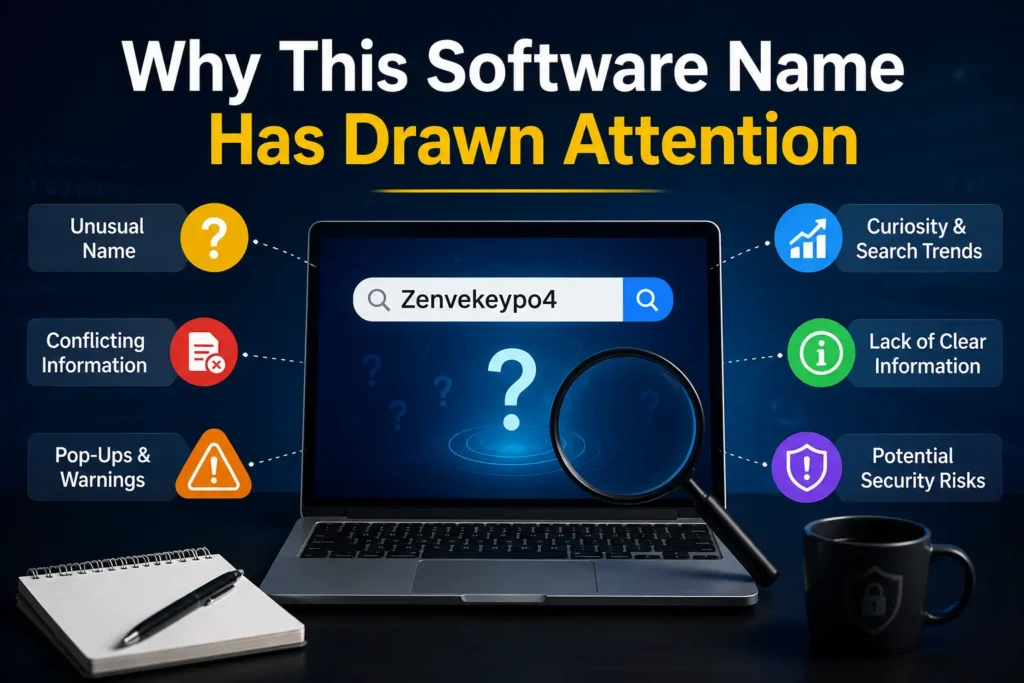
Unusual software names often spread because people want quick answers. They see a warning, error message, download page, or blog post. Then they search the name to figure out whether they should worry.
That’s where confusion starts.
The name “Zenvekeypo4” looks technical enough to seem real. It contains “key,” which can suggest encryption, passwords, or access management. It also contains “PO4,” which may remind some people of LiFePO4 batteries. Add “software” after it, and suddenly the term sounds like a specialized digital tool.
But a technical-looking name doesn’t prove legitimacy.
Plenty of fake alerts and suspicious download pages use names that sound official. They know people trust complicated wording. Scammers often wrap simple tricks in technical language because it makes users hesitate.
The name may have gained attention for three main reasons.
Conflicting Online Descriptions
The biggest clue is inconsistency.
One page may describe Zenvekeypo4 as a business management tool. Another may call it a password manager. Another may connect it to battery monitoring. Another may warn that the term appears in fake alerts.
That kind of mismatch should make readers pause.
Real software products usually have a stable identity. Microsoft Word doesn’t become a battery monitor on one site and a password vault on another. A genuine app may offer many features, of course, but its category stays fairly consistent.
When several pages describe one name in unrelated ways, one of four things may be happening:
- Writers copied the term without verifying it.
- Different tools share a similar or mistaken name.
- The phrase comes from a suspicious pop-up or redirect.
- The term has become an SEO keyword rather than a verified product.
That’s why this topic needs caution. A strong article should not pretend the facts are clearer than they are.
Searchers Want Safety, Not Marketing
People searching this term usually don’t want a sales pitch. They want reassurance.
They may be asking:
- “Is this real?”
- “Is it safe?”
- “Why did it appear on my computer?”
- “Should I install it?”
- “How do I remove the warning?”
- “Could this steal my data?”
- “Is this connected to my battery, browser, or business software?”
Those are real questions. They deserve real answers.
A generic article that says “this tool boosts productivity and improves collaboration” misses the point. Users need a practical safety guide, not a shiny brochure for a product nobody can clearly verify.
Pop-Ups Create Panic
Fake pop-ups work because they rush people.
They often say things like:
“Your computer is infected. Download this repair tool now.”
That message creates pressure. It makes a normal person feel like they must act before thinking. That’s the whole trick.
Real security tools don’t need to trap you with fear. They also don’t need random browser pages to announce system disasters. If a warning appears inside a browser tab and demands a download, it deserves suspicion.
A calm response beats panic every time.
What Zenvekeypo4 Software Means in Current Search Results
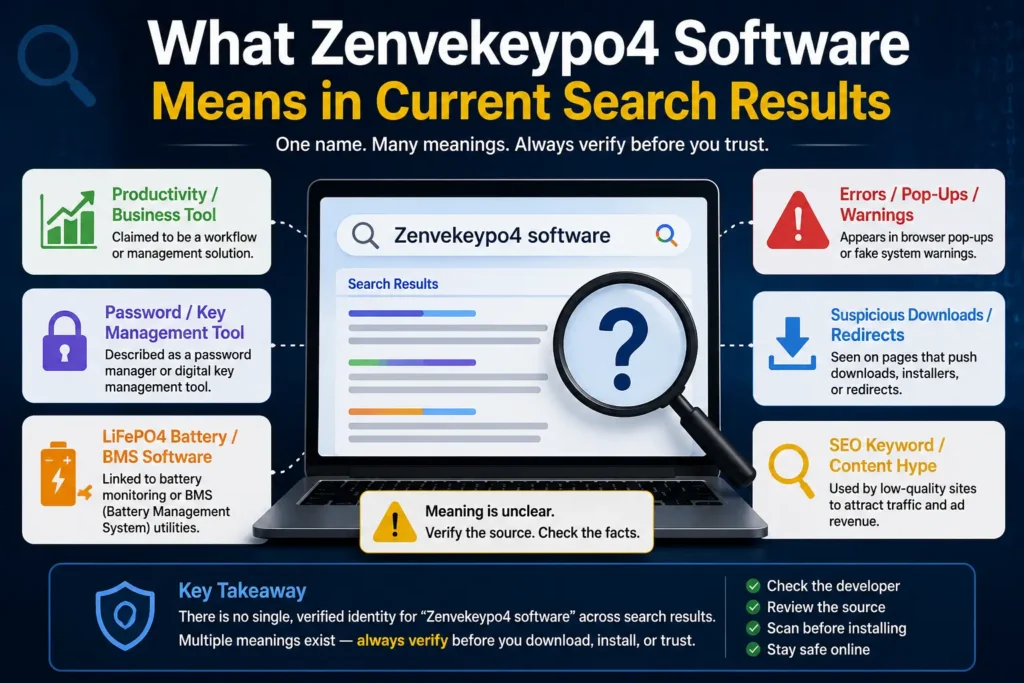
The phrase has no single stable meaning across current online discussions. That’s the most important fact.
Instead of forcing one definition, it makes more sense to group the common interpretations.
| Possible Meaning | What It Claims to Be | What You Should Check |
| Workflow tool | A platform for tasks, reports, and team productivity | Official website, pricing, documentation, app store listing |
| Password or key manager | A tool for storing passwords, tokens, or encryption keys | Security audits, encryption model, developer identity |
| Battery/BMS utility | A dashboard for LiFePO4 battery data | Hardware compatibility, manufacturer documentation |
| Error or issue message | A software problem users need to fix | Real app logs, system event history, installed programs |
| Fake alert or adware prompt | A suspicious warning or download request | Browser notifications, extensions, malware scan results |
This table keeps the issue honest. It doesn’t pretend all claims are equal. It also doesn’t call the name a virus without proof.
That balance matters. False confidence can hurt readers just as much as panic.
Read this also: WYW Mean in Text: What It Really Means in Chats, DMs, and Social Media
How to Tell Whether a Software Tool Is Real
The easiest way to check any unknown program is to look for a trail. Real tools leave evidence. Fake or low-quality ones often leave smoke.
A legitimate software product usually has several of these signals:
- A clear company or developer name
- A professional official website
- A real support page
- A privacy policy
- Terms of service
- A version history or changelog
- Signed installers
- Documentation or user guides
- Verified app store listings
- Real support emails tied to the domain
- Consistent descriptions across trusted sources
- Reviews that look specific, not copied
- Clear pricing or licensing terms
No single item proves safety. Together, they create trust.
For example, a small developer may not have enterprise-level documentation. That’s fine. But they should still explain who they are, what the app does, what data it touches, and how users can contact support.
When none of those basics appear, you’re staring at a foggy road. Drive slowly.
What You Should Not Assume
This topic attracts exaggerated claims. Some pages throw around terms like “military-grade encryption,” “AI-powered automation,” “post-quantum protection,” or “enterprise-grade security” without showing proof.
Those phrases sound impressive. They can also be empty.
Don’t assume the tool has:
- AES-256 encryption
- Zero-knowledge architecture
- Password vault protection
- AI automation
- Battery control features
- Team dashboards
- Compliance controls
- SOC 2 certification
- HIPAA readiness
- GDPR compliance
- Official support
- Safe installers
- Real pricing plans
- Mobile apps
Unless a trusted source confirms those details, treat them as claims.
This point is especially important for password and access-management tools. If an app handles passwords, API keys, tokens, or admin credentials, it needs serious proof. A pretty blog post doesn’t count.
Why Unknown Software Can Be Risky
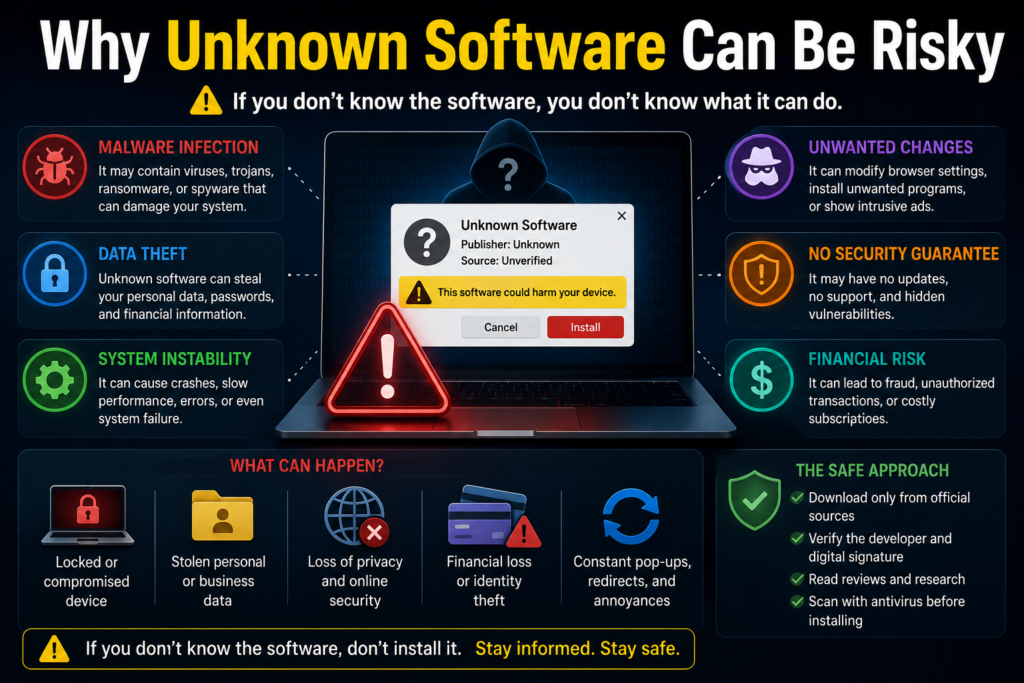
Software doesn’t just sit on your computer like a book on a shelf. It can read files, change settings, connect to the internet, run in the background, track activity, and request permissions.
That power creates risk.
Unknown tools may cause problems such as:
- Browser hijacking
- Pop-up spam
- Unwanted extensions
- Slow system performance
- Suspicious startup programs
- Data collection
- Credential theft
- Remote access abuse
- Fake antivirus warnings
- Unnecessary paid repair offers
Even harmless-looking utilities can become risky if they request too much access.
For example, a calculator app should not need your passwords. A battery monitor should not need access to your browser history. A workflow app should not ask for full disk access unless it has a clear reason.
Permissions should match purpose. When they don’t, something smells fishy.
Common Warning Signs
A suspicious download or alert often gives itself away. You just need to know what to look for.
Watch for these warning signs:
- The page says your device has many viruses.
- A countdown timer pushes you to act fast.
- The alert asks you to call a phone number.
- The page blocks you from closing the tab.
- The download starts without permission.
- The message uses poor grammar.
- The “company” name looks slightly misspelled.
- The page uses fake security badges.
- The installer has an unknown publisher.
- The app asks for admin access immediately.
- The alert returns after you close the browser.
- The software appears after installing a free tool.
One warning sign may have an innocent explanation. Several together should ring the alarm bell.
Good rule: If a website scares you into downloading something, close it before it closes the trap.
Possible Meaning as a Productivity Tool
Some pages describe Zenvekeypo4 as a productivity or workflow platform. If that’s the intended meaning, the software would likely help users manage tasks, files, team updates, or business operations.
That category makes sense in theory. Many businesses use digital tools to reduce manual work and organize information.
A real productivity platform should offer clear features such as:
- Task creation
- Project boards
- Shared calendars
- File organization
- Status updates
- Notifications
- Role-based access
- Reports
- Integrations
- Search and filtering
- Export options
These features can help teams move faster. A small business, for instance, might use one dashboard to track client work, assign tasks, and review deadlines. Instead of chasing updates through five chat threads, the team can see progress in one place.
However, the claim needs proof.
Before using any unknown workflow tool, ask these questions:
| Question | Why It Matters |
| Who owns the platform? | You need accountability if data gets lost. |
| Where does it store files? | Storage location affects privacy and compliance. |
| Can you export your data? | Lock-in becomes painful when you cannot leave. |
| Does it support user roles? | Teams need controlled access. |
| Does it keep activity logs? | Logs help investigate mistakes or misuse. |
| Does it integrate safely? | Bad integrations can expose sensitive data. |
A workflow tool may look harmless, but it can hold customer names, invoices, internal notes, and documents. That makes verification essential.
Possible Meaning as a Password or Key Tool
The word “key” inside the name may lead some writers to frame it as a password manager or key-management product. That’s a serious category.
Password managers and key tools protect digital doors. If one fails, attackers may reach email accounts, business dashboards, servers, payment systems, or cloud storage.
A genuine password manager should explain:
- How it encrypts data
- Whether it uses zero-knowledge design
- How recovery works
- Whether it supports multi-factor authentication
- How it handles password sharing
- Whether it has independent audits
- What happens if the company shuts down
- How users export their vault
- Which platforms it supports
A genuine key-management tool should explain:
- How it stores keys
- How it rotates keys
- How access rules work
- Whether it supports audit logs
- Whether it integrates with cloud platforms
- How it handles emergency access
- Which compliance standards it supports
This isn’t optional paperwork. It’s the foundation of trust.
No user should store passwords in a tool simply because an article says it has “military-grade encryption.” That phrase gets tossed around like confetti. What matters is architecture, audits, transparency, and recovery.
For personal use, trusted password tools usually offer browser extensions, mobile apps, recovery options, and visible security documentation. For business use, teams also need admin controls, access policies, and logs.
If a tool cannot explain these basics, don’t give it your keys.
Possible Meaning as a LiFePO4 Battery Tool
The “PO4” part may also point some people toward LiFePO4 batteries. LiFePO4 stands for lithium iron phosphate, a battery chemistry used in solar systems, RVs, marine setups, off-grid storage, backup power, and electric mobility.
Battery management software usually works with a BMS, or battery management system. The BMS monitors battery health and helps protect the cells from unsafe conditions.
A real LiFePO4 battery utility may show:
- State of charge
- Cell voltages
- Pack voltage
- Charge current
- Discharge current
- Battery temperature
- Cycle count
- Balance status
- Protection alerts
- Error logs
- Charge cutoff settings
- Discharge cutoff settings
This kind of tool can be useful. It can help users spot weak cells, overheating, imbalance, or charging problems before they become expensive.
But battery software carries its own risk.
Changing the wrong setting can reduce battery life, trigger shutdowns, or create unsafe operation. For example, adjusting charge limits without understanding the battery manual may stress cells or confuse the inverter.
If the name appears in a battery context, follow this checklist:
- Match the software with the exact battery or BMS model.
- Download only from the battery or BMS manufacturer.
- Read the manual before changing settings.
- Record original values before editing anything.
- Avoid changing protection limits unless you understand them.
- Ask the manufacturer before using third-party tools.
A battery dashboard should help you see. It shouldn’t tempt you to tweak blindly.
Possible Meaning as a Fake Alert or Adware Issue
This is the most urgent angle for everyday users.
If Zenvekeypo4 appears as a pop-up, warning, browser redirect, or download prompt, you should treat it like a potential fake alert. That doesn’t mean your device is doomed. It means you should stop clicking and switch into cleanup mode.
Fake alerts often try to make users believe:
- The computer has a serious virus.
- Personal files are at risk.
- A subscription expired.
- A system driver broke.
- A special repair tool is required.
- A phone call will fix everything.
- Closing the window will damage the device.
That last one is especially sneaky. A scam page may make closing feel dangerous. In reality, closing is usually the safest first move.
Here’s the calm response:
- Don’t click the download button.
- Don’t call any number shown in the alert.
- Don’t give remote access to anyone.
- Don’t enter passwords on that page.
- Close the tab or browser.
- Restart the device if the browser locks.
- Review extensions and notifications.
- Run a full security scan.
A fake alert needs your fear to work. Take away the fear, and it loses power.
How to Check the Source
The first question should always be simple: Where did you see the name?
Your answer changes the next step.
| Where It Appeared | Likely Meaning | Best First Action |
| Browser pop-up | Fake alert, redirect, or adware | Close the page and check browser settings |
| Installed apps list | Actual installed program or bundled app | Review publisher and uninstall if suspicious |
| Email attachment | Potential phishing or malware risk | Do not open it; verify sender |
| Work chat | Shared internal tool or file | Ask IT or the sender for source details |
| Battery manual | Possible BMS utility | Confirm with manufacturer |
| Blog article only | Unverified online claim | Avoid downloading from that article |
This simple step prevents overreaction.
If the term appears only in a random article, you may not need to do anything. If it appears inside your installed apps list, that’s different. If it appears in a browser alert asking for a download, that’s a bigger warning.
Context is king.
How to Verify the Developer
A real developer should not hide behind smoke and mirrors.
Look for:
- Company name
- Business address or clear operating region
- Support email
- Support portal
- Privacy policy
- Terms of service
- Software documentation
- Social or business profiles
- Release notes
- Download page
- Installer signature
Then compare details.
Does the support email match the domain? Does the privacy policy name the same company? Does the installer publisher match the website? Do the screenshots match the actual app?
Small mismatches matter.
A fake download site may copy a product name but use a different domain. A shady installer may show an unknown publisher even though the page claims a famous company made it. That gap tells you to walk away.
How to Check the Installer Safely
Before opening any unknown installer, inspect it.
On a Windows device, you can usually right-click the file and check properties. Look for publisher details, digital signatures, file size, and file name. On macOS, check whether the app comes from an identified developer. On mobile, stick with official app stores whenever possible.
Be careful with files that use names like:
- setup-free-final.exe
- security-fix-now.exe
- update-required.exe
- system-repair-tool.exe
- crack-version.exe
- installer-new-latest.zip
Those names don’t prove malware, but they look sloppy and risky.
Also watch for bundled installers. These are setup files that install extra programs unless you uncheck optional offers. That’s how many users end up with browser extensions, toolbars, notification spam, or apps they never wanted.
Choose custom installation when available. Read each screen. Uncheck anything unrelated.
A few extra seconds can save an afternoon of cleanup.
Permissions That Should Make You Pause
Permissions tell you what an app can touch.
Some permissions make sense. A screen recorder needs screen access. A backup tool needs file access. A password manager needs browser integration, but it should explain exactly why and how.
High-risk permissions include:
- Full disk access
- Admin rights
- Accessibility access
- Clipboard access
- Browser data access
- Password access
- Contact access
- Microphone or camera access
- Remote control access
- Startup background service permission
Ask yourself one question:
Does this permission match the app’s purpose?
If a battery tool asks for browser passwords, something is wrong. If a workflow app asks for full device control during setup, slow down. If a pop-up “repair tool” demands admin rights before it explains anything, close the door.
Software permissions are like house keys. Don’t hand out the master key to someone who only needs to ring the bell.
What to Do If You Already Installed It
Don’t panic. Panic leads to messy decisions.
Start with damage control.
Disconnect If Behavior Looks Suspicious
If the device starts showing strange pop-ups, redirects, new extensions, or unknown background activity, disconnect from the internet. That step can limit communication with suspicious servers while you investigate.
You don’t need to smash the router. Just turn off Wi-Fi or unplug Ethernet.
Stop Entering Sensitive Information
Avoid typing passwords, bank details, recovery codes, or admin credentials on that device until you feel confident it’s clean.
If you already entered important passwords after seeing suspicious behavior, change them from another clean device.
Start with:
- Banking
- Cloud storage
- Website admin panels
- Social accounts
- Business dashboards
- Password vault
- Payment platforms
Your email account matters most because it often controls password resets for everything else.
Uninstall Recent Unknown Programs
Open your installed apps list. Sort by installation date. Look for anything you don’t recognize, especially items installed around the same time the alert appeared.
Remove suspicious programs. Restart afterward.
Don’t uninstall random system components if you don’t know what they are. When in doubt, search the exact program name from a clean browser or ask a technical person.
Remove Suspicious Browser Extensions
Browser extensions can cause redirects, pop-ups, tracking, and search hijacking.
Check every browser you use:
- Chrome
- Edge
- Firefox
- Safari
- Opera
- Brave
Remove extensions you didn’t install intentionally. Pay special attention to extensions that claim to offer coupons, downloads, PDF tools, video helpers, search enhancement, or security fixes.
Many unwanted extensions hide behind useful-sounding names.
Block Unknown Notification Permissions
Modern browsers let websites send notifications. Some shady sites abuse this feature.
If you accidentally clicked “Allow” on a suspicious page, it may keep sending fake warnings even after you close the site.
Open browser settings and review notification permissions. Remove unknown websites from the allowed list.
This one fix solves many “virus alert” pop-up complaints.
Run a Full Security Scan
Use trusted security software and run a full scan. A quick scan may miss deeply placed files, scheduled tasks, or unwanted extensions.
If your system offers an offline scan, use it when normal cleanup doesn’t work. Offline scans run before the full operating system loads, which can help catch stubborn threats.
Check Startup Apps
Some unwanted programs launch every time your device starts.
Review startup apps and disable unknown entries. If something keeps returning after you disable it, that may signal a deeper issue.
At that point, get help from a trusted technician. Avoid anyone recommended by a pop-up.
Safe Troubleshooting for Common Problems
Sometimes users search this topic because something simply doesn’t work. If you believe you’re dealing with a real app, use a careful troubleshooting process.
App Fails to Launch
Common causes include damaged files, missing dependencies, blocked permissions, or compatibility issues.
Try this:
- Restart the device.
- Check whether the app came from an official source.
- Review system requirements.
- Install operating system updates.
- Reinstall only from a verified source.
- Check security software logs to see whether the app was blocked.
Don’t download random “DLL fixers” or driver tools. Those often create more trouble than they solve.
App Runs Slowly
Slow performance can come from limited memory, background processes, old hardware, corrupted cache, or network delay.
Try this:
- Close unnecessary apps.
- Restart the device.
- Clear cache if the app offers that option.
- Check storage space.
- Update the app.
- Test on another network.
- Review CPU and memory usage.
If the software connects to cloud services, slow performance may not come from your computer. It may come from the network or server side.
App Won’t Sync
Sync problems usually come from internet issues, account sessions, firewall rules, VPN conflicts, or service outages.
Try this:
- Test your internet connection.
- Sign out and sign back in.
- Turn off VPN temporarily.
- Check firewall settings.
- Try another device.
- Confirm your account has access.
- Review the app’s sync settings.
Avoid repeatedly deleting files to “force sync” unless the official guide tells you to do that. Sync conflicts can create duplicates or data loss.
App Shows Repeated Errors
Repeated errors need notes.
Write down:
- Exact error message
- Time of error
- What you were doing
- Device model
- Operating system version
- App version
- Recent updates
- Recent installations
That small log helps you spot patterns. It also helps support teams if the tool has legitimate support.
Case Study: A Home User Sees a Warning
Maya is browsing a recipe site. A new tab opens and says her laptop has a severe software issue. The page uses a scary red design and tells her to download a repair tool.
She almost clicks because the warning looks serious.
Instead, she closes the browser. The pop-up returns. She restarts the laptop, opens browser settings, and finds an unknown site under allowed notifications. She removes it. Then she checks extensions and finds a “Free Video Downloader” add-on she installed last week. She removes it and runs a full scan.
The warnings stop.
What happened?
Maya didn’t have a confirmed system failure. She had a browser notification or extension problem. If she had downloaded the “repair tool,” she might have installed the real threat.
Lesson: When a warning appears in the browser, clean the browser before assuming the whole computer is infected.
Case Study: A Small Business Receives an Unknown Tool
A small accounting firm receives a file from a freelancer. The freelancer says it will “improve workflow automation.” The file name includes Zenvekeypo4. Nobody at the firm recognizes it.
The office manager pauses the installation and asks three questions:
- Who developed it?
- Where is the official download page?
- What data will it access?
The freelancer cannot answer clearly.
The firm sends the file to IT. IT checks the file signature, scans it, and tests it on a separate machine. The installer requests broad admin access and tries to add a browser extension. The firm rejects it and asks the freelancer to use approved tools instead.
No drama. No breach. No cleanup bill.
Lesson: A simple approval process can stop risky software before it becomes a company-wide headache.
Case Study: A Battery User Checks a BMS Utility
Daniel owns a LiFePO4 battery bank for his RV. He sees a forum mention a similar-looking tool name and wonders whether it can read his BMS.
Instead of downloading the first result, he checks his battery manual. The manufacturer recommends a specific app for his BMS model. It connects through Bluetooth and displays cell voltage, temperature, and state of charge.
Daniel uses the manufacturer-recommended app. He avoids unknown third-party downloads and doesn’t change advanced battery limits.
His system works fine.
Lesson: Battery tools must match the exact hardware. Guesswork can damage equipment.
How Businesses Should Handle Unknown Software
Businesses need stricter rules than home users. One random install can expose client files, credentials, invoices, emails, or internal systems.
A smart software approval process doesn’t need to be complicated. It just needs to exist.
Create an Approved Software List
Keep a simple list of tools employees can install or request.
Include:
- Software name
- Vendor
- Purpose
- Approved version
- License owner
- Renewal date
- Data accessed
- Approval status
This list saves time. It also prevents “shadow IT,” where employees install tools without oversight.
Require Source Verification
Before a new tool enters the company, verify:
- Official vendor website
- Legal company name
- Support contact
- Privacy policy
- Terms
- Installer signature
- Documentation
- Data storage details
- Security controls
A vendor that handles business data should answer basic questions without dodging.
Test Before Deployment
Never roll out unknown tools directly to everyone.
Test first on a non-critical device. Watch for:
- Startup changes
- Browser changes
- New services
- Network connections
- Permission requests
- Uninstall behavior
- Performance impact
If the software behaves badly during testing, it will behave worse at scale.
Limit Permissions
Use the principle of least privilege.
That means users and apps should only get the access they need. Nothing more.
For example:
- A task app doesn’t need accounting software admin rights.
- A browser extension doesn’t need full customer database access.
- A battery utility doesn’t need company email access.
- A password tool needs special review before anyone stores credentials in it.
Least privilege sounds boring. It saves companies from expensive mistakes.
Train Employees
Security training doesn’t need to feel like a lecture.
Show employees real examples:
- Fake update pop-ups
- Suspicious download buttons
- Browser notification scams
- Unknown extensions
- Fake support numbers
- Bundled installer tricks
Give them one clear rule:
“When software feels urgent, stop and ask.”
That simple habit can block a surprising number of problems.
Safety Checklist Before Installing Any Unknown Tool
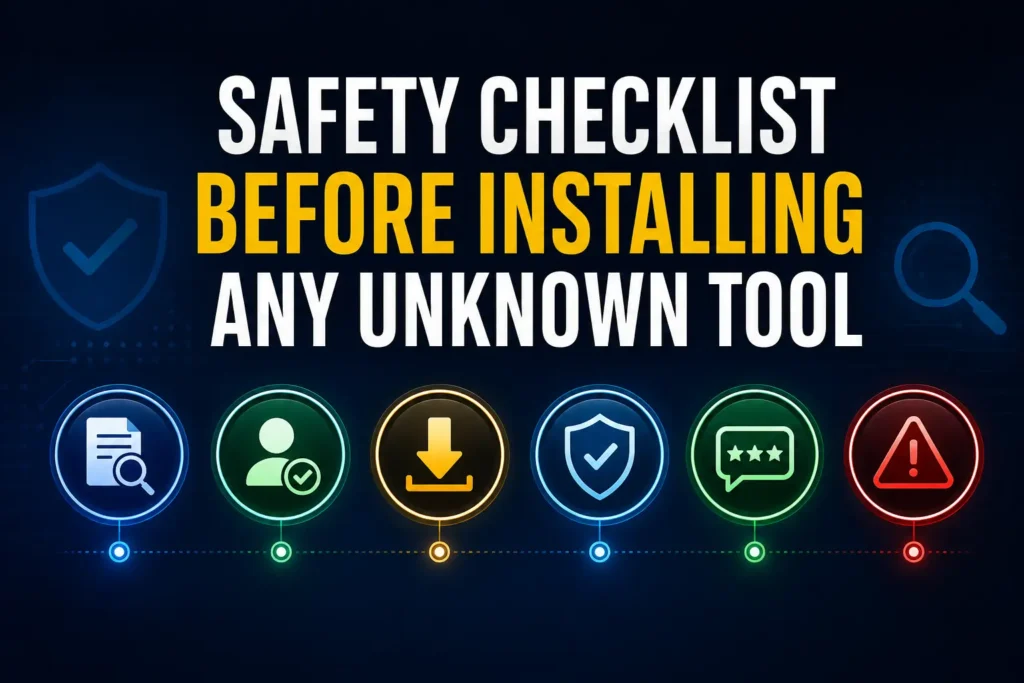
Use this checklist before you install anything unclear.
| Checkpoint | Safe Signal | Risk Signal |
| Developer | Real company with clear details | No company name |
| Website | Professional, consistent, documented | Thin page with vague claims |
| Download | Official source or app store | Random mirror or pop-up |
| Installer | Signed by known publisher | Unknown publisher |
| Reviews | Specific and realistic | Generic praise everywhere |
| Permissions | Match the tool’s purpose | Broad access for no reason |
| Privacy | Clear data handling | Missing or copied policy |
| Support | Real help channel | No support contact |
| Updates | Version history visible | No release history |
| Uninstall | Easy removal | Keeps returning |
Print it, save it, or keep it in your notes. It’s not glamorous, but it works.
Safer Alternatives by Need
If you landed on this topic because you need a real tool, choose by category.
If You Need Productivity Software
Look for platforms that offer:
- Clear pricing
- Team roles
- Integrations
- Data export
- Activity logs
- Reliable support
- Mobile and desktop access
- Permission controls
Good productivity tools make work simpler. Bad ones add another messy dashboard.
If You Need a Password Manager
Look for:
- Independent security audits
- Strong encryption details
- Multi-factor authentication
- Secure sharing
- Emergency access options
- Clear recovery process
- Transparent privacy terms
- Easy export
Do not test unknown password tools with real passwords. Use fake test data first, if you must evaluate one.
If You Need Key Management
Businesses should look for:
- Key rotation
- Role-based access
- Audit logs
- Cloud integration
- API controls
- Compliance documentation
- Strong vendor reputation
- Incident response process
Key management is not a place for guesswork. Keys unlock systems. Treat them like gold.
If You Need Battery Monitoring
Use the app recommended by the battery, inverter, charger, or BMS manufacturer.
Check:
- Battery chemistry
- BMS model
- Connection method
- Firmware version
- Operating system support
- Manual instructions
- Safe default settings
Never change protection limits unless you understand what they do.
If You Need Malware Removal
Use trusted security tools, not a tool promoted by a scary pop-up.
A real cleanup process usually includes:
- Removing suspicious extensions
- Blocking bad notifications
- Uninstalling unknown programs
- Running a full scan
- Updating the operating system
- Changing passwords from a clean device
- Reviewing startup items
The goal is not to click faster. The goal is to clean smarter.
Final Verdict: Should You Trust Zenvekeypo4 Software?
The safest answer is cautious.
You should not blindly trust Zenvekeypo4 software because current public descriptions are inconsistent. A name that appears as a productivity tool on one page, a password tool on another, a battery utility somewhere else, and a fake-alert issue on another page needs careful verification.
That does not prove every mention is malicious. It proves the name lacks a stable, easy-to-confirm identity in common public results.
Use it only if you can verify:
- The official developer
- The official download source
- The exact purpose
- The documentation
- The installer signature
- The privacy policy
- The support channel
- The permissions
- The uninstall process
If you saw the term in a warning, redirect, or pop-up, don’t install anything from that page. Close it, clean the browser, scan the device, and change important passwords if you entered sensitive information.
The simplest takeaway is still the best one:
A trustworthy tool can answer basic questions. An unsafe one pushes you to click before you think.
Frequently Asked Questions
Q1: What is Zenvekeypo4?
Zenvekeypo4 is an unclear software-related term that appears online in several different contexts. Some pages describe it as a business tool, password tool, battery utility, or software issue. Because the descriptions conflict, users should verify the source before installing anything.
Q2: Is it safe to install?
It is only safe to consider if you can verify the developer, official download source, documentation, installer signature, privacy policy, and permissions. If the name appears in a pop-up or urgent warning, do not install the suggested download.
Q3: Is it a virus?
There is not enough verified evidence to call the name itself a virus. However, alerts or downloads using this name may be suspicious if they appear through browser redirects, fake warnings, unknown extensions, or scam-style pages.
Q4: Why did the warning appear on my browser?
Browser warnings often come from notification permissions, adware, suspicious extensions, redirects, or unsafe websites. Check your browser extensions and notification settings before assuming your whole device has a serious infection.
Q5: How do I remove pop-ups linked to this name?
Close the browser, restart the device, remove suspicious extensions, block unknown notification permissions, uninstall recent unknown programs, and run a full security scan. If pop-ups keep returning, get help from a trusted technician.
Q6: Should a business allow employees to install it?
A business should not allow installation until IT verifies the vendor, installer, purpose, permissions, data access, and security documentation. Unknown software should go through testing before deployment.
Q7: Could it steal passwords?
Any unknown tool that accesses browsers, clipboards, files, or login data can create password risk. If you entered passwords after seeing suspicious behavior, change them from a clean device and turn on multi-factor authentication.
Q8: Is it related to LiFePO4 batteries?
The “PO4” part may remind users of LiFePO4 battery systems, but that connection needs confirmation from a battery or BMS manufacturer. Use only the software recommended for your exact hardware model.
Q9: What should I do before downloading unknown software?
Check the developer, official source, installer signature, permissions, documentation, privacy policy, and reviews. Scan the file before opening it. Businesses should test unknown tools on a separate device.
Q10: What is the main takeaway?
Do not trust unclear software names based on blog claims alone. Verify the source, avoid pop-up downloads, protect your passwords, and use trusted tools when security or business data is involved.