

Fix zenvekeypo4 software issue is something many users search when a strange browser pop-up, fake security alert, or suspicious software warning suddenly appears on their device. The purpose of this guide is simple: help you understand what this issue means, stop the warning safely, and avoid risky downloads that could make the problem worse.
If you saw a message asking you to click Fix Now, install a repair tool, or call a support number, don’t rush. That kind of warning often points to a scam pop-up, adware, browser redirect, or unwanted notification permission rather than a real system failure.
The good news? You can usually fix it without panic.
This guide will show you how to check your browser, remove suspicious extensions, block unknown site notifications, scan your device, and protect your passwords if you clicked something by mistake.
By the end, you’ll know how to handle the Zenvekeypo4 software warning safely and stop it from coming back.
Quick Answer: How to Fix Zenvekeypo4 Software Issue Safely
The safest way to handle this problem is to close the suspicious page, remove unknown browser permissions, delete suspicious extensions, uninstall recently added unknown apps, and run a trusted full security scan.
Do not start with random downloads. That’s where many users make the problem worse.
Use this quick action plan:
| What You See | What It Usually Means | Best First Step |
| Browser pop-up | Fake alert or notification scam | Close the tab and check notifications |
| Download prompt | Possible risky installer | Do not open the file |
| Repeated alerts | Browser permission or extension issue | Remove suspicious permissions and extensions |
| Search redirects | Browser hijacker or adware behavior | Reset browser settings |
| Unknown installed app | Possible bundled software | Uninstall after checking publisher |
| Phone number in warning | Tech-support scam sign | Do not call |
If you clicked once, don’t panic. A click does not always mean infection.
The bigger danger begins when you download a file, run an installer, approve admin access, enter passwords, pay for fake support, or give remote access to a stranger.
What Is the Zenvekeypo4 Software Issue?
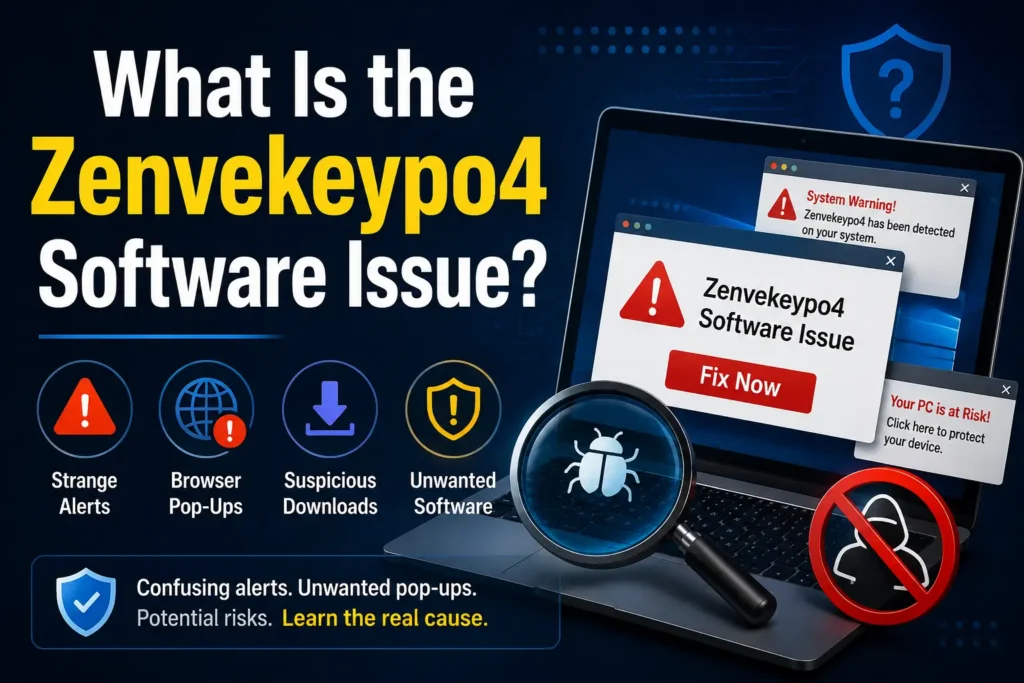
The Zenvekeypo4 software issue usually refers to a confusing alert, pop-up, redirect, or suspicious message that uses the Zenvekeypo4 name. Some users may also see the term while searching for a strange download, app error, or unwanted browser behavior.
The problem is messy because the name does not have one clear, verified meaning across the web.
In one place, it may look like software. In another, it may appear inside a fake warning. Somewhere else, a low-quality page may describe it as a repair tool or digital utility without proving anything.
That confusion matters.
A real software error and a fake browser warning need different fixes. If a real app fails, you troubleshoot the app. If a fake warning appears, you clean the browser and avoid scam traps.
The phrase can point to several situations:
- A fake security alert using the Zenvekeypo4 name
- A browser notification scam that keeps showing warnings
- A redirect page that pushes a download
- An unwanted extension causing pop-ups
- A bundled app installed with another free tool
- A vague online claim about software that lacks clear verification
The safest approach starts with context. Where did you see the name? That answer tells you what to do next.
Is Zenvekeypo4 a Real Software Error or a Fake Alert?
The answer depends on where the message appears.
If it appears inside a web browser, especially on a random page, it likely deserves suspicion. Browser pages can imitate security alerts. They can use logos, bright colors, scary wording, and fake countdowns to make a warning look official.
If the message appears inside a known app you installed from an official source, it may be a normal software error. Even then, you should verify the app’s publisher before following instructions.
Signs It May Be a Fake Alert
A fake alert often tries to scare you into quick action.
Watch for these red flags:
- It appears in a browser tab.
- It says your device has several viruses.
- It uses urgent words like “critical,” “danger,” or “immediate.”
- It asks you to call a support number.
- It pushes a download button.
- It says your files will be deleted.
- It claims your passwords are exposed.
- It blocks the page or prevents easy closing.
- It shows poor grammar or awkward wording.
- It uses fake security badges.
- It claims to come from a famous company but uses a strange website address.
A real warning may feel serious, but it usually does not beg you to call a random number. It also does not need a browser page to sell you a magic repair tool.
Signs It May Be a Real Local Problem
A local software issue usually behaves differently.
It may show up:
- Inside a known installed application
- In system settings
- In app logs
- During a normal software update
- After launching a specific program
- In a trusted security app already installed on your device
Even then, verify before acting.
Look for the publisher name, install date, file location, and official documentation. If the source feels unclear, slow down. Good software can answer basic questions. Shady software hides behind fog.
Where the Zenvekeypo4 Warning Usually Appears
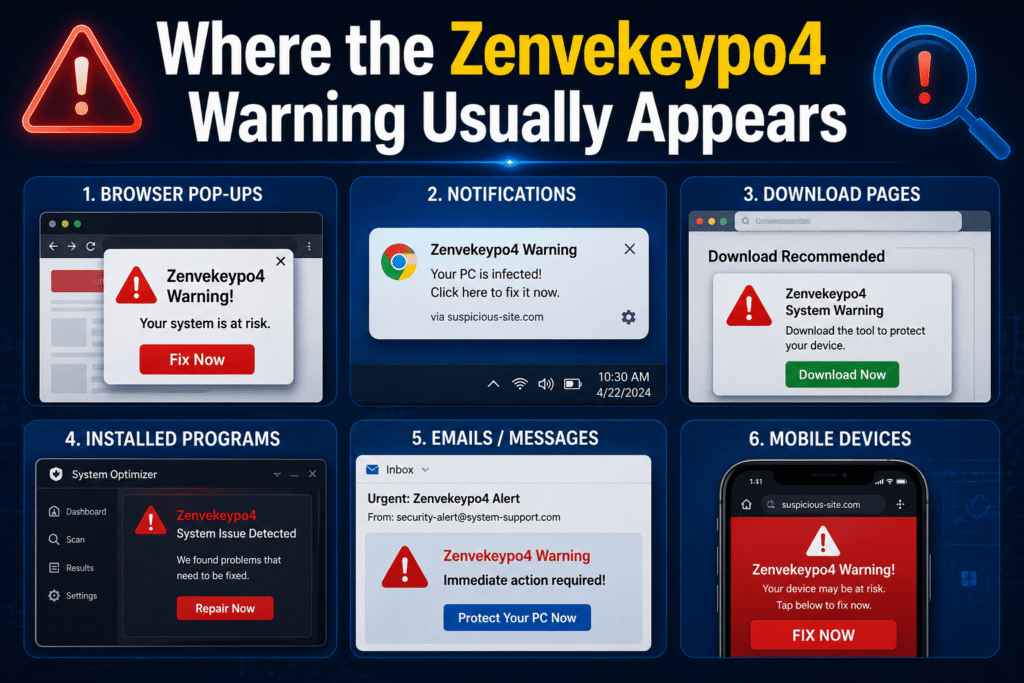
Users may see the warning in different places. Each location tells a story.
Browser Pop-Ups
Browser pop-ups are one of the most common places for suspicious warnings. They can appear on Chrome, Edge, Firefox, Safari, Opera, Brave, or mobile browsers.
The alert may look like a system message, but it may only come from a website.
That distinction matters.
A browser page can say almost anything. It can claim your PC has a virus, your phone has been hacked, your software license expired, or your personal files are at risk. It can mimic a real warning with logos and colors.
However, a page cannot confirm your whole system is infected just by appearing in your browser.
If the warning appears only when browsing, start with browser cleanup.
Fake Security Alerts
Fake security alerts use fear as fuel.
They often say something like:
- “Your computer is infected.”
- “Your device is damaged.”
- “Your system has been blocked.”
- “Download the repair tool now.”
- “Call certified support immediately.”
- “Your data will be lost.”
These messages want you to act before you think. That’s the trick.
A calm user becomes hard to fool. Read the message slowly. Ask where it appears. Check whether your real security software shows the same warning. Most fake alerts fall apart once you stop rushing.
Redirect Pages
Redirects happen when one page sends your browser to another page.
Sometimes this comes from unsafe ads. Sometimes a site gets compromised. Sometimes a shady extension changes browser behavior. The original site may not even be the villain.
For example, you might visit a normal-looking page. Then a new tab opens with a fake warning. You may think the whole device has a problem, but the cause could be a bad ad or browser permission.
Redirects often push users toward:
- Fake repair tools
- Fake antivirus pages
- Scam support numbers
- Unwanted extensions
- Fake update installers
- Suspicious subscription pages
Close the page. Don’t reward the trap with another click.
Suspicious Browser Notifications
Browser notifications can become annoying little troublemakers.
Many websites ask for permission to send notifications. If you click “Allow” on a suspicious page, that site can send messages that look like alerts. These may appear on your desktop or phone even when the site is closed.
That’s why some users think a virus keeps returning.
In many cases, the real fix is simple: remove the unknown site from allowed notification settings.
This is one of the most overlooked fixes.
Bundled Software or Unknown Extensions
Free downloads often come with extras. Not always, but often enough to stay alert.
A user may install a free PDF converter, video downloader, coupon tool, driver updater, or file compressor. During installation, the setup wizard adds another app or browser extension. The user clicks “Next” quickly and misses the offer.
Then the browser starts acting strange.
Bundled extras may change:
- Homepage
- Search engine
- New tab page
- Notification permissions
- Default browser behavior
- Extension list
- Pop-up settings
The fix starts by checking recent installs and extensions.
Why Users See the Zenvekeypo4 Warning
A warning rarely appears from thin air. Something usually triggers it.
Accidental Notification Permission
One wrong click can open the door.
Many fake alert pages show a small message asking you to allow notifications. They may pretend you need to click “Allow” to watch a video, download a file, prove you are human, or continue to the website.
Once allowed, the site may send repeated alerts.
These notifications can look official. They may even display scary icons. But they often come from a website you accidentally approved.
Adware or Unwanted Browser Extension
Adware tries to show ads, redirect pages, or inject unwanted messages into your browsing experience.
A suspicious extension may cause:
- Pop-ups
- Search redirects
- Changed homepage
- Slow browsing
- New tabs opening by themselves
- Fake warning pages
- Extra ads on normal websites
Some extensions use friendly names. A “PDF Helper” or “Shopping Saver” may sound harmless. Behind the curtain, it may track browsing and trigger redirects.
When in doubt, remove extensions you do not recognize.
Suspicious Ads and Malvertising
Malvertising means malicious advertising.
It can appear through online ads that send users to scam pages, fake alerts, or unwanted downloads. The scary part is that the original website may seem normal.
You might visit a news site, blog, or streaming page. A bad ad appears. The ad redirects your browser to a fake warning.
This is why browser updates, ad controls, and cautious clicking matter.
Software Bundles
Software bundles hide unwanted extras inside installers.
These bundles often appear with free tools such as:
- Media players
- Video downloaders
- File converters
- Game mods
- Crack tools
- Driver updaters
- “PC cleaner” utilities
- Browser toolbars
The installer may include checkboxes for extra offers. If you use quick install, those boxes may stay checked.
Choose custom install when possible. Read each screen. It sounds boring, but it saves headaches.
Search Engine Poisoning
Search engine poisoning happens when low-quality or harmful pages target trending search terms. They try to rank for strange software names, fake errors, or urgent fixes.
Why?
Because worried users search fast. A scam page that ranks for a “fix” keyword can push unsafe downloads or fake support.
That’s why you should be careful when searching for any unusual software warning. The first page you see may not be trustworthy.
Fake Tech Support Tactics
Fake tech support scams use human psychology, not just technology.
They rely on:
- Fear
- Urgency
- Confusion
- Fake authority
- Technical jargon
- Repetition
- Payment pressure
The message often says you need help right now. Then it pushes a number, a download, or a remote support session.
Never give remote access to someone from a pop-up. Real support does not need to trap you through fear.
What Happens If You Click a Zenvekeypo4 Alert?
A click can mean different things. Don’t assume the worst. Also, don’t ignore it.
Nothing May Happen Immediately
Sometimes a click only opens another page. You may see more warnings or redirects. That alone may not infect your system.
Still, close the page. Then clean your browser.
A Download May Start
A download is more serious, but the file usually becomes dangerous when you open it.
If a file downloaded by accident:
- Do not open it.
- Do not run it.
- Do not extract it.
- Delete it from the Downloads folder.
- Empty the trash or recycle bin.
- Run a security scan.
Don’t open the file “just to check.” That’s like tasting spoiled milk to confirm it’s bad.
A Browser Permission May Be Granted
If you clicked “Allow,” the site may now send notifications.
This can cause repeated fake alerts. The fix is to remove the site from notification permissions.
Once removed, the alerts often stop.
A Suspicious Extension May Install
Some pages push browser extensions. If you installed one, it may change your browser behavior.
Remove unknown extensions immediately. Then reset your browser if redirects continue.
Sensitive Data May Be at Risk
The highest risk comes from giving away information or access.
Take quick action if you:
- Entered passwords
- Shared payment details
- Called a fake support number
- Gave remote access
- Installed a repair tool
- Approved admin permissions
- Shared security codes
Use a clean device to change important passwords. Start with your email account because email often controls account recovery.
What Not to Do When You Try to Fix the Issue
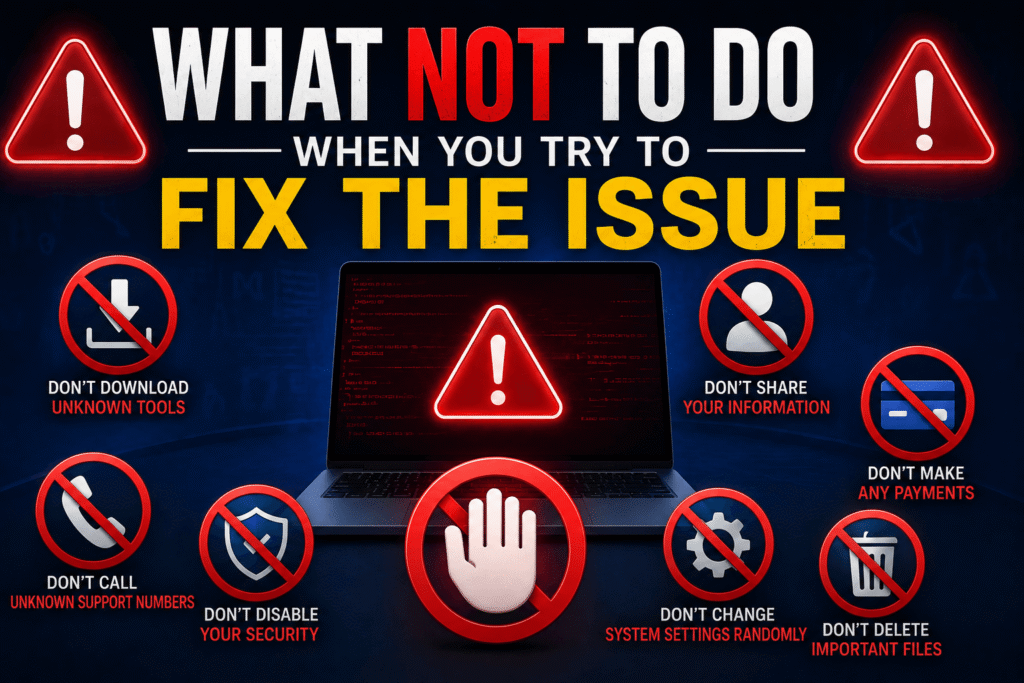
A bad fix can make a small problem worse.
Avoid these mistakes:
- Do not click “Fix Now.”
- Do not install a tool promoted by the alert.
- Do not call phone numbers shown in pop-ups.
- Do not give remote access to strangers.
- Do not enter passwords into warning pages.
- Do not disable antivirus protection permanently.
- Do not download “repair tools” from random blogs.
- Do not delete system files manually.
- Do not pay for urgent support from a pop-up.
- Do not ignore the problem if it keeps returning.
The golden rule is simple.
If the alert creates fear and offers the solution in the same breath, question it.
Real troubleshooting starts with observation, not panic.
Before You Start: Simple Safety Checklist
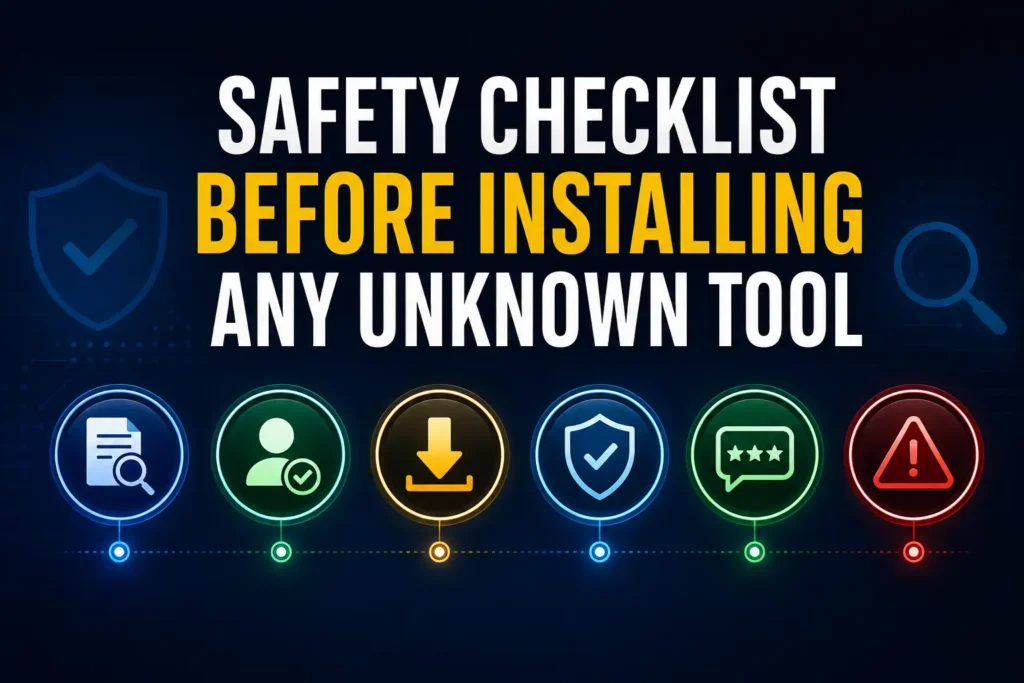
Before cleaning anything, gather a little context.
Use this checklist:
| Question | Why It Helps |
| Where did the warning appear? | Browser issues need browser fixes first. |
| Did a file download? | You may need to delete it before opening. |
| Did you install anything recently? | Recent installs often reveal the trigger. |
| Did you allow notifications? | This causes repeated fake alerts. |
| Did you enter passwords? | You may need account cleanup. |
| Did you call a number? | Scam risk increases. |
| Did you give remote access? | Professional help may be needed. |
Take a screenshot if possible. Do not click inside the warning to do it.
If the computer behaves strangely, disconnect from the internet for a short time. This gives you room to think and reduces risk while you clean.
How to Fix the Zenvekeypo4 Warning on a Browser
Most users should start here. Browser-based cleanup solves many fake alert problems.
Close the Suspicious Page Safely
Try closing the tab first. If the page blocks you, close the whole browser.
If the browser refuses to close, force-close it from your device’s app manager or task manager. When reopening the browser, avoid restoring the previous session if it brings back the same page.
Do not click buttons inside the warning. Even “Cancel” can sometimes trigger another redirect.
Remove Suspicious Notification Permissions
Browser notifications can create repeated alerts that look like system warnings.
Open your browser settings and look for notification permissions. Remove any site you do not recognize, especially strange domains that appeared around the time the warning started.
This step often fixes the “it keeps coming back” problem.
Remove Unknown Browser Extensions
Extensions can change what you see online.
Review every installed extension. Remove anything you did not choose on purpose.
Pay special attention to:
- Coupon extensions
- Download helpers
- PDF converters
- Video tools
- Search enhancers
- Shopping assistants
- Free VPN add-ons
- “Security” extensions from unknown brands
After removing suspicious extensions, restart the browser.
Clear Cache and Site Data
Cache and site data help websites load faster, but they can also store scripts, permissions, and redirect behavior.
Clearing site data may sign you out of websites. That’s normal. It’s a small price to pay for a cleaner browser.
Clear:
- Cache
- Cookies
- Site data
- Temporary files
Then restart the browser and test again.
Reset Browser Settings
If redirects continue, reset the browser settings.
A reset can help fix:
- Changed homepage
- Changed search engine
- Pop-ups
- Redirects
- Disabled security settings
- Suspicious new tab behavior
Most modern browsers keep bookmarks during reset, but check before you continue. If you rely on saved passwords, make sure you know how to access them safely afterward.
How to Fix the Issue on Windows
Windows users should check both the browser and the system.
Check Recently Installed Apps
Open the installed apps list. Sort by date. Look at programs added near the time the warnings started.
Suspicious categories may include:
- PC cleaners
- Driver updaters
- Search tools
- Unknown browsers
- Free converters
- Fake antivirus tools
- Download managers
- Toolbars
- “Update helper” apps
If you do not recognize a program, check its publisher and purpose. Remove clearly unwanted apps.
Uninstall Unknown or Suspicious Programs
Use the normal uninstall option.
Do not delete program folders manually unless you know what you’re doing. Manual deletion can leave services, startup entries, or broken settings behind.
After uninstalling, restart the computer.
Review Startup Apps
Some unwanted apps launch every time Windows starts.
Open startup settings and disable unknown entries. This can stop pop-ups or background behavior from returning after restart.
Look for names that don’t match known software.
Run a Full Security Scan
Run a full scan with trusted security software or built-in protection.
A full scan takes longer than a quick scan, but it checks more places. That matters when unwanted software hides in folders, startup entries, or browser data.
If your security tool offers an offline scan, use it when alerts keep returning.
Check the Downloads Folder
Open your Downloads folder and sort by date.
Delete unknown installers, compressed files, or suspicious downloads from the time the alert appeared. Do not open them to inspect them.
If you accidentally downloaded a file but never opened it, deleting it quickly may be enough.
How to Fix the Issue on Mac
Mac users can also see fake browser alerts, suspicious notifications, and unwanted extensions.
Check the Applications Folder
Open Applications and look for unfamiliar apps. Focus on recent additions.
Remove suspicious apps through the proper uninstall method when available. Some apps come with uninstallers, while others can move to Trash.
Restart afterward.
Review Login Items
Login items open when your Mac starts.
If an unwanted app keeps returning after restart, check login items. Remove anything suspicious or unnecessary.
Check Browser Extensions
Review Safari, Chrome, Firefox, Edge, or any browser you use.
Remove unknown extensions. Then clear site data and notification permissions.
Browser-based scams work on Mac too. A fake warning in Safari is still a fake warning if it comes from a random website.
Review Profiles and Permissions
Some unwanted tools add configuration profiles. These profiles can control browser, network, or device settings.
Check for unknown profiles. Remove only those you understand as suspicious. If the Mac belongs to a workplace or school, ask the admin before removing profiles because some may be legitimate.
Run a Trusted Scan
If the issue continues after browser cleanup, run a trusted Mac security scan. Also update macOS and your browsers.
Security updates often close gaps that shady pages try to exploit.
How to Fix the Issue on Android
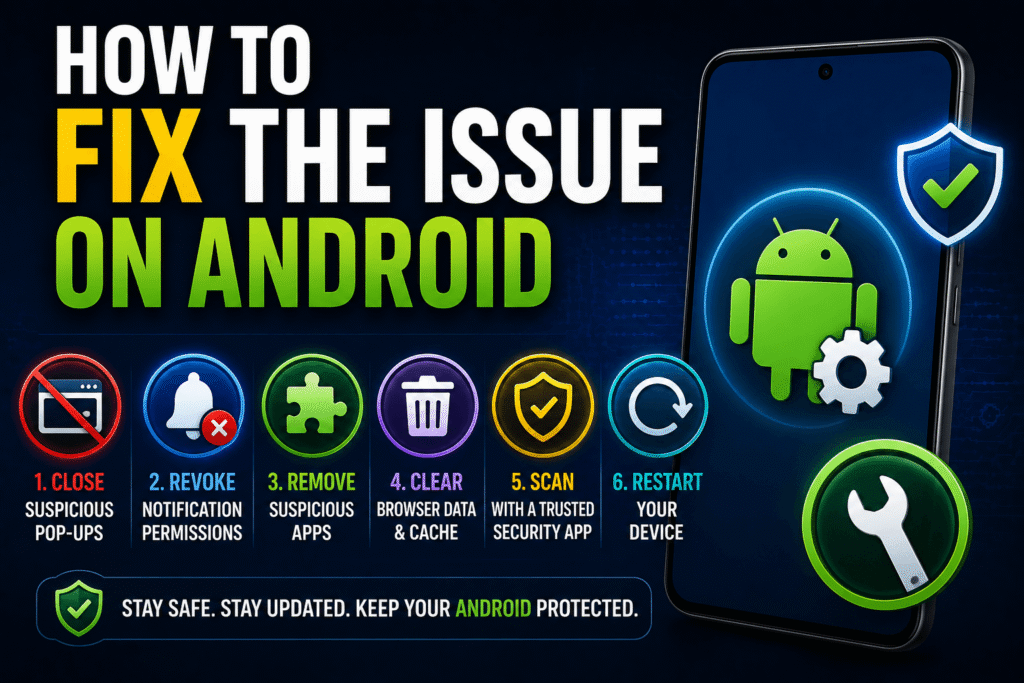
Android users may see suspicious browser alerts, notification spam, or ads from recently installed apps.
Check Recent Apps
Open your apps list and look for anything installed before the warnings began.
Pay attention to free tools, wallpaper apps, cleaners, file managers, video apps, or APKs installed outside the Play Store.
Uninstall suspicious apps.
Review Browser Notifications
Mobile browsers can send site notifications too.
Check notification permissions inside Chrome, Firefox, Samsung Internet, or whichever browser you use. Block unknown websites.
This step can stop fake virus messages that appear as phone notifications.
Check App Permissions
Some risky apps ask for permissions they don’t need.
Review permissions such as:
- Accessibility
- Notifications
- Draw over other apps
- Device admin
- SMS access
- Contacts
- Storage
- Microphone
- Camera
If a simple app asks for powerful permissions, remove it.
Run Play Protect or Trusted Mobile Security
Run a scan through built-in protection or a reputable mobile security app.
Also update Android and your browser. Old versions can leave more room for tricks.
How to Fix the Issue on iPhone or iPad
iPhone and iPad users usually deal with fake web alerts, spam calendars, or notification tricks rather than traditional malware.
Close the Suspicious Tab
If a warning appears in Safari or another browser, close the tab. Do not click inside the message.
If the page keeps reopening, clear website data.
Clear Safari Website Data
Clearing website data can remove stored page behavior, cookies, and scripts connected to repeated alerts.
You may need to sign in again to websites afterward.
Remove Unknown Calendar Subscriptions
Some scams add spam calendar events that look like warnings.
Check calendar subscriptions. Remove anything you do not recognize.
Review Installed Apps
Delete apps you do not remember installing. Be extra careful with apps that send strange notifications.
Update iOS
Install available iOS updates. Updates help fix security bugs and improve browser protection.
How to Remove Zenvekeypo4 Pop-Ups Permanently
Stopping one pop-up is good. Stopping the source is better.
Block the Source
Turn off notifications from unknown websites. Also enable browser protections that block pop-ups and redirects.
This closes the easiest door.
Remove the Trigger
The trigger may be an extension, app, notification permission, or bad site data.
Remove:
- Unknown extensions
- Recently installed suspicious apps
- Allowed notifications from strange sites
- Temporary browser data
- Unknown startup entries
Then restart the device.
Scan the Device
Run a full scan after cleanup. Restart and scan again if warnings return.
If the same item keeps appearing, use offline scanning or professional help.
Change Passwords If Needed
You do not need to change every password because you saw a pop-up. You should change passwords if you typed sensitive data after the warning appeared, installed suspicious software, or gave remote access.
Use a clean device.
Start with:
- Banking
- Cloud accounts
- Website admin panels
- Social accounts
- Payment platforms
- Password manager account
Turn on multi-factor authentication where possible.
Monitor for Recurrence
For the next few days, watch for:
- Search redirects
- New tabs opening
- Homepage changes
- Browser slowdown
- New extensions
- Repeated notifications
- Unknown apps returning
If the device stays clean, you likely removed the trigger.
How to Know If the Device Is Still Affected
A clean device behaves normally. A still-affected device keeps dropping clues.
Signs the Issue Is Fixed
You’re likely in good shape if:
- Pop-ups stop.
- Search results open normally.
- Notifications stop appearing.
- Unknown extensions stay removed.
- No strange apps launch at startup.
- Browser settings stay the same.
- Security scans show no threats.
- Device speed returns to normal.
Give it a little time. Some problems seem fixed until a restart.
Signs the Problem Still Exists
Dig deeper if:
- Warnings return after restart.
- Browser redirects continue.
- New extensions appear by themselves.
- Homepage changes again.
- Search engine changes again.
- Antivirus detects the same item repeatedly.
- Unknown apps reinstall.
- Device runs hot or slow without reason.
Recurring problems may involve deeper adware, a stubborn extension, a scheduled task, or a hidden startup item.
When to Seek Professional Help
Most browser pop-ups can be handled at home. Some situations deserve expert attention.
Get Help If You Gave Remote Access
Remote access changes the risk level.
If you let someone connect to your device after seeing a warning, ask a trusted technician to inspect the system. Remote tools can leave behind access programs, changed settings, or stolen data risk.
Do not contact the number from the pop-up again.
Get Help If You Entered Payment Details
If you paid for fake support or entered card details, contact your bank or card provider. Ask about blocking the card, disputing charges, and monitoring activity.
Also review accounts for suspicious logins.
Get Help If Business Data Is Involved
Business devices need stronger cleanup.
Get IT help if the device holds:
- Customer files
- Invoices
- Passwords
- CRM data
- Email accounts
- Payroll records
- Website admin access
- Cloud storage
- Financial dashboards
One infected or misused device can create wider business risk.
Get Help If the Issue Keeps Returning
If you clean the browser and scan the device but the warning returns, don’t keep repeating the same steps forever.
A technician can check startup entries, browser policies, hidden extensions, system profiles, scheduled tasks, remote tools, and deeper malware indicators.
Sometimes the fastest fix is getting trained eyes on the machine.
How to Protect Your Passwords After the Warning
Passwords sit at the center of your digital life. Protect them early.
Change Important Passwords
Change passwords from a clean device if you suspect risk.
Start with email. Your email account often resets other accounts, so it acts like the master key.
Then change:
- Banking passwords
- Cloud storage passwords
- Social media passwords
- Website admin passwords
- Payment account passwords
- Work dashboard passwords
Use unique passwords. Reused passwords can turn one mistake into a domino chain.
Turn On Multi-Factor Authentication
Multi-factor authentication adds another lock.
Even if someone gets your password, they still need the second factor. Use an authenticator app or hardware key where possible. SMS is better than nothing, but authenticator apps usually offer stronger protection.
Check Account Activity
Review recent account activity.
Look for:
- Unknown logins
- New devices
- Password reset emails
- Changed recovery numbers
- New forwarding rules
- Unknown connected apps
- Suspicious purchases
Email accounts need extra attention. Attackers sometimes create forwarding rules to keep reading messages after you change a password.
Avoid Reusing Passwords
Password reuse feels convenient until one leak unlocks everything.
Use different passwords for important accounts. A password manager from a trusted, verified provider can help. Do not test unknown password software with real logins.
How to Identify Fake Software Warnings in the Future
The best fix is prevention. Once you know the pattern, fake warnings look less convincing.
Look for Fear-Based Language
Fake warnings love drama.
They may say:
- “Your files will be deleted.”
- “Your computer has 5 viruses.”
- “Your IP has been blocked.”
- “Your device is damaged.”
- “Call now.”
- “Install this fix immediately.”
Real security messages can be serious, but they do not usually sound like a carnival barker yelling through your screen.
Check Where the Warning Appears
Location reveals credibility.
A warning inside a random browser tab should not get the same trust as a warning inside your installed security app.
Ask:
- Is this inside my browser?
- Which website is showing it?
- Does my real security tool show the same alert?
- Did this appear after clicking an ad?
- Did a notification come from a site I allowed?
The answers often expose the trick.
Avoid Unknown Download Buttons
Scam pages push fake cleaners, drivers, updates, and repair tools.
A button may say:
- “Fix Now”
- “Clean Device”
- “Update Required”
- “Download Security Tool”
- “Repair System”
- “Remove Threats”
Don’t click these from a warning page. Go to trusted software sources directly if you need real tools.
Check the Website Address
A strange website address is a clue.
Watch for:
- Random letters
- Misspelled brand names
- Long messy domains
- Unusual endings
- Extra words before a known brand
- Domains that don’t match the company shown on the page
Scam pages often borrow logos while using unrelated addresses.
Trust Built-In Security Tools First
Before believing a pop-up, open your installed security app manually. Check its dashboard. Run a scan from there.
Do not click the pop-up to open a tool. Open the tool yourself from the device menu.
That small habit cuts off many scams.
Why Fake Software Names Like Zenvekeypo4 Exist
Strange names work because they create uncertainty.
When users don’t recognize a term, they search it. That search can lead them into pages that claim to have the answer, the fix, or the download.
They Sound Technical
A name like Zenvekeypo4 sounds complicated. It contains pieces that feel digital, such as “key” and “PO4.”
That complexity can make people think the problem is too technical to question. Scammers like that feeling. Confused people click faster.
They Avoid Easy Recognition
A common scam name gets flagged quickly. A random-looking name can slip into search results, forums, and fake guides before people understand it.
It’s a moving target.
They Target Search Traffic
Low-quality pages often chase unusual keywords because competition is lower. A strange term can become a mini trend if enough users search it after seeing a warning.
Some pages may then publish thin articles with generic fixes. Others may push unsafe downloads.
They Support Social Engineering
The name is only part of the trap.
The full strategy may include:
- A scary warning
- A fake brand
- A countdown
- A phone number
- A repair download
- A support chat
- A payment request
- Remote access pressure
The goal may be money, data, clicks, commissions, or account access.
Case Study: A User Sees a Browser Warning
A user named Sara visits a free streaming page. A new tab opens and shows a red warning. It says her laptop has a serious software problem and must download a repair tool.
She feels nervous. The page looks official enough.
Instead of clicking, she closes the browser. The warning returns as a desktop notification. That’s the clue.
Sara opens browser settings and checks notifications. She finds a strange site in the allowed list. She removes it. Then she checks extensions and removes a “Video Helper” tool she installed last week.
After clearing site data and running a full scan, the warning stops.
Lesson: The alert did not prove the system had a deep infection. The browser had allowed a suspicious site to send notifications.
Case Study: A Business Device Gets the Warning
A small logistics company uses laptops for invoices and customer emails. One employee sees a warning with the Zenvekeypo4 name and a “Fix Now” button.
He almost clicks. Then he remembers the company rule: report weird warnings before acting.
IT checks the laptop. They find no official app with that name. They do find a recently installed file converter and a suspicious browser extension. The extension caused redirects and pop-ups.
IT removes the extension, uninstalls the converter, clears browser data, runs a full scan, and resets the browser.
No customer data gets exposed.
Lesson: Reporting early beats cleaning up a bigger mess later.
Prevention Tips to Avoid the Issue Again
A clean device needs good habits to stay clean.
Keep Browsers Updated
Browser updates fix security gaps and improve protection against dangerous pages, redirects, and malicious scripts.
Turn on automatic updates when possible.
Download From Trusted Sources
Use official websites, app stores, or trusted vendor portals.
Avoid random mirror sites, cracked tools, and download pages filled with bright buttons. Those pages often hide the real download behind several fake ones.
Avoid Quick Install Options
Quick install saves seconds. Custom install can save your browser.
When installing free tools, choose custom settings and uncheck extras you do not want.
Review Extensions Monthly
Browser extensions pile up like old receipts.
Once a month, remove extensions you no longer use. Fewer extensions mean fewer risks.
Keep Notifications Under Control
Only allow notifications from sites you trust.
Most websites do not need notification access. Be picky. Your browser is not a billboard.
Back Up Important Files
Backups protect you from malware, accidental deletion, drive failure, and bad updates.
Use at least one backup that is not always connected to your device. Cloud backup helps too, especially when paired with account security.
Train Family Members or Employees
One careless click can affect a shared computer or company laptop.
Teach simple rules:
- Don’t click scary pop-ups.
- Don’t call numbers in warnings.
- Don’t install unknown tools.
- Ask before approving permissions.
- Report strange behavior early.
Simple habits stop many problems before they grow teeth.
Expert Safety Checklist
Use this checklist whenever you see a suspicious software warning.
| Safety Question | Good Answer |
| Did it appear inside a browser? | Treat it with suspicion. |
| Did it ask for a download? | Do not download from the alert. |
| Did it show a phone number? | Do not call it. |
| Did it use urgent language? | Slow down and verify. |
| Did it ask for admin access? | Refuse unless source is verified. |
| Did a file download? | Delete it if you did not request it. |
| Did a new extension appear? | Remove it if unknown. |
| Did notifications turn on? | Block unknown sites. |
| Did search settings change? | Reset the browser. |
| Did you enter passwords? | Change them from a clean device. |
| Did you give remote access? | Get professional help. |
Print this mentally. It works for many fake warning names, not just this one.
Final Verdict: What Users Should Really Do
Treat the Zenvekeypo4 warning as suspicious until you can prove otherwise.
Do not trust a pop-up that tells you to download a repair tool. Do not call a number inside a browser warning. Do not give remote access to strangers. Clean the browser first, then check installed apps, scan the device, and protect your accounts if needed.
Most users can solve the problem by removing suspicious notification permissions, deleting unknown extensions, clearing site data, uninstalling recent unwanted apps, and running a full security scan.
You don’t need to panic.
You do need to move carefully.
FAQs About Fixing Zenvekeypo4 Software Problems
Q1: What is the Zenvekeypo4 software warning?
It usually refers to a suspicious alert, browser pop-up, redirect, notification, or unclear software-related message using the Zenvekeypo4 name. Many cases appear closer to browser-based scams or unwanted software behavior than a confirmed official app error.
Q2: Is Zenvekeypo4 a real program?
You should not treat it as verified software unless you can confirm the official developer, download source, installer signature, documentation, and support channel. Without those signals, handle the name with caution.
Q3: Why do Zenvekeypo4 pop-ups appear?
They may appear because you allowed notifications from a suspicious site, installed an unwanted browser extension, clicked a bad ad, visited a redirect page, or installed bundled software.
Q4: How can I fix zenvekeypo4 software issue safely?
Close the alert, remove unknown notification permissions, delete suspicious browser extensions, clear site data, uninstall recently added unknown apps, and run a trusted full system scan. Avoid repair tools promoted by pop-ups.
Q5: Can Zenvekeypo4 pop-ups harm my computer?
The pop-up itself may not harm the device. The danger grows if you click downloads, approve permissions, install unknown tools, enter passwords, call fake support, or give remote access.
Q6: Should I download a Zenvekeypo4 repair tool?
No. Do not download repair tools from pop-ups, redirects, or random pages. Use trusted security software and official app sources only.
Q7: What if I already clicked the alert?
Close the page, remove notification permissions, check extensions, delete unwanted downloads, and run a full scan. If you did not run a downloaded file or enter sensitive data, the risk may be lower.
Q8: What if I already installed something?
Uninstall unknown apps, remove suspicious extensions, review startup items, run a full scan, and change important passwords from a clean device if you entered sensitive information.
Q9: How do I stop the alert from coming back?
Remove the source. Block unknown browser notifications, delete suspicious extensions, clear site data, reset browser settings if needed, uninstall recent unknown apps, and scan the device.
Q10: When should I contact a professional?
Get help if the issue keeps returning, you gave remote access, you entered payment details, the device belongs to a business, or important accounts may be exposed.