

If you’ve ever seen someone drop “TSTS” in a chat and just stared at your screen like, “Okay… what does that even mean?” — you’re not alone.
Text slang moves fast. One day it’s new, the next it’s everywhere, and suddenly you’re expected to just “know it.” TSTS is one of those confusing little abbreviations that doesn’t have a single fixed meaning, which makes it even trickier.
Let’s break it down in a simple, real-world way so you actually understand how people use it in conversations.
Quick Answer: What Does TSTS Mean in Text?
The meaning of TSTS in text depends heavily on context.
In most cases, it is used as a short emotional or conversational shorthand, and not a strict dictionary acronym.
Common interpretations include:
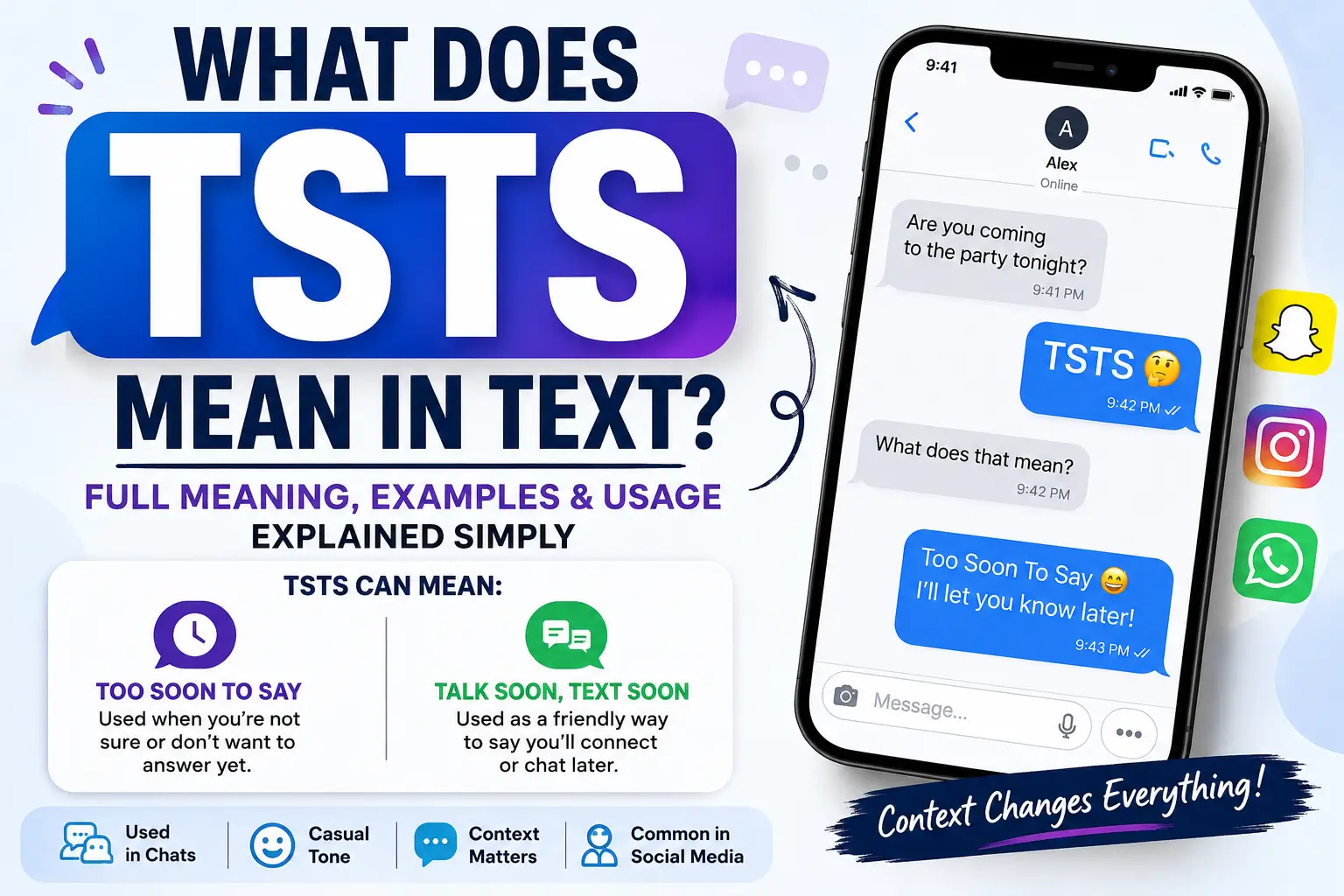
- “Too Soon To Say” (most widely accepted meaning in general discussions)
- “Talk Soon, Text Soon” (casual friendly usage in chats)
- In some rare cases, it can be personal slang between people
So when someone asks what does TSTS mean in text, the real answer is simple:
👉 It means “it depends on the situation and the relationship between people texting.”
TSTS Meaning in Text Explained Clearly
When people search for what does TSTS mean in text, they usually expect one fixed definition. But slang doesn’t always work like that.
TSTS is part of modern compressed digital communication, where people shorten phrases to:
- Save time
- Sound casual
- Keep messages less emotional or less direct
Instead of typing full sentences, users rely on short codes like TSTS to quickly express uncertainty or timing.
Think of it like this:
You don’t want to commit to an answer yet, so you just say TSTS.
That’s the core idea behind it.
Most Common Meaning of TSTS
The most widely accepted meaning of TSTS in text slang is:
“Too Soon To Say”
This is used when someone:
- Doesn’t have a final answer yet
- Wants to delay a decision
- Is uncertain about something happening
Example:
A: “Are you coming to the party tomorrow?”
B: “TSTS.”
👉 Meaning: I’m not sure yet, I’ll tell you later.
This usage is very common in casual decision-making conversations.
Other Possible Meanings of TSTS
While “Too Soon To Say” is dominant, TSTS can also shift meaning depending on tone and platform.
“Talk Soon, Text Soon”
This version is more friendly and used in casual goodbyes.
Example:
- “Gotta go now, TSTS!”
👉 Meaning: We’ll talk soon / I’ll message you later.
Personal or Private Slang
In many friend groups or couples, TSTS can become:
- A private joke
- A shortcut phrase with emotional meaning
- Something completely unrelated to public slang
That’s why guessing meaning without context can go wrong fast.
How TSTS Is Used in Real Conversations
Let’s make it real. Here’s how TSTS meaning in text messages appears in daily chats.
Casual chat example
A: “Will you join the call tonight?”
B: “TSTS, I’m busy right now.”
👉 Uncertainty or delay.
Friendly conversation example
A: “I’m heading out.”
B: “Alright, TSTS!”
👉 Talk soon.
Social media DM example
A: “Are you posting the video today?”
B: “TSTS, still editing.”
👉 Not confirmed yet.
Group chat example
A: “Who’s in for cricket tomorrow?”
B: “TSTS depends on work.”
👉 Conditional response.
TSTS Meaning on Snapchat, TikTok, Instagram & WhatsApp
Slang behaves differently depending on the platform.
Snapchat
On Snapchat, TSTS is often quick and emotional:
- Used in snap replies
- Used during fast conversations
- Often means uncertainty or “I’ll reply later”
TikTok
On TikTok comments:
- Rare but appears in replies
- Usually part of trends or jokes
- Meaning depends entirely on comment thread
On Instagram DMs:
- Used for soft replies
- Often signals delay or hesitation
Example:
- “TSTS, I’ll decide later.”
Most common platform for TSTS:
- Group planning
- Friends coordination
- Family casual chats
Tone Behind TSTS (Very Important)
The meaning of what does TSTS mean in text is not just about words — it’s about tone.
Neutral tone:
- “TSTS, I’m checking.”
👉 Just informational.
Slightly dismissive tone:
- “TSTS.”
👉 Can feel like someone is avoiding commitment.
Friendly tone:
- “TSTS haha, will update you.”
👉 Casual and relaxed.
So yes, punctuation and timing matter more than the abbreviation itself.
Why People Use TSTS Instead of Full Words
People don’t just shorten words randomly. There are real reasons:
Speed
Typing “too soon to say” feels long. TSTS is faster.
Digital habits
Short-form communication is normal now:
- TikTok captions
- Instagram DMs
- WhatsApp chats
Emotional control
Sometimes people use TSTS to avoid:
- Giving direct answers
- Sounding too serious
- Making promises early
Social flexibility
It keeps conversations open-ended without pressure.
Where You’ll Commonly See TSTS
You’ll mostly find TSTS in:
- Friend group chats
- Casual online conversations
- Teen and young adult messaging
- Gaming chats
- Meme-style communication
It’s rarely used in formal or business settings.
Misunderstandings About TSTS
A lot of confusion comes from assuming TSTS has one fixed meaning.
Common mistakes:
- Thinking it always means “talk soon”
- Assuming it’s offensive
- Trying to translate it literally every time
Reality:
It shifts meaning based on:
- Context
- Relationship
- Conversation flow
So the safest approach is always: read the full chat, not just the acronym.
TSTS vs Similar Text Abbreviations
Here’s a quick comparison:
| Slang | Meaning | Usage |
|---|---|---|
| TSTS | Too Soon To Say / Talk Soon Text Soon | Uncertain or casual reply |
| IDK | I Don’t Know | Direct uncertainty |
| BRB | Be Right Back | Temporary absence |
| TBD | To Be Decided | Formal uncertainty |
| LMK | Let Me Know | Asking for response |
👉 Compared to others, TSTS is more conversational and less formal.
How to Respond When Someone Uses TSTS
Your reply depends on tone.
Neutral response:
- “Alright, no problem.”
Friendly response:
- “Cool, just let me know.”
Playful response:
- “TSTS or mystery mode activated 😄”
Clarifying response:
- “Got it, should I wait or plan ahead?”
Don’t overthink it. Most of the time it’s not serious.
Is TSTS Safe to Use in Conversations?
Yes, but with limits.
Good for:
- Friends
- Casual chats
- Social media
- Informal planning
Avoid in:
- Work emails
- Professional communication
- Academic writing
- Formal messages
Using slang in the wrong place can make you look careless.
Regional and Cultural Differences
The what does TSTS mean in text question can also change depending on who you ask.
Younger users:
- Use it more often
- Understand context quickly
Older users:
- May not recognize it at all
- Prefer full sentences
Global variation:
- In South Asian chats: often casual shorthand
- In Western chats: less common but still understood in online circles
Real-Life Case Examples
Case 1: Planning confusion
Ali: “Are you joining the trip?”
Sara: “TSTS, depends on my schedule.”
👉 Meaning: not confirmed yet.
Case 2: Friendly delay
John: “Movie tonight?”
Emma: “TSTS, I’ll confirm later.”
👉 Meaning: unsure but interested.
Case 3: Casual goodbye
Mike: “I’m logging off.”
Liam: “Alright, TSTS!”
👉 Meaning: talk soon.
Key Takeaways About TSTS
Here’s what matters most:
- TSTS is not a fixed acronym
- Meaning depends on context
- Most common sense is “Too Soon To Say”
- It can also mean casual goodbye phrases
- Tone and timing change everything
- It’s best used in informal chats only
FAQs About TSTS Meaning in Text
What does TSTS mean in text messages?
It usually means “Too Soon To Say” or sometimes “Talk Soon, Text Soon,” depending on context.
Is TSTS a common slang word?
It’s moderately common in casual texting but not universal across all users.
Can TSTS have more than one meaning?
Yes. Its meaning changes based on conversation and relationship.
Is TSTS appropriate for formal communication?
No. It should be avoided in professional or formal messages.
How do I know what someone means by TSTS?
Look at:
- Previous messages
- Tone of conversation
- Relationship between sender and receiver
Final Thoughts
Understanding what does TSTS mean in text is really about understanding modern communication, not memorizing definitions.
People don’t always speak in fixed rules anymore. They text in moods, shortcuts, and context-based codes.
Once you get that, TSTS stops being confusing and starts feeling pretty normal.
It’s just another piece of today’s fast, flexible digital language.