
Have you ever received a text that simply said “DW” and wondered what it meant?
You’re not alone. Every day, millions of people use abbreviations in text messages, social media chats, gaming conversations, and online communities. Some are easy to understand. Others can leave you scratching your head.
Among the most common texting abbreviations is DW. It appears in personal messages, group chats, Snapchat conversations, Instagram DMs, WhatsApp discussions, and even workplace messaging apps.
So, what does DW mean in text?
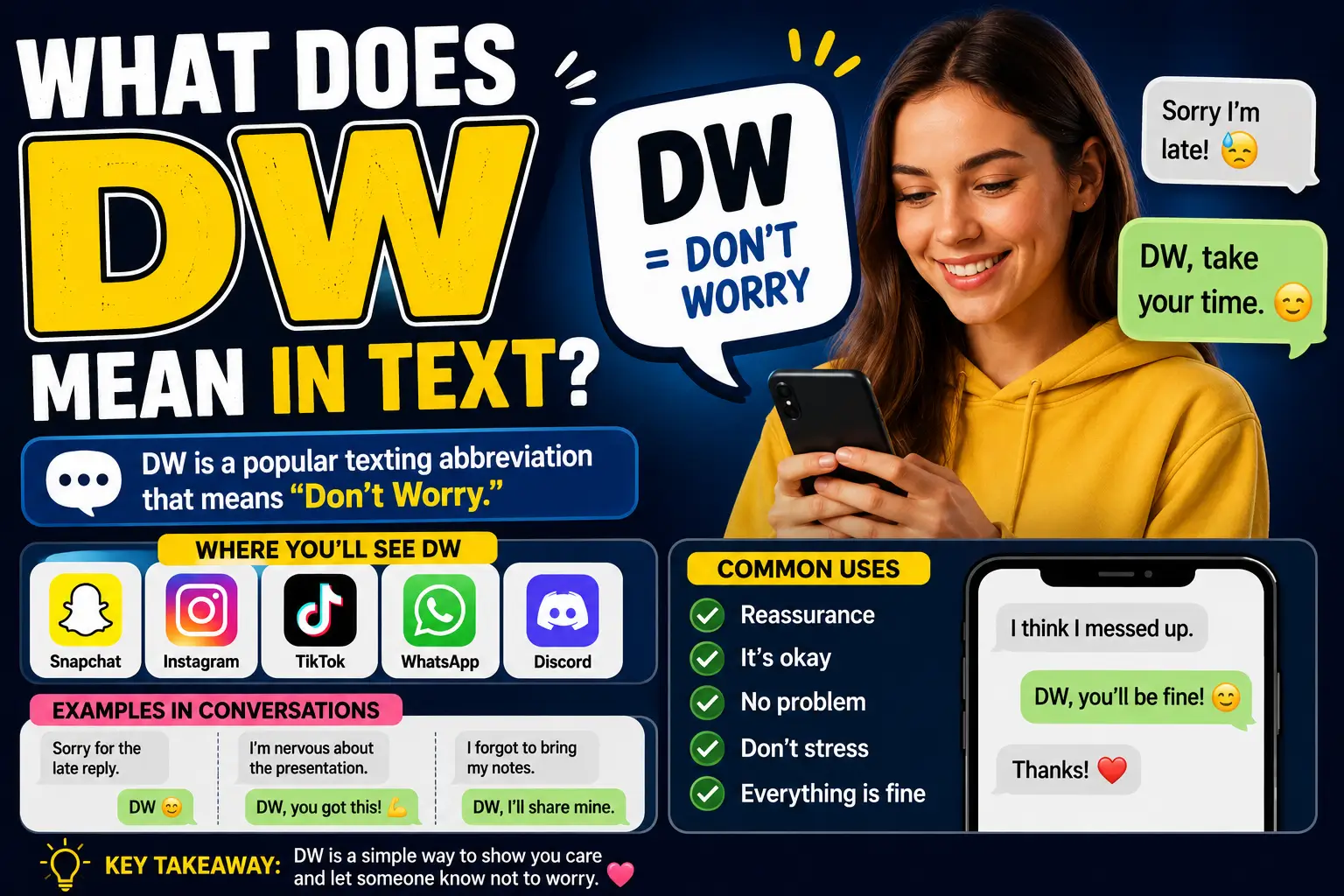
In most cases, DW stands for “Don’t Worry.” People use it to reassure someone, reduce concern, or create a relaxed tone during a conversation.
While the definition sounds simple, the way people use DW can vary depending on context, tone, relationship, and platform.
This guide explains everything you need to know about DW, including its meaning, usage, examples, social media interpretations, emotional impact, and common misunderstandings.
What Does DW Mean in Text? (Quick Answer)
DW Meaning in One Sentence
DW is a texting abbreviation that usually means “Don’t Worry.”
Full Form of DW
| Abbreviation | Full Form |
| DW | Don’t Worry |
Featured Snippet Answer
If you’re searching for what does DW mean in text, the answer is simple:
DW stands for “Don’t Worry.” People use it in text messages, chats, and social media conversations to reassure someone or tell them that everything is okay.
Quick Example
Friend:
Sorry I’m running late.
Reply:
DW, take your time.
In this example, DW means:
Don’t worry. It’s not a problem.
What Does DW Stand For in Texting?
Text messaging has changed how people communicate. Instead of typing long phrases, users often shorten common expressions into abbreviations.
DW is one of the most popular examples.
The Most Common Meaning: Don’t Worry
When someone types DW, they are usually trying to:
- Reassure you
- Reduce anxiety
- Show understanding
- Create a relaxed atmosphere
- Let you know something isn’t a problem
Think of DW as a digital version of saying:
- It’s okay.
- No problem.
- Don’t stress.
- Everything is fine.
- No need to worry.
Why People Use DW Instead of Writing “Don’t Worry”
The answer is simple: convenience.
Modern communication moves quickly. People want to send messages without typing long sentences.
Instead of writing:
Don’t worry about it. Everything is fine.
They simply write:
DW.
The meaning remains almost identical.
How DW Makes Conversations Faster
Texting abbreviations exist because they save time.
Consider these examples:
| Full Phrase | Short Version |
| Don’t Worry | DW |
| Be Right Back | BRB |
| To Be Honest | TBH |
| Never Mind | NVM |
| Laugh Out Loud | LOL |
Over time, these abbreviations became part of everyday digital language.
What Does DW Mean in a Text Message?
While DW always points toward reassurance, the exact meaning can shift slightly depending on the situation.
The Emotional Meaning Behind DW
At its core, DW is emotionally supportive.
It tells someone:
- You are forgiven.
- The issue isn’t serious.
- Everything is under control.
- There’s no reason to stress.
That’s why the abbreviation feels friendly and comforting.
What Someone Is Usually Trying to Say
When a person sends DW, they often mean one of the following:
| Possible Meaning | Example |
| It’s okay | DW, it happens. |
| No problem | DW about it. |
| Relax | DW, we’ve got time. |
| Don’t stress | DW, everything worked out. |
| You’re forgiven | DW, I’m not upset. |
When DW Means Reassurance and Comfort
Imagine a student texting:
I forgot to bring the notes.
A friend replies:
DW, I brought extra copies.
The abbreviation instantly reduces anxiety.
Instead of focusing on the mistake, the conversation shifts toward a solution.
That’s one reason DW remains so popular.
How DW Is Used in Everyday Conversations
One of the best ways to understand DW is to see it in action.
DW When Someone Apologizes
This is one of the most common uses.
Example:
Person A:
Sorry for replying late.
Person B:
DW. I was busy too.
The response removes tension and shows understanding.
DW When Someone Feels Worried
People often use DW to calm fears.
Example:
Person A:
I think I messed up the presentation.
Person B:
DW. You did great.
Notice how DW acts like a verbal pat on the back.
DW When Someone Makes a Mistake
Mistakes happen every day.
Example:
Person A:
I accidentally deleted the file.
Person B:
DW. We have a backup.
The abbreviation quickly reassures the other person.
DW in Casual Friend-to-Friend Chats
Friends use DW constantly because it feels natural.
Example:
DW. We’ll figure it out.
Short. Friendly. Effective.
Real-Life Examples of DW in Text Messages
Seeing realistic examples helps you understand how people actually use the abbreviation.
Example: DW After an Apology
Sarah:
Sorry I forgot your birthday message yesterday.
Emily:
DW. I completely understand.
Example: DW Between Friends
Jake:
I might be 15 minutes late.
Ryan:
DW. I’m still getting ready.
Example: DW in a Relationship
Partner A:
Sorry for falling asleep during our movie.
Partner B:
DW. We can finish it tomorrow.
Example: DW in a Group Chat
Friend:
I can’t make it tonight.
Group Admin:
DW. We’ll catch up another day.
Example: DW in a Work Conversation
Coworker:
Sorry for the delay.
Manager:
DW. Thanks for the update.
Common Pattern
In nearly every example, DW serves one purpose:
It lowers stress and keeps the conversation positive.
What Does DW Mean From a Girl?
Many people search this question because they wonder whether DW carries a hidden meaning when it comes from someone they like.
The truth is that context matters far more than gender.
Friendly Meaning
Most of the time, a girl who says DW simply means:
Don’t worry.
Example:
DW. It wasn’t your fault.
Nothing complicated. Just reassurance.
Caring and Supportive Meaning
Sometimes DW reflects kindness.
Example:
DW. I know you’ve had a busy week.
Here, the abbreviation communicates empathy and understanding.
Possible Romantic Context
If the conversation already contains romantic interest, DW can feel warmer.
Example:
DW. I’ll wait for you.
The phrase itself isn’t romantic.
However, the surrounding conversation may create a romantic tone.
Example Conversation
Person:
Sorry I couldn’t call last night.
Girl:
DW. I know you were busy.
The message feels supportive rather than critical.
What Does DW Mean From a Guy?
The meaning remains largely the same.
Casual Usage
Many guys use DW casually throughout the day.
Example:
DW. I’ll handle it.
Reassuring Usage
The abbreviation often appears when someone wants to calm concerns.
Example:
DW. Everything’s under control.
Relationship Context
Within relationships, DW can signal patience and understanding.
Example:
DW. We can talk later.
Example Conversation
Person:
Sorry I missed your message.
Guy:
DW. I just saw it too.
Again, the purpose is reassurance rather than criticism.
DW Meaning on Social Media
Social media platforms helped popularize texting abbreviations.
Today, DW appears almost everywhere online.
People use it because it’s short, recognizable, and easy to understand.
What Does DW Mean on Snapchat?
On Snapchat, DW almost always means:
Don’t worry.
Example:
DW. I’ll send another snap.
What Does DW Mean on Instagram?
Instagram users commonly write DW in:
- Direct messages
- Comments
- Story replies
Example:
DW. Your post looks great.
What Does DW Mean on TikTok?
TikTok users often use DW in comments and private messages.
Example:
DW. Everybody makes mistakes.
What Does DW Mean on WhatsApp?
WhatsApp conversations tend to be casual.
As a result, DW appears frequently.
Example:
DW. I’ll be there soon.
What Does DW Mean on Facebook Messenger?
Messenger users employ DW in much the same way.
The abbreviation signals reassurance and understanding.
What Does DW Mean on Discord?
Gaming and community servers regularly use DW.
Example:
DW. We’ll win the next round.
DW Meaning in Online Gaming and Chat Communities
Gaming culture helped normalize abbreviations like DW.
Competitive games move quickly.
Players don’t have time to type long explanations.
Instead, they rely on short expressions.
Gaming Chats
A teammate might say:
Sorry, that was my fault.
Response:
DW.
The message prevents blame and keeps morale high.
Livestream Conversations
Viewers often use DW when reassuring streamers or other audience members.
Discord Servers
Discord communities use DW during:
- Voice chats
- Text channels
- Team discussions
- Event planning
Multiplayer Team Communication
Fast communication matters in games.
DW helps players maintain a positive atmosphere without lengthy explanations.
Why People Use DW So Often
The popularity of DW isn’t an accident. It solves a simple problem: people want to communicate quickly while still sounding friendly and supportive.
A full sentence takes time to type. DW delivers the same message in just two letters.
Faster Than Typing “Don’t Worry”
Modern conversations move quickly.
Whether you’re texting a friend, responding to a Snapchat message, or chatting in a group conversation, speed matters.
Instead of writing:
Don’t worry about it. Everything is okay.
People simply type:
DW.
The meaning stays clear while saving time.
Creates a Relaxed Tone
Words influence how messages feel.
When someone says DW, they often create a calmer atmosphere.
For example:
DW. We can figure it out later.
This response feels less stressful than a detailed explanation.
Popular in Digital Communication
The rise of smartphones has transformed communication habits.
Today’s users rely heavily on abbreviations because they:
- Save time
- Reduce typing effort
- Feel more conversational
- Fit naturally into casual chats
DW checks all those boxes.
Widely Understood Across Platforms
Unlike some internet slang that only exists within specific communities, DW is recognized almost everywhere.
You can find it on:
- Text messages
- Snapchat
- TikTok
- Discord
- Facebook Messenger
- Gaming chats
Its universal recognition contributes to its lasting popularity.
Is DW Polite, Rude, or Dismissive?
One reason people search what does DW mean in text is because they want to understand the tone behind it.
The answer depends entirely on context.
When DW Sounds Polite
Most of the time, DW is polite.
Examples:
DW. It happens.
DW. Thanks for letting me know.
DW. I understand.
These responses feel warm and reassuring.
When DW Can Feel Cold
Short messages sometimes appear distant.
Consider this example:
Person A:
I spent hours fixing the project.
Person B:
DW.
While the intention may be positive, the response can feel brief or uninterested.
When Tone Changes the Meaning
Text messages lack facial expressions and voice inflection.
As a result, the same abbreviation can sound completely different depending on the situation.
Compare:
Friendly
DW 😊
Neutral
DW.
Potentially Cold
DW.
The words remain identical. The emotional impact changes.
Understanding Context
Whenever you encounter DW, consider:
- Who sent it
- What happened earlier
- The overall conversation tone
- Any emojis used
- Your relationship with the sender
Context almost always reveals the intended meaning.
Can DW Be Used Sarcastically?
Yes, although it’s far less common.
Most uses of DW are genuine. However, sarcasm occasionally appears.
Genuine DW
Example:
Sorry I forgot your notebook.
Response:
DW. I already printed another copy.
This use is sincere.
Sarcastic DW
Example:
I accidentally deleted the entire project.
Response:
Yeah, DW. Totally fine.
Here, the tone suggests frustration rather than reassurance.
Signs Someone Is Being Sarcastic
Watch for clues such as:
- Exaggerated wording
- Previous conflict
- Obvious frustration
- Contradictory statements
- Negative emojis
Example of Sarcasm
Person A:
I crashed your car.
Person B:
DW. It’s not like I needed it anyway.
The literal words say “don’t worry” while the actual meaning communicates annoyance.
When Should You Use DW?
Although DW is common, it’s most effective in certain situations.
Best Situations for Using DW
Use DW when:
- Someone apologizes
- Someone feels nervous
- You want to reassure someone
- A mistake isn’t serious
- You want to keep the conversation positive
Informal Conversations
DW works perfectly in casual settings.
Examples include:
- Friendships
- Family chats
- Group conversations
- Online communities
Social Media Chats
Most social media platforms encourage informal communication.
DW fits naturally into:
- DMs
- Replies
- Comments
- Community discussions
Text Messaging Etiquette
A few simple guidelines help ensure your message feels friendly:
Good Examples
DW. I understand.
DW. It happens.
DW. We can fix it.
Less Effective Examples
DW.
K.
Fine.
Adding a few extra words often improves clarity and warmth.
When Should You Avoid Using DW?
Not every situation is appropriate for abbreviations.
Professional Emails
Formal business communication usually requires complete words.
Instead of:
DW about the report.
Write:
Don’t worry about the report.
Professional language creates a stronger impression.
Business Communication
Internal workplace chats may allow abbreviations.
However, external communication often benefits from more formal wording.
Serious Discussions
Certain conversations deserve extra care.
Examples include:
- Medical concerns
- Financial issues
- Legal matters
- Personal crises
In these situations, a full response feels more thoughtful.
Academic Settings
Professors, teachers, and academic professionals often prefer complete sentences.
Although DW isn’t wrong, traditional language generally works better.
How to Reply When Someone Says DW
Receiving DW is common. Knowing how to respond keeps conversations flowing smoothly.
Friendly Responses
- Thanks!
- Appreciate it.
- That’s good to hear.
- Glad to know.
Polite Responses
- Thank you for understanding.
- I appreciate your patience.
- Thanks for being flexible.
Casual Responses
- Cool.
- Sounds good.
- Got it.
- Perfect.
Flirty Responses
If the conversation already contains romantic interest, you might respond:
- You’re sweet.
- Thanks for always understanding.
- That’s one reason I like talking to you.
Professional Responses
In workplace settings:
- Thank you for the clarification.
- I appreciate the update.
- Understood.
Other Meanings of DW You Should Know
Although “Don’t Worry” dominates texting culture, DW can have other meanings.
Less Common Definitions
Depending on context, DW may refer to:
| DW Meaning | Context |
| Don’t Worry | Texting and social media |
| Dear Wife | Family discussions |
| Data Warehouse | Technology and business |
| Doctor Who | Entertainment and television |
| Distant Worlds | Gaming and media |
Why Context Matters
Imagine reading:
DW released a new episode.
In this case, DW likely refers to Doctor Who rather than Don’t Worry.
Similarly:
The company upgraded its DW infrastructure.
That usage probably refers to Data Warehouse.
Context always determines the correct interpretation.
DW vs Similar Texting Abbreviations
Many abbreviations appear similar at first glance.
However, their meanings differ significantly.
DW vs NVM
| Term | Meaning |
| DW | Don’t Worry |
| NVM | Never Mind |
DW reassures.
NVM ends a topic.
DW vs NP
| Term | Meaning |
| DW | Don’t Worry |
| NP | No Problem |
The meanings overlap, but NP usually responds to gratitude.
DW vs IDC
| Term | Meaning |
| DW | Don’t Worry |
| IDC | I Don’t Care |
DW sounds supportive.
IDC often sounds indifferent.
DW vs TBH
| Term | Meaning |
| DW | Don’t Worry |
| TBH | To Be Honest |
These abbreviations serve completely different purposes.
DW vs BRB
| Term | Meaning |
| DW | Don’t Worry |
| BRB | Be Right Back |
One offers reassurance. The other indicates a temporary absence.
Common Misunderstandings About DW
Even simple abbreviations create confusion.
Assuming It Has Only One Meaning
Most people think DW always means Don’t Worry.
While that’s usually true, alternative meanings exist.
Misreading the Tone
A short message can appear:
- Friendly
- Neutral
- Cold
- Sarcastic
The surrounding conversation matters more than the abbreviation itself.
Using DW in Formal Situations
Many people mistakenly use texting abbreviations in professional communication.
A full phrase often works better in formal environments.
Why Understanding DW Matters in Modern Communication
Digital communication continues to evolve.
Every year, new abbreviations appear while older ones gain broader acceptance.
Understanding terms like DW helps you:
- Avoid confusion
- Interpret messages accurately
- Communicate naturally online
- Participate in modern digital conversations
Think of internet slang as a new layer of language. The more you understand it, the easier online communication becomes.
Case Study: How DW Changes a Conversation
Let’s compare two versions of the same exchange.
Without DW
Person A:
Sorry I’m late.
Person B:
Okay.
The response feels neutral and slightly cold.
With DW
Person A:
Sorry I’m late.
Person B:
DW. I’m still getting ready.
The conversation instantly feels friendlier and more relaxed.
That’s the power of a simple abbreviation.
DW Meaning at a Glance
If you need a quick reference, this table summarizes the most important information about DW.
| Term | Meaning | Tone | Common Usage |
| DW | Don’t Worry | Reassuring | Text messages |
| DW | Don’t Worry | Friendly | Social media chats |
| DW | Don’t Worry | Casual | Group chats |
| DW | Don’t Worry | Supportive | Relationship conversations |
| DW | Don’t Worry | Professional (limited use) | Informal work chats |
Quick Facts About DW
| Question | Answer |
| What does DW mean in text? | Don’t Worry |
| Is DW positive? | Usually yes |
| Is DW rude? | Generally no |
| Is DW formal? | No |
| Is DW still popular? | Yes |
| Is DW used on TikTok? | Yes |
| Is DW used on Snapchat? | Yes |
| Can DW be sarcastic? | Sometimes |
Expert Insight: Why DW Continues to Thrive
Language constantly evolves.
A century ago, people wrote long handwritten letters. Today, many conversations happen through quick text messages.
Abbreviations like DW survive because they solve a practical problem.
They make communication:
- Faster
- Simpler
- More efficient
- Easier on mobile devices
Interestingly, DW succeeds because it carries emotional value.
Many abbreviations simply transfer information.
DW does something different.
It reassures.
That emotional function makes it especially useful in everyday communication.
The Psychology Behind DW
When someone feels worried, embarrassed, or stressed, they often seek reassurance.
A simple message such as:
DW. Everything is okay.
Can immediately reduce tension.
That’s why the abbreviation has remained popular for years while many internet slang terms disappear quickly.
How Different Generations Use DW
Not everyone uses DW in exactly the same way.
Gen Z
Gen Z commonly uses DW across:
- TikTok
- Snapchat
- Discord
- Gaming chats
For younger users, DW feels completely natural.
Millennials
Millennials frequently use DW in:
- Facebook Messenger
- Text messages
- Workplace chats
Older Adults
Many older users recognize DW even if they don’t use it regularly.
The abbreviation has become mainstream enough to cross generational boundaries.
The Evolution of Texting Abbreviations
DW belongs to a larger family of internet shorthand.
Over the years, texting culture introduced hundreds of abbreviations.
Popular Examples
| Abbreviation | Meaning |
| DW | Don’t Worry |
| LOL | Laugh Out Loud |
| BRB | Be Right Back |
| TBH | To Be Honest |
| IMO | In My Opinion |
| NVM | Never Mind |
| IDK | I Don’t Know |
| TTYL | Talk To You Later |
Some abbreviations fade over time.
Others become permanent parts of online communication.
DW falls into the second category.
Real-World Scenarios Where DW Works Best
Understanding practical situations makes the abbreviation easier to use correctly.
Scenario: Missed Call
Friend:
Sorry, I missed your call.
Response:
DW. I’ll call later.
Scenario: Late Arrival
Coworker:
Traffic is terrible. I’ll be late.
Response:
DW. The meeting hasn’t started yet.
Scenario: Forgotten Assignment
Student:
I forgot to bring my notes.
Classmate:
DW. You can use mine.
Scenario: Social Plans
Friend:
I can’t make it tonight.
Response:
DW. We’ll meet next week.
Each example shares one thing in common:
The abbreviation reduces pressure and keeps the conversation positive.
Common Situations Where DW Appears
You’ll often see DW in the following contexts:
Apologies
Example:
Sorry about that.
Response:
DW.
Scheduling Problems
Example:
I’m running late.
Response:
DW.
Minor Mistakes
Example:
I sent the wrong file.
Response:
DW.
Everyday Conversations
Example:
I forgot to text back.
Response:
DW.
Because these situations happen frequently, DW remains one of the most useful texting abbreviations.
What DW Does NOT Mean
Many people occasionally misunderstand internet slang.
Let’s clear up a few misconceptions.
DW Does Not Automatically Mean:
- Anger
- Frustration
- Rejection
- Romantic interest
- Disrespect
The abbreviation itself is neutral.
The surrounding conversation determines the emotional tone.
Example
Message:
DW. I understand.
This sounds supportive.
Message:
Yeah, DW.
This might sound annoyed depending on the context.
The difference comes from tone rather than the abbreviation itself.
Why Context Is Everything
One of the most important lessons about texting language is this:
Words don’t exist in isolation.
The same abbreviation can carry different emotional weight depending on:
- Relationship
- Situation
- Timing
- Previous messages
- Punctuation
- Emojis
Consider these examples:
Warm Response
DW 😊
Neutral Response
DW.
Potentially Annoyed Response
DW, whatever.
The abbreviation remains identical.
The meaning shifts because the context changes.
Frequently Asked Questions About DW
Q1:What does DW mean in text messages?
DW usually means Don’t Worry. People use it to reassure someone that everything is okay.
Q2:What does DW stand for?
The full form of DW is Don’t Worry.
Q3:What does DW mean on Snapchat?
On Snapchat, DW almost always means Don’t Worry and is used in casual conversations.
Q4:What does DW mean on TikTok?
On TikTok, DW generally means Don’t Worry in comments, messages, and replies.
Q5:Is DW rude?
No. In most situations, DW is polite and reassuring.
Q6:Can DW sound sarcastic?
Yes. Although uncommon, context can make DW sound sarcastic.
Q7:What does DW mean from a girl?
Usually, it simply means Don’t Worry. The exact tone depends on the conversation.
Q8:What does DW mean from a guy?
Most often, it means Don’t Worry and serves as reassurance.
Q9:Is DW appropriate for work messages?
It can work in informal workplace chats. However, professional emails usually benefit from complete wording.
Q10:Is DW still popular in 2026?
Yes. DW remains one of the most recognized and frequently used texting abbreviations across social media and messaging platforms.
Final Thoughts on What Does DW Mean in Text
If you’ve been wondering what does DW mean in text, the answer is straightforward.
DW stands for Don’t Worry.
People use it to reassure others, reduce stress, and keep conversations relaxed. Whether you’re chatting on Snapchat, sending a WhatsApp message, replying on Instagram, or talking in a gaming community, you’ll likely encounter DW regularly.
The abbreviation has remained popular because it’s simple, helpful, and universally understood.
Remember these key takeaways:
- DW usually means Don’t Worry.
- It creates a reassuring tone.
- It’s commonly used in texting and social media.
- Context helps determine the exact meaning.
- It works best in casual communication.
- Professional settings generally require full wording.
As digital language continues to evolve, abbreviations like DW remain an important part of modern communication. Understanding them helps you communicate more confidently and interpret online conversations with greater accuracy.
“Sometimes two letters are all it takes to make someone feel better.”
And that’s exactly why DW continues to thrive in today’s texting culture.
Read these posts also:
- GNG Meaning: What It Means in Text, TikTok, Snapchat, and Slang
- What Does ICL Mean in Slang? Meaning, Text Examples, and How to Reply
- Prayers in Spanish: The Complete Guide Every Believer and Learner Needs
- Bussing Meaning: Every Definition, Use, and Context Fully Explained
- Zesty Meaning Slang: The Complete Guide to What It Really Means in 2026
- What Does SYBAU Mean? The Internet Slang Term Everyone’s Typing in 2026
- Chopped Meaning Slang: The Simple Answer