

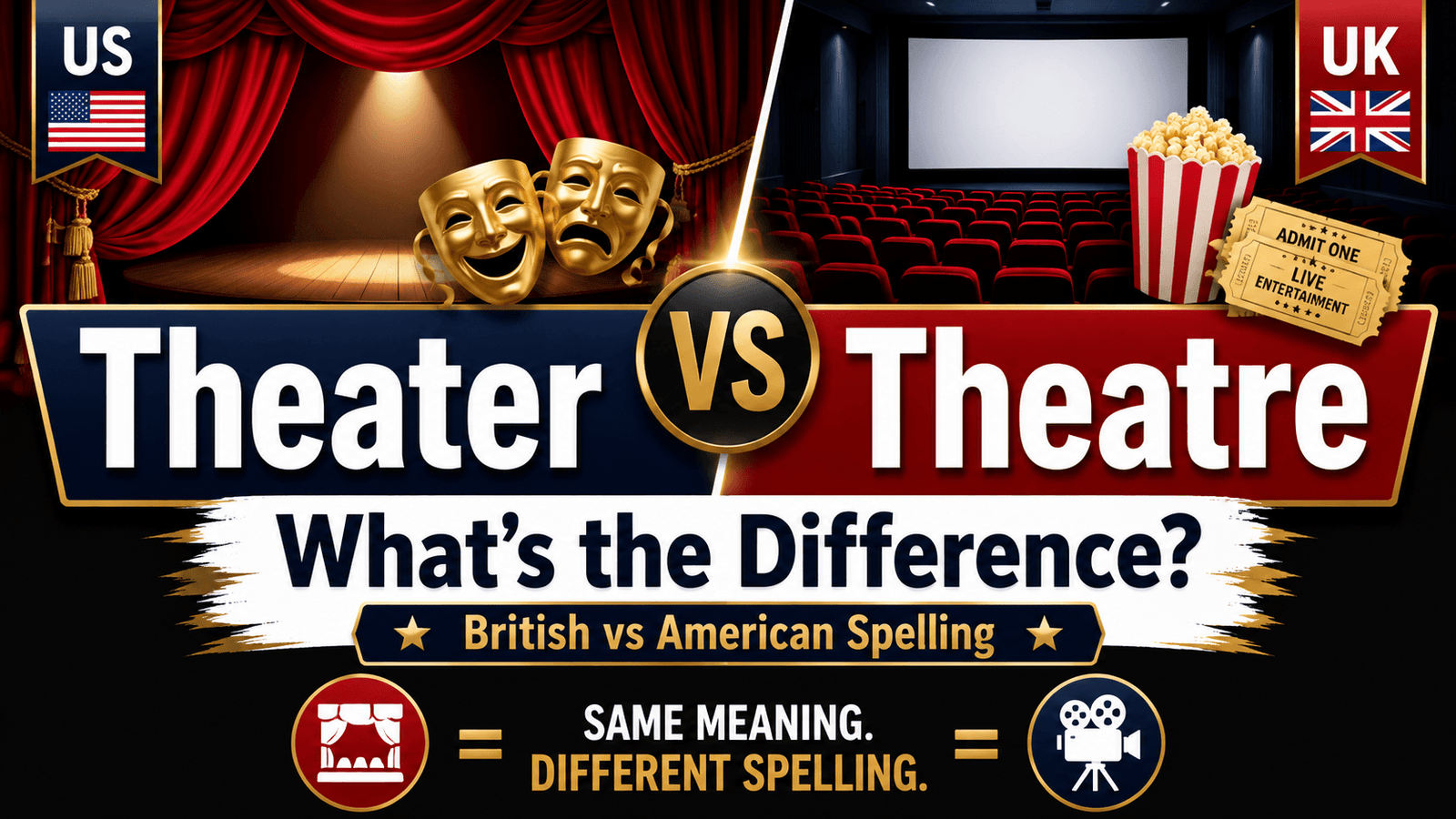
Theater vs theatre meaning shows British English uses theatre and American English uses theater for same performing arts place in English usage
Many people get confused by spelling in British English and American English. Theatre is used in UK while theater is used in US. Both mean a place for plays, films and performances. This difference is only about spelling, not meaning. Writers should choose based on audience and context when writing content for readers worldwide.
Understanding theater vs theatre is simple once you know the rule. It is not a meaning change but a spelling choice. Always match your writing style to the region you are targeting. This helps improve clarity and avoids confusion for readers. Whether you are a student or writer, using the correct form makes your content look more natural and professional in English communication every time you write online content for better understanding readers clearly.
Quick Answer: Theater vs. Theatre Meaning
If you’re looking for the short answer, here it is.
| Feature | Theater | Theatre |
| Meaning | Building or performing arts | Building or performing arts |
| Pronunciation | Same | Same |
| American English | Preferred spelling | Occasionally used for branding |
| British English | Rare | Preferred spelling |
| Correct? | Yes | Yes |
Key takeaway: There is no difference in the actual meaning of theater and theatre. Both describe:
- A place where performances take place
- The art of live performance
- The entertainment industry related to drama and stage productions
The only major difference is regional spelling and stylistic preference.
Theater vs. Theatre at a Glance
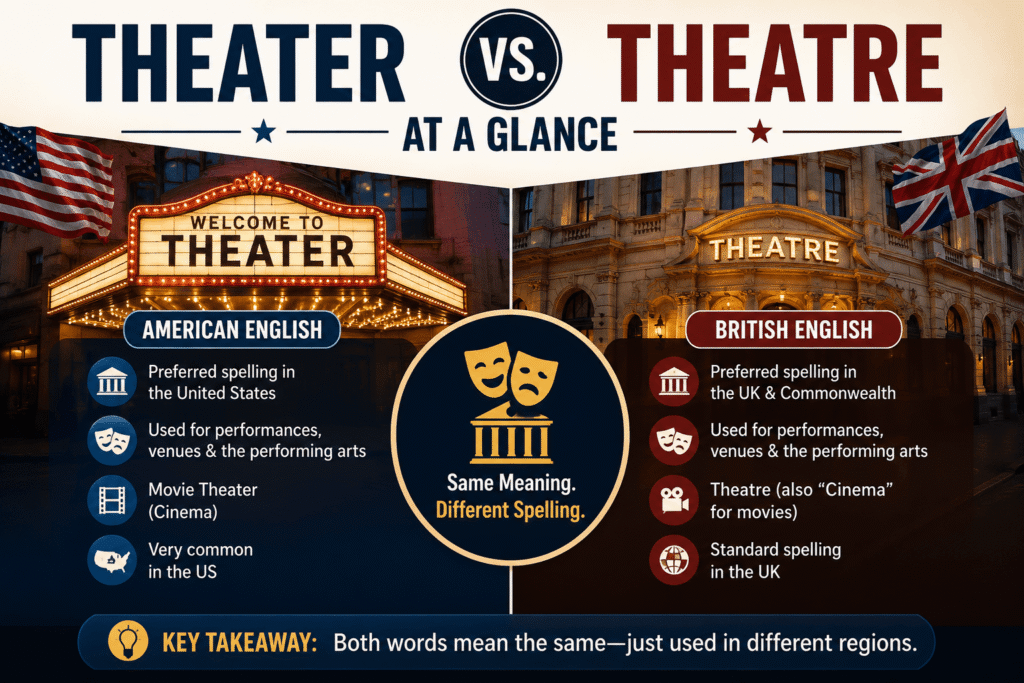
Before diving deeper, here’s a quick comparison that answers the most common questions.
| Category | Theater | Theatre |
| Language | American English | British English |
| Meaning | Identical | Identical |
| Pronunciation | THEE-uh-ter | THEE-uh-ter |
| Common in the US | Very common | Less common but accepted |
| Common in the UK | Uncommon | Standard spelling |
| Used for live performances | Yes | Yes |
| Used for movie venues | Yes | Yes, although “cinema” is also common in the UK |
Despite what many websites claim, dictionaries recognize both spellings as valid. Your audience usually determines which one you should choose.
What Does “Theater” Mean?
The word theater is the standard spelling in American English. It appears in newspapers, books, schools, government publications, and everyday conversation throughout the United States.
Definition
Theater refers to:
- A building where people watch plays, musicals, concerts, or films.
- The art of performing dramatic works before an audience.
- The profession or industry centered on live performances.
In broader contexts, the word can also describe a specific area of activity, such as a military theater.
Common Uses of Theater
The word appears in several everyday situations.
A performance venue
People visit a theater to watch live entertainment such as:
- Plays
- Musicals
- Ballets
- Operas
- Comedy shows
Movie theater
In American English, a cinema is almost always called a movie theater.
Examples include:
- We watched the latest superhero film at the movie theater.
- The theater has comfortable reclining seats.
Performing arts
The word also describes the artistic discipline itself.
Examples:
- She studied theater in college.
- Community theater helps local actors gain experience.
- Children’s theater introduces young audiences to live performances.
Military use
Outside entertainment, theater has another accepted meaning.
For example:
- The Pacific Theater played a major role during World War II.
- Military planners discussed operations in the European Theater.
Although this meaning differs from performing arts, it follows the same spelling conventions in American English.
Example Sentences
Here are several examples that show how naturally the word fits into everyday writing.
- We bought tickets to the theater for Saturday night.
- Her dream is to work in musical theater.
- The city built a modern theater downtown.
- Our local theater hosts free performances every summer.
- They spent the evening at the movie theater.
Each sentence uses theater correctly in American English.
What Does “Theatre” Mean?
Theatre carries exactly the same definition. The primary difference lies in where people use it.
It is the standard spelling throughout:
- The United Kingdom
- Ireland
- Australia
- New Zealand
- Many Commonwealth countries
Definition
Theatre refers to:
- A venue where audiences watch live performances.
- The art of acting, directing, producing, and staging plays.
- Organizations devoted to dramatic arts.
Common Uses of Theatre
In British English, you’ll regularly see examples such as:
- National Theatre
- Community theatre
- Theatre production
- Theatre company
- Theatre festival
Many universities also offer degrees in theatre studies.
Example Sentences
- They attended a Shakespeare performance at the local theatre.
- She teaches theatre at the university.
- Community theatre welcomes actors of all experience levels.
- The theatre reopened after extensive renovations.
- He hopes to pursue a career in theatre.
Every example is perfectly correct for audiences that follow British English conventions.
See this also: BM Meaning in Text: What Does BM Mean in Texting?
Theater vs. Theatre Meaning: Is There Any Difference?
This is where confusion often begins.
Many people believe these spellings have different meanings. A common claim is:
- Theater refers only to the building.
- Theatre refers only to the performing arts.
While this distinction sometimes appears in branding or casual conversation, it is not an official grammar rule.
Modern dictionaries recognize both spellings as equivalent. Each can describe:
- A building
- Live dramatic performances
- The performing arts industry
- Educational programs
- Professional organizations
In other words, the difference is conventional rather than grammatical.
Why Does the Myth Exist?
Some performing arts organizations intentionally choose theatre because it sounds more traditional or artistic.
For example:
- Community Theatre
- Children’s Theatre
- Regional Theatre Company
Meanwhile, commercial venues often prefer theater, especially in the United States.
These branding choices created the impression that each spelling has a separate meaning. In reality, organizations simply choose the version that matches their identity.
When Should You Use “Theater”?
If your audience primarily reads American English, theater is usually the safest choice.
You’ll find it throughout:
- Newspapers
- Magazines
- Educational materials
- Government publications
- Business websites
- Most American dictionaries
Use Theater in American English
Examples include:
- Movie theater
- Home theater
- Theater major
- Community theater
- Theater department
This spelling feels natural to American readers.
Use Theater in Everyday Writing
Whether you’re writing a blog post, an email, or a school assignment, theater fits most situations involving an American audience.
For example:
- We visited the theater after dinner.
- She teaches theater at the high school.
- Their theater program won several awards.
Professional Writing
Businesses also favor theater when targeting customers in the United States.
Examples include:
- Theater seating
- Theater tickets
- Theater schedule
- Theater membership
Maintaining consistent spelling throughout your document creates a more polished and professional impression.
Examples of “Theater” in Real Sentences
Seeing words in context makes them easier to remember.
Building
- The theater opens its doors one hour before the performance.
- Our town recently restored its historic theater.
Performing Arts
- She earned a degree in theater arts.
- The university offers scholarships for theater students.
Entertainment
- Families packed the movie theater during the holiday weekend.
- The new theater complex features luxury seating.
Education
- Theater classes help students build confidence and communication skills.
- Many schools encourage participation in theater productions.
Key Takeaways So Far
Before moving on, remember these essential points:
- Theater and theatre have the same meaning.
- The difference is primarily regional spelling.
- Theater is standard in American English.
- Theatre is standard in British English and many Commonwealth countries.
- Some organizations intentionally choose theatre for historical or artistic branding, but that doesn’t change the definition.
- The best choice depends on your audience. Stay consistent throughout your writing for a professional result.
When Should You Use “Theatre”?
If you’re writing for readers in the United Kingdom, Ireland, Australia, New Zealand, or many other Commonwealth countries, theatre is the preferred spelling. It follows the standard conventions of British English and appears in newspapers, books, educational institutions, and government publications.
However, geography isn’t the only factor. Many organizations, even in the United States, deliberately choose theatre because of its historical roots or artistic identity.
Use Theatre in British English
In British English, you’ll commonly see phrases such as:
- Theatre company
- Theatre production
- Theatre school
- Theatre festival
- Musical theatre
- Theatre director
These expressions sound natural to British readers because theatre is the accepted spelling.
Examples
- The theatre hosts performances throughout the year.
- She studied theatre at a university in London.
- The theatre company announced its new season.
- Our local theatre welcomes emerging playwrights.
Use Theatre for Official Names
One important rule applies regardless of where you live:
Always use an organization’s official spelling.
Many famous venues and companies have chosen theatre as part of their brand. Even if you’re writing in American English, you should preserve that spelling when referring to their official names.
Examples
- Children’s Theatre Company
- Goodman Theatre
- National Theatre
- American Conservatory Theater
Notice that some organizations use theatre, while others use theater. Neither spelling is incorrect because they reflect official branding.
Why Do Some American Venues Use “Theatre” Instead of “Theater”?
This question often surprises people.
If theater is the standard American spelling, why do so many venues still use theatre?
The answer lies in history, tradition, and branding rather than grammar.
Historical Influence
Before American English developed its modern spelling conventions, theatre was common throughout the English-speaking world.
During the 19th century, theater became the dominant American spelling. However, many established venues kept the older version because it had already become part of their identity.
As a result, numerous historic buildings still display theatre on their signs today.
Brand Identity
Many performing arts organizations feel that theatre communicates:
- Tradition
- Classical performance
- Artistic excellence
- Cultural heritage
While this perception isn’t based on grammar, it remains a popular branding choice.
For example, a local arts organization may prefer Community Theatre because the spelling conveys a more traditional image.
Meanwhile, a commercial cinema often chooses Movie Theater, which feels more familiar to American audiences.
A Real-World Example
Imagine two businesses operating in the same city.
Riverside Theater
- Shows blockbuster movies
- Focuses on mainstream entertainment
- Targets families and casual visitors
Riverside Theatre
- Produces live plays
- Offers acting workshops
- Hosts Shakespeare festivals
Both spellings are correct. Their names simply reflect different branding strategies.
Theater vs. Theatre in Popular Style Guides
Professional writers often follow established style guides.
Fortunately, these guides make the choice fairly straightforward.
AP Style
The Associated Press Stylebook recommends using the spelling that matches your audience.
For American publications, theater is generally preferred.
However, official names should never be altered.
Correct:
- Goodman Theatre
- Ford’s Theatre
Incorrect:
- Goodman Theater
- Ford’s Theater
Changing an organization’s official spelling creates factual errors.
Chicago Manual of Style
The Chicago Manual of Style follows the same general principle.
Use the regional spelling that matches your document.
Maintain consistency throughout the entire piece.
MLA and Academic Writing
Academic writing usually follows one simple rule:
Use the spelling that matches the variety of English you’ve chosen.
For example:
If your paper uses American spelling:
- Theater
- Color
- Center
If your paper follows British English:
- Theatre
- Colour
- Centre
Avoid mixing the two systems in a single document unless you’re quoting an original source or preserving an official name.
Common Expressions and Which Spelling to Use
Some expressions appear far more often than others.
The table below shows the preferred spelling in different regions.
| Expression | American English | British English |
| Movie theater | ✔ Preferred | Movie theatre or cinema |
| Home theater | ✔ Preferred | Home theatre |
| Community theater | ✔ Preferred | Community theatre |
| Musical theater | ✔ Preferred | Musical theatre |
| Theater district | ✔ Preferred | Theatre district |
| Theater arts | ✔ Preferred | Theatre arts |
| Operating theater | Rare | Operating theatre |
| Dinner theater | ✔ Preferred | Dinner theatre |
Interesting Fact
In the United Kingdom, hospitals commonly use operating theatre, while hospitals in the United States almost always use operating room instead.
This difference reflects regional vocabulary rather than spelling alone.
Grammar Tips for Using Theater and Theatre Correctly
Although the spellings differ, the grammar remains exactly the same.
Both words function as nouns.
Correct Usage
- We visited the theater yesterday.
- She studies theatre at university.
- The theater closed after the final performance.
- The theatre received national recognition.
Plural Forms
The plural changes naturally.
| Singular | Plural |
| Theater | Theaters |
| Theatre | Theatres |
Examples:
- The city has several historic theaters.
- London’s theatres attract millions of visitors every year.
Adjective Forms
Related adjectives include:
- Theatrical
- Theatrically
Examples:
- The performance featured theatrical lighting.
- His speech became increasingly theatrical.
Notice that these forms stay the same regardless of whether you write theater or theatre.
Real-Life Case Studies
Looking at real situations makes the distinction much easier to understand.
Case Study: American Entertainment Website
A streaming platform targets readers across the United States.
Its articles consistently use:
- Movie theater
- Theater tickets
- Home theater system
- Theater industry
This creates consistency with American English.
Case Study: British Arts Magazine
A publication covering London’s performing arts uses:
- Theatre reviews
- Theatre festivals
- National theatre productions
- Theatre companies
Again, the spelling aligns with the audience.
Case Study: International Business
An international travel company maintains two versions of its website.
US Version
- Theater
- Color
- Center
UK Version
- Theatre
- Colour
- Centre
This localization improves readability while matching readers’ expectations.
Common Mistakes to Avoid
Even experienced writers occasionally misuse these spellings.
Fortunately, avoiding the most common errors is simple.
Mixing American and British Spelling
Incorrect:
- The theatre has excellent theater seating.
Correct:
- The theatre has excellent seating.
- The theater has excellent seating.
Choose one spelling system and stay consistent.
Changing Official Names
Always preserve official branding.
Incorrect:
- National Theater
- Goodman Theater
Correct:
- National Theatre
- Goodman Theatre
Assuming the Meanings Are Different
Many people believe:
- Theater = building
- Theatre = performing arts
While some organizations encourage this distinction, dictionaries do not treat it as a formal rule.
Both spellings can describe:
- Buildings
- Live performances
- Academic subjects
- Arts organizations
Using the Wrong Regional Spelling
Think about your audience before publishing.
If your readers are primarily American, theater usually feels more natural.
If your readers are British, theatre is generally expected.
Easy Memory Tricks
Remembering the correct spelling doesn’t have to be difficult.
Here are a few simple tricks.
Think About Your Audience
American audience?
➡ Use theater
British audience?
➡ Use theatre
Match the Rest of Your Spelling
If you write:
- Color
- Favorite
- Center
Use:
Theater
If you write:
- Colour
- Favourite
- Centre
Use:
Theatre
Matching your spelling style creates a polished piece of writing.
Remember This Phrase
American English loves “ER.” British English often prefers “RE.”
Examples include:
| American | British |
| Theater | Theatre |
| Center | Centre |
| Fiber | Fibre |
| Meter | Metre |
This simple pattern makes regional spelling much easier to remember.
Synonyms and Related Words
Depending on the context, several words can replace theater or theatre.
Synonyms for the Building
- Playhouse
- Auditorium
- Performance hall
- Concert hall
- Opera house
- Cinema
- Venue
Related Performing Arts Terms
- Drama
- Stage
- Acting
- Production
- Performance
- Musical
- Play
- Script
- Director
- Cast
- Audience
Using these related terms naturally throughout your writing can improve clarity while avoiding unnecessary repetition.
Quick Reference Checklist
Before publishing your work, ask yourself these questions:
- ✔ Am I writing in American English or British English?
- ✔ Did I use the same spelling throughout the article?
- ✔ Did I preserve official organization names?
- ✔ Does my spelling match my audience?
- ✔ Have I avoided the myth that the words have different meanings?
If you answered yes to each question, you’ve almost certainly chosen the correct spelling and used it consistently.
See this also: What Does OOTN Mean? Texting, Instagram, TikTok, and Style Meaning
Frequently Asked Questions About Theater vs. Theatre Meaning
Both “theater” and “theatre” are correct spellings. They have the same meaning and pronunciation. The right choice depends on the variety of English you’re using.
Theater is the standard spelling in American English.
Theatre is the standard spelling in British English and many Commonwealth countries.
The primary difference is spelling, not meaning.
Both words can refer to:
A building where plays, musicals, or films are presented.
The art of live dramatic performance.
The performing arts industry.
Academic programs related to drama.
Many people believe theatre refers only to live performances while theater refers only to the building. However, dictionaries and style guides do not recognize this as a formal grammar rule.
In the United States, theater is the preferred spelling for most situations.
You’ll commonly see:
Movie theater
Community theater
Theater department
Home theater
Theater tickets
That said, some American organizations intentionally use theatre as part of their official name for historical or branding reasons.
In the United Kingdom, theatre is the standard spelling.
You’ll find it in:
Theatre schools
Theatre companies
Theatre festivals
Theatre reviews
Theatre productions
British publications, universities, and government organizations consistently use theatre unless they’re referring to an official name with a different spelling.
Many American performing arts venues adopted theatre long before theater became the dominant American spelling.
Today, organizations often keep theatre because it reflects:
Tradition
Heritage
Artistic identity
Brand recognition
Changing the spelling would alter their established name and identity.
The answer depends on your audience.
Audience
Preferred Term
American English
Movie theater
British English
Movie theatre or cinema
In the United Kingdom, people frequently use cinema instead of either spelling.
Generally, no.
Choose one spelling and use it consistently throughout your article.
The only exception is when you’re writing an official name.
For example:
Goodman Theatre
Ford’s Theatre
Community Theater Association
Maintaining consistency improves readability and creates a more professional impr
No.
Both words are pronounced the same way.
The pronunciation is:
THEE-uh-ter
The spelling changes, but the spoken word remains identical across American and British English.
Use the spelling that matches your target audience and your primary keyword.
For example:
If your audience is in the United States, optimize for theater.
If your audience is in the United Kingdom or Australia, optimize for theatre.
If your content targets an international audience, it’s perfectly accep
Yes.
Both expressions are grammatically correct.
The preferred spelling depends on regional English.
Examples:
American English: Theater Arts Department
British English: Theatre Arts Department
The meaning remains the same.
Key Takeaways
Before you leave, here’s a quick recap of the most important points.
| Question | Answer |
| Do theater and theatre mean the same thing? | Yes. |
| Are both spellings correct? | Yes. |
| Which spelling is American? | Theater |
| Which spelling is British? | Theatre |
| Do they have different pronunciations? | No. |
| Should you mix both spellings? | No, unless using an official name. |
| Does theatre always mean live performances? | No. That’s a common misconception. |
Common Usage Examples
The following examples show how both spellings work naturally in everyday writing.
American English
- We bought tickets to the theater for Friday night.
- She earned a degree in theater arts.
- The movie theater was sold out before the premiere.
- Our community theater stages several productions every year.
British English
- They visited the theatre during their trip to London.
- He teaches theatre at the university.
- The local theatre company performs classic plays.
- She hopes to build a career in musical theatre.
Each sentence is correct because it matches the intended variety of English.
Final Comparison Table
| Feature | Theater | Theatre |
| Meaning | Same | Same |
| Pronunciation | Same | Same |
| American English | Preferred | Less common |
| British English | Rare | Preferred |
| Live performances | ✔ | ✔ |
| Movie venue | ✔ | ✔ |
| Academic subject | ✔ | ✔ |
| Official venue names | Sometimes | Sometimes |
| Correct spelling | ✔ | ✔ |
Expert Writing Tips
If you regularly write blogs, academic papers, marketing content, or business documents, these simple habits will help you stay consistent.
- Choose your audience before choosing the spelling.
- Don’t switch between American and British English in the same document.
- Respect official organization names exactly as they are written.
- Use a spell checker that matches your chosen variety of English.
- Proofread headings, image captions, and meta descriptions to ensure spelling consistency.
These small details improve readability, professionalism, and trustworthiness.
Conclusion
Understanding the theater vs. theatre meaning is much simpler than it first appears. Although the two spellings look different, they share the same definition. Both refer to a place where performances take place and to the broader world of the performing arts. The real distinction lies in regional spelling conventions, not in the meaning of the word itself.
If you’re writing for an American audience, theater is the standard choice. If your readers use British English, theatre is the preferred spelling. In every case, the most important rule is consistency. Select the version that fits your audience, preserve the official spelling of organizations and venues, and use the same style throughout your writing.
Ultimately, both theater and theatre are correct. By understanding when and why each spelling is used, you’ll write with greater confidence, avoid common mistakes, and communicate more clearly. Whether you’re discussing live performances, movie venues, theater arts, or theatre productions, choosing the right spelling for your audience ensures your writing feels natural, polished, and professional.