

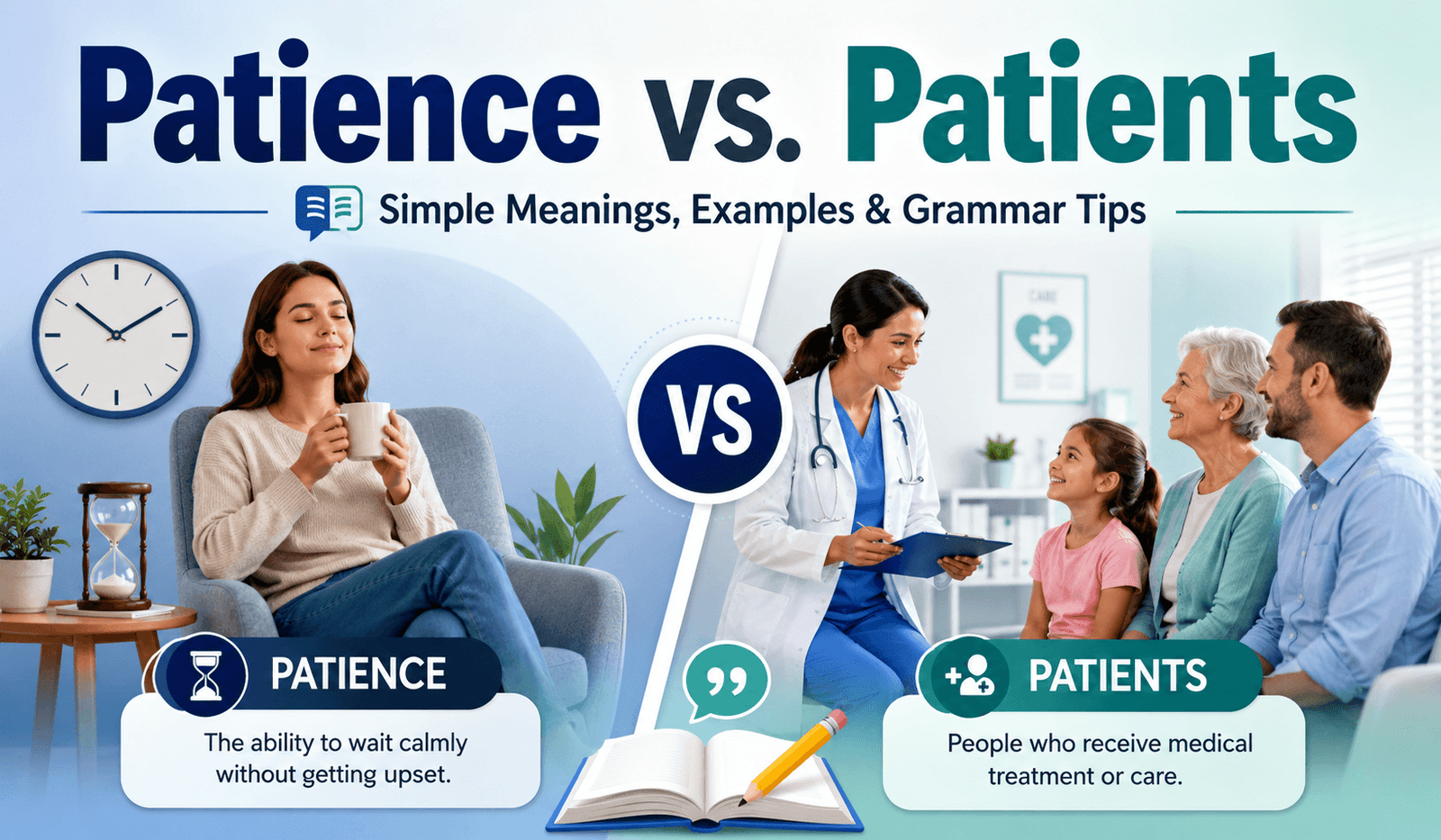
Knowing the difference between patience or patients helps you communicate clearly. Patience is the quality and quality of being patient that gives you the ability to wait, accept delay, and face problems without becoming upset. It develops through calm perseverance, perseverance, and the ability to wait, helping you remain calm and stay calm in everyday situations.
As you practice patience, you learn to endure challenges with greater endurance and tolerance. Instead of reacting to irritation or suffering, you can tolerate delay, stay composed, and compose your thoughts before responding. These habits improve calmness and make difficult moments easier to manage.
Whether you face adversity, the face of adversity, or work under pressure, patience becomes a lasting virtue. It gives you the confidence to handle challenges with a clear mind instead of rushing into poor decisions. Learning this skill strengthens your character and helps you respond wisely in both personal and professional life.
Quick Answer: Patience vs. Patients
Here’s the short answer if you’re in a hurry.
- Patience is a noun that means the ability to stay calm while waiting or dealing with something difficult.
- Patients is the plural form of patient, meaning more than one person receiving medical care.
Quick Comparison
| Word | Part of Speech | Meaning | Example |
| Patience | Noun | The ability to remain calm while waiting | She showed remarkable patience during the delay. |
| Patient | Noun / Adjective | A person receiving medical care, or someone who stays calm | The patient thanked the nurse. |
| Patients | Plural noun | More than one person receiving medical care | The doctor examined several patients today. |
Remember:
- You have patience.
- Doctors treat patients.
That simple rule solves most cases.
Patience vs. Patients: The Difference Explained
Although these words sound alike, they belong to different parts of speech and describe completely different ideas.
Patience
Patience refers to a personal quality. It describes someone’s ability to stay calm without becoming frustrated when things take longer than expected or become challenging.
People often need patience when:
- Waiting in traffic
- Raising children
- Learning a new skill
- Solving difficult problems
- Waiting for important news
Example
Sarah showed incredible patience while teaching her younger brother to ride a bicycle.
Patients
Patients refers to people.
Specifically, it means more than one person receiving treatment or medical care from healthcare professionals.
You’ll commonly see this word in places such as:
- Hospitals
- Medical clinics
- Dental offices
- Emergency rooms
- Veterinary clinics
Example
The nurse checked on all the patients before the doctor arrived.
Why Are Patience and Patients So Confusing?
Several factors make these words easy to confuse.
They Sound Almost the Same
In everyday conversation, many English speakers pronounce these words very similarly.
For example:
- patience
- patients
The final sounds differ only slightly. When speaking quickly, that difference almost disappears.
They Share the Same Root Word
Both words come from the Latin word meaning “to suffer” or “to endure.”
Over hundreds of years, English developed different meanings.
Today:
- Patience refers to enduring difficulties calmly.
- Patient describes someone receiving medical care.
- Patients simply means more than one patient.
Even though they share an origin, their modern meanings are completely different.
They Often Appear in Similar Sentences
Consider these examples:
✅ Please have patience while we process your request.
✅ Please ask all patients to remain seated.
Only one word fits each sentence.
What Does Patience Mean?
Patience is an abstract noun.
Unlike a chair or a book, you can’t physically touch patience. Instead, it describes a personal quality or character trait.
Definition
Patience means:
The ability to remain calm, tolerant, and composed while waiting or facing challenges.
People show patience every day without realizing it.
For example:
- Waiting in a long grocery line
- Listening carefully during a disagreement
- Teaching children
- Recovering after surgery
- Learning a foreign language
Each situation requires emotional control rather than frustration.
Characteristics of Patience
Someone with patience usually:
- Thinks before reacting
- Controls frustration
- Waits calmly
- Accepts delays
- Handles setbacks maturely
- Remains respectful under pressure
These qualities help people succeed both personally and professionally.
Examples of Patience in Everyday Life
At Work
Good managers show patience while training new employees.
At School
Learning mathematics takes patience and consistent practice.
At Home
Parents need endless patience during bedtime routines.
While Driving
Heavy traffic tests everyone’s patience.
During Travel
Flight delays require plenty of patience.
Common Expressions with Patience
English uses this word in many everyday expressions.
| Expression | Meaning |
| Have patience | Stay calm |
| Lose patience | Become frustrated |
| Patience is a virtue | Staying calm is a valuable quality |
| Test someone’s patience | Annoy someone repeatedly |
| Reward your patience | Thank someone for waiting |
Examples
Thank you for your patience.
His constant interruptions tested my patience.
Your patience will eventually pay off.
Read this also: What Does GMFU Mean Texting? Simple Meaning, Examples, and Replies
What Does Patients Mean?
Unlike patience, patients always refers to people.
It is the plural form of patient, which means someone receiving medical treatment or professional healthcare.
Definition
Patients means:
Two or more individuals receiving medical attention, diagnosis, or treatment.
Where You’ll See the Word Patients
This word commonly appears in healthcare settings.
Examples include:
- Hospitals
- Urgent care centers
- Dental clinics
- Physical therapy offices
- Eye clinics
- Veterinary hospitals
Examples of Patients in Sentences
Hospital
The hospital admitted twenty new patients overnight.
Dental Clinic
The dentist treated several patients before lunch.
Emergency Room
Nurses monitored the patients throughout the evening.
Veterinary Clinic
The veterinarian examined three patients, including two dogs and one cat.
Medical Research
Researchers followed the patients for twelve months.
Patient, Patients, and Patience: Understanding All Three Words
Many learners confuse these three words because they look and sound alike.
Here’s how they differ.
| Word | Meaning | Part of Speech | Example |
| Patient | Calm person | Adjective | She remained patient. |
| Patient | Person receiving healthcare | Noun | The patient spoke with the doctor. |
| Patients | More than one patient | Plural noun | The clinic welcomed new patients. |
| Patience | Ability to stay calm | Noun | Thank you for your patience. |
Notice that patient has two different meanings depending on how it’s used.
Patient as an Adjective
When used as an adjective, patient describes someone’s personality.
Examples
The teacher remained patient with struggling students.
He stayed patient despite the long delay.
Patient as a Singular Noun
As a noun, patient means one person receiving healthcare.
Examples
The doctor examined the patient carefully.
Every patient completed the registration form.
Patients as a Plural Noun
When more than one person receives medical care, use patients.
Examples
The clinic serves hundreds of patients every week.
Nurses visited all the patients before midnight.
Patience as an Abstract Noun
Unlike patient or patients, patience represents a personal quality rather than a person.
Examples
Gardening teaches patience.
Success often requires patience and persistence.
Side-by-Side Comparison: Patient vs. Patients vs. Patience
The table below summarizes the differences.
| Feature | Patient | Patients | Patience |
| Part of speech | Noun or adjective | Plural noun | Noun |
| Refers to people | Yes | Yes | No |
| Refers to a quality | Only as an adjective | No | Yes |
| Medical meaning | One person | More than one person | None |
| Everyday meaning | Calm person | Medical recipients | Ability to remain calm |
| Example | Be patient. | The patients waited. | Show patience. |
Key Differences Between Patience and Patients
Although they differ by only one letter, these words serve completely different purposes.
Patience is a personal quality.
You use it when talking about calmness, self-control, or waiting without frustration.
Examples include:
- Showing kindness during delays
- Learning difficult skills
- Remaining calm under pressure
Patients refers to people.
Use it only when discussing individuals receiving healthcare or medical treatment.
Examples include:
- Hospital admissions
- Dental appointments
- Medical records
- Healthcare services
Understanding this distinction will help you avoid one of the most common spelling mistakes in English.
How to Use Patience Correctly in a Sentence
Knowing the definition of patience is only the first step. To write confidently, you also need to understand how the word functions in real sentences.
Because patience is an abstract noun, it names a quality rather than a person or object. In most cases, it appears after verbs such as have, show, need, practice, develop, or lose.
Everyday Examples of Patience
At Work
Professional environments often demand patience. New projects, changing priorities, and unexpected challenges all require a calm mindset.
Examples:
- Good leaders have patience when coaching new employees.
- The manager showed remarkable patience during the meeting.
- Building a successful business requires patience and persistence.
At School
Students rarely master difficult subjects overnight. Progress comes through consistent practice.
Examples:
- Learning algebra takes patience.
- The teacher thanked the class for their patience during the technical issue.
- Reading challenging books develops patience over time.
At Home
Families practice patience every day without realizing it.
Examples:
- Parents need patience while helping children with homework.
- Cooking a large holiday meal requires patience.
- She handled the situation with great patience.
In Sports
Athletes understand that improvement happens gradually.
Examples:
- Every successful athlete learns patience during training.
- Recovery from an injury requires patience.
- The coach encouraged patience instead of rushing the process.
During Everyday Life
Life constantly presents situations that test your patience.
Examples:
- Waiting in traffic
- Standing in long checkout lines
- Waiting for important emails
- Learning to drive
- Assembling furniture
Example sentences:
- Traffic tested everyone’s patience this morning.
- Thank you for your patience while we resolved the issue.
- Patience often leads to better decisions.
Read this also: DTTM Meaning in Text: What Does DTTM Mean in Chat?
How to Use Patients Correctly in a Sentence
Unlike patience, the word patients always refers to people receiving medical treatment.
You’ll usually find it in healthcare settings, news reports, medical research, insurance documents, and hospital communications.
Hospital Examples
- Doctors examined twenty patients before noon.
- The hospital admitted several new patients overnight.
- Nurses monitored the patients throughout the evening.
Medical Clinic Examples
- The clinic accepts new patients every month.
- Patients should arrive fifteen minutes before their appointment.
- The physician spent extra time answering patients’ questions.
Dental Office Examples
- The dentist scheduled twelve patients today.
- Patients received instructions after the procedure.
- The hygienist greeted every patient warmly.
Veterinary Examples
Animals can also be patients.
Examples:
- The veterinarian examined three patients before lunch.
- The clinic cares for both emergency and routine patients.
Medical Research Examples
Researchers frequently use the word in clinical studies.
Examples:
- Researchers followed patients for two years.
- The treatment improved outcomes for many patients.
- Patients reported fewer side effects after six months.
Grammar Tips for Patient, Patients, and Patience
Many writing mistakes happen because these words look similar. Fortunately, a few simple grammar rules eliminate most confusion.
Rule One: Use Patience for a Quality
Ask yourself:
Are you talking about someone’s ability to stay calm?
If the answer is yes, choose patience.
Correct:
- Your patience is appreciated.
- She has incredible patience.
- Patience makes difficult tasks easier.
Incorrect:
- Your patients is appreciated.
Rule Two: Use Patients for People
If you’re referring to multiple people receiving healthcare, use patients.
Correct:
- The nurse greeted the patients.
- Patients completed the paperwork.
Incorrect:
- The nurse greeted the patience.
Rule Three: Use Patient for One Person
Remember that patient becomes singular when referring to one individual.
Examples:
- The patient recovered quickly.
- Every patient received detailed instructions.
Rule Four: Use Patient as an Adjective
Sometimes patient doesn’t refer to healthcare at all.
Instead, it describes a person’s attitude.
Examples:
- She remained patient during the delay.
- Be patient while learning something new.
- Patient people often solve problems more effectively.
Real-Life Examples You Might See Every Day
Understanding grammar becomes much easier when you see words in familiar situations.
Example 1: Customer Service
Thank you for your patience while we update your account.
Here, patience means calm waiting.
Example 2: Hospital Reception
Patients should check in at the front desk.
Here, patients refers to people receiving healthcare.
Example 3: Classroom
The teacher stayed patient even when students asked the same question repeatedly.
Patient describes the teacher.
Example 4: Airport Announcement
We appreciate your patience during today’s flight delay.
No medical meaning exists here.
Example 5: Doctor’s Office
Several patients arrived early for their appointments.
Clearly, the word refers to multiple people visiting the doctor.
Common Mistakes People Make
Even experienced writers occasionally confuse these words. Most mistakes happen because the pronunciation is so similar.
Let’s look at the most common errors.
Mistake One
❌ Please have patients.
✅ Please have patience.
Why?
You’re asking someone to remain calm, not become multiple hospital visitors.
Mistake Two
❌ The doctor treated several patience.
✅ The doctor treated several patients.
Why?
The sentence refers to people.
Mistake Three
❌ Thank you for being one of our valued patience.
✅ Thank you for being one of our valued patients.
Healthcare organizations always use the plural noun here.
Mistake Four
❌ I admire your patient.
✅ I admire your patience.
You’re describing a personal quality.
Mistake Five
❌ The patience waited outside the clinic.
✅ The patients waited outside the clinic.
Again, the sentence refers to people.
Quick Editing Checklist
Before submitting an email, report, essay, or article, ask yourself these questions.
- Am I talking about calmness? → Use patience.
- Am I talking about one person receiving healthcare? → Use patient.
- Am I talking about several people receiving healthcare? → Use patients.
- Am I describing someone’s personality? → Use patient as an adjective.
This simple checklist catches nearly every mistake.
Easy Memory Tricks to Remember the Difference
Memory tricks help because they create a mental shortcut.
Here are several that actually work.
Trick One: Doctors Have Patients
Think of a hospital.
Doctors treat patients.
The word naturally belongs in medical settings.
Trick Two: You Have Patience
You can’t “have patients.”
You have patience.
Whenever you hear the phrase “have patience,” you’ll remember the correct spelling.
Trick Three: The Letter “S”
Notice that patients ends with S.
That extra letter reminds you there is more than one person.
- One patient
- Many patients
Trick Four: Think About Qualities
Words like these describe personal qualities:
- Kindness
- Happiness
- Confidence
- Patience
Since patience belongs with those qualities, it isn’t talking about people.
Are Patience and Patients Pronounced the Same?
Almost.
In everyday American English, patience and patients sound extremely similar. Many speakers pronounce them almost identically during casual conversation.
Approximate pronunciations:
- Patience — PAY-shuhns
- Patients — PAY-shuhnts
The final sound differs only slightly.
That’s why listening alone often isn’t enough to identify the correct spelling. Instead, pay attention to the meaning of the sentence.
Ask yourself:
- Is the sentence about calmness?
- Or is it about people receiving medical care?
The answer tells you which word belongs.
Word Origins: Why These Words Are Related
Although patience, patient, and patients now have different meanings, they all trace back to the same Latin root.
The Latin verb pati means to suffer, to endure, or to bear.
From that shared origin, English developed several related words.
- Patient originally described someone who endures hardship or suffering.
- Later, the word also came to mean a person receiving medical treatment because that individual was experiencing illness or injury.
- Patience evolved to describe the ability to endure difficulty calmly without complaint.
Today, these meanings have become distinct. Even so, their shared history explains why the words look and sound so similar.
Common Expressions Using Patience
The word patience appears in many everyday conversations and idioms. Learning these expressions helps you sound more natural and understand spoken English more easily.
Have Patience
This phrase encourages someone to remain calm while waiting or dealing with a challenge.
Examples
- Please have patience while we fix the issue.
- You’ll need patience when learning a new language.
Lose Patience
When someone can no longer stay calm, they lose patience.
Examples
- The customers lost patience after waiting for an hour.
- He rarely loses patience, even under pressure.
Patience Is a Virtue
This well-known saying reminds us that staying calm is an admirable quality.
Example
Patience is a virtue, especially when success takes time.
Test Someone’s Patience
This expression means something repeatedly annoys or frustrates a person.
Examples
- The constant delays tested everyone’s patience.
- Technical problems can test even the most patient person.
Thank You for Your Patience
You’ll often hear this phrase in customer service, airports, banks, and support centers.
Examples
- Thank you for your patience while we process your request.
- We appreciate your patience during today’s maintenance.
Synonyms of Patience
Using synonyms adds variety to your writing. However, each word carries a slightly different meaning, so choose the one that best fits your sentence.
| Word | Best Used For |
| Tolerance | Accepting difficult situations or people |
| Endurance | Lasting through hardship or pain |
| Perseverance | Continuing despite obstacles |
| Self-control | Managing emotions and reactions |
| Composure | Staying calm under pressure |
| Calmness | Remaining peaceful and relaxed |
| Forbearance | Showing restraint when provoked |
| Restraint | Controlling impulses or emotions |
Example
Instead of writing:
She had patience with the new employee.
You could write:
She showed remarkable composure while training the new employee.
Or:
Her tolerance helped resolve the conflict peacefully.
Remember that no synonym perfectly replaces patience in every context. Consider the meaning before making a substitution.
Related Words You Should Know
Expanding your vocabulary helps you avoid confusion and communicate more precisely.
| Word | Meaning |
| Patient | A person receiving medical care or someone who remains calm |
| Patients | More than one person receiving medical care |
| Patience | The ability to remain calm |
| Impatient | Unable to wait calmly |
| Impatience | The feeling of frustration while waiting |
| Outpatient | A patient who receives treatment without staying overnight |
| Inpatient | A patient admitted to a hospital for at least one night |
| Caregiver | Someone who provides care or assistance to others |
Understanding these related words makes it easier to recognize the correct term in different situations.
Practice Quiz: Can You Choose the Correct Word?
Test your understanding with these short exercises.
Choose patient, patients, or patience.
Questions
- The doctor examined several ________ before lunch.
- Please have ________ while your order is prepared.
- Every ________ received a follow-up appointment.
- She remained ________ throughout the long meeting.
- Learning to play the piano requires ________.
- The hospital admitted twelve new ________ yesterday.
- Be ________. Success takes time.
- The nurse explained the procedure to all the ________.
- His ________ impressed everyone on the team.
- The dentist greeted each ________ with a smile.
Answers
- patients
- patience
- patient
- patient
- patience
- patients
- patient
- patients
- patience
- patient
If you answered all ten correctly, you’ve mastered one of the most commonly confused word pairs in English.
Frequently Asked Questions
Q1: Is “patience” always a noun?
Yes. Patience is always a noun. It refers to the ability to remain calm, tolerant, or composed while waiting or facing difficulties. It never functions as an adjective or a verb.
Example
Patience helps people make better decisions under pressure.
Q2: Is “patients” ever an adjective?
No. Patients is always a plural noun. It refers to two or more people receiving medical care.
Example
The clinic welcomed several new patients this week.
Q3: What is the singular form of “patients”?
The singular form is patient.
Examples
- One patient
- Two patients
- Fifty patients
Q4: Why do “patience” and “patients” sound almost the same?
Both words share the same Latin origin and evolved from related meanings. Over time, English kept similar pronunciations while assigning different definitions to each word. That’s why context is more reliable than sound when choosing the correct spelling.
Q5: Should I say “be patient” or “have patience”?
Both expressions are correct, but they serve different grammatical purposes.
Use be patient when describing someone’s attitude.
Example
Please be patient while we finish the installation.
Use have patience when referring to the quality itself.
Example
You need to have patience if you want long-term success.
Although they express a similar idea, they aren’t interchangeable in every sentence.
Q6: Can “patient” describe someone’s personality?
Yes. As an adjective, patient describes someone who remains calm and doesn’t become frustrated easily.
Example
She is a patient teacher who encourages every student.
Q7: Is “patience” used only in formal writing?
Not at all. You’ll hear patience in everyday conversations, business communication, schools, customer service, and casual speech.
Examples include:
- Thanks for your patience.
- I need more patience.
- Patience is a virtue.
Q8: Can animals be patients?
Yes. Veterinarians treat animals, so pets and other animals receiving medical care are also called patients.
Example
The veterinary clinic treated dozens of patients during the week.
Key Takeaways
Before you finish, remember these simple rules.
| Word | Meaning | Example |
| Patience | The ability to remain calm | Thank you for your patience. |
| Patient | One person receiving healthcare or someone who stays calm | The patient recovered quickly. |
| Patients | More than one person receiving healthcare | The doctor examined several patients. |
Remember These Rules
- You have patience.
- Doctors treat patients.
- Patient can describe a calm person.
- Patients always refers to multiple people receiving medical care.
- Context determines which spelling is correct.
These simple guidelines will help you avoid one of the most common spelling mistakes in English.
Conclusion: Patience vs. Patients Made Simple
Although patience and patients differ by only one letter, they express completely different ideas. Patience describes the ability to remain calm when life tests your resolve. Patients, on the other hand, refers to people receiving medical treatment. Understanding that distinction makes your writing clearer, more accurate, and more professional.
A helpful way to remember the difference is to focus on the meaning rather than the pronunciation. If you’re talking about calmness, waiting, or self-control, choose patience. If you’re referring to people in a hospital, clinic, dental office, or another healthcare setting, use patients. When you’re describing someone’s calm attitude, patient works as an adjective.
The more you read and write these words in context, the more natural the correct choice becomes. With the comparison tables, examples, grammar tips, and memory tricks in this guide, you now have everything you need to use patience, patient, and patients with confidence in everyday conversations, academic writing, and professional communication.
1 thought on “Patience vs. Patients: What’s the Difference? Simple Meanings, Examples, and Grammar Tips”