

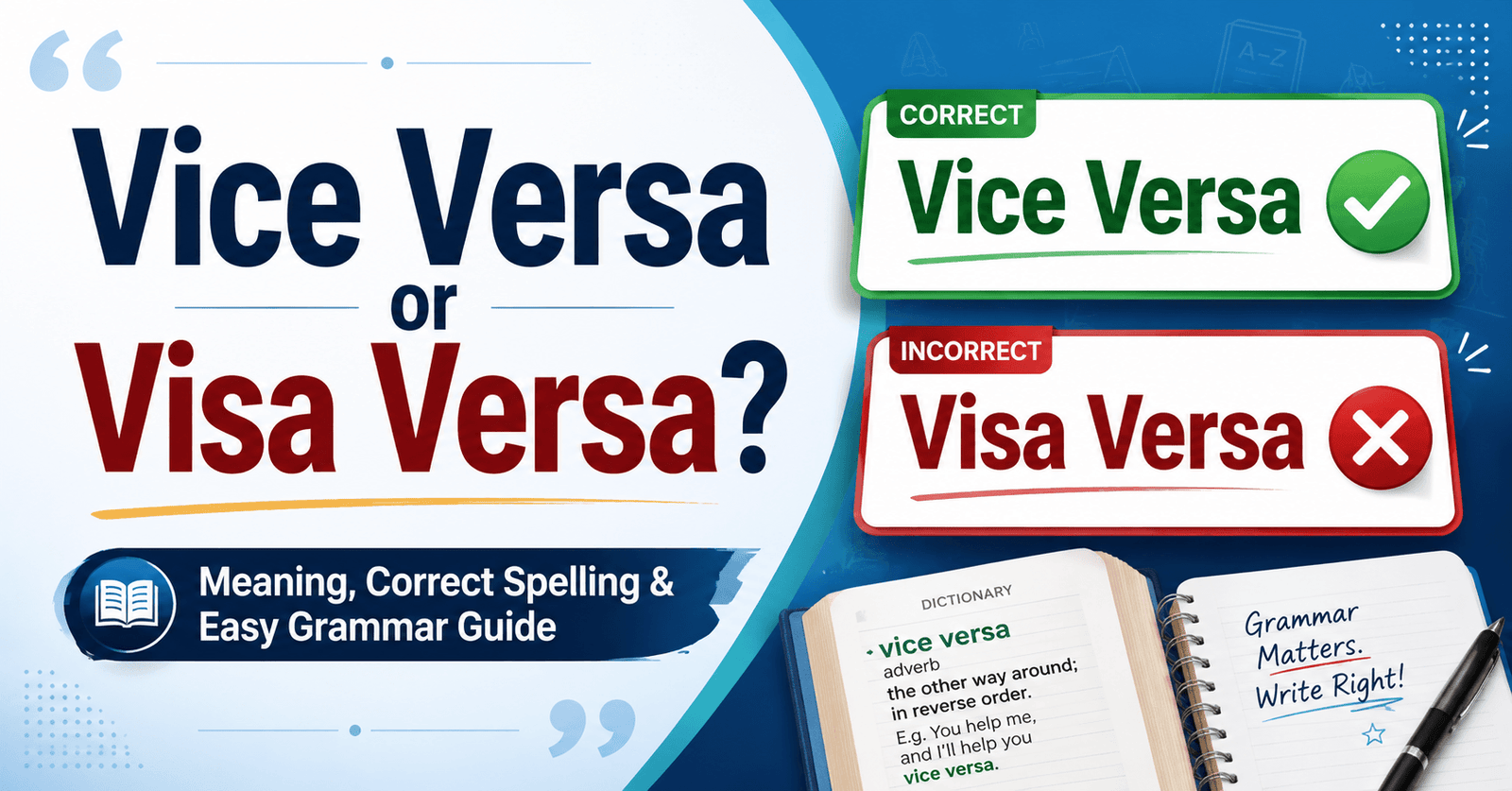
When readers ask is it vice versa or visa versa, they want the correct spelling fast: Vice Versa is right, and Visa Versa is wrong.
The meaning is simple. Vice versa meaning points to a reverse meaning or reciprocal meaning. In plain English, it means the other way around. I’ve corrected this common mistake in emails, text, social media, and business writing, where one spelling error can weaken a professional message and hurt credibility.
Use this Latin phrase only when the idea can flip both ways. For correct usage, write natural lines like, “Teachers help students, and vice versa.” Avoid visa versa mistake, vis-à-vis confusion, and poor word choice by checking the phrase meaning, grammar, and sentence structure before you send. This gives your writing more clarity, better tone, stronger communication skills, and safer professional writing for daily use too.
Quick Answer: Is It Vice Versa or Visa Versa?
The correct spelling is vice versa.
The incorrect spelling is visa versa.
| Phrase | Correct? | Meaning |
| Vice versa | Yes | The reverse is also true |
| Visa versa | No | A common misspelling |
| The other way around | Yes | A simpler alternative |
| Conversely | Yes | A more formal alternative |
Here’s a simple example:
Correct:
Parents can teach children, and vice versa.
This means parents can teach children, and children can also teach parents.
Incorrect:
Parents can teach children, and visa versa.
That spelling doesn’t work because visa refers to travel permission, not reversal.
A useful rule is this: use vice versa when two things can switch places, roles, directions, or effects.
What Does Vice Versa Mean?
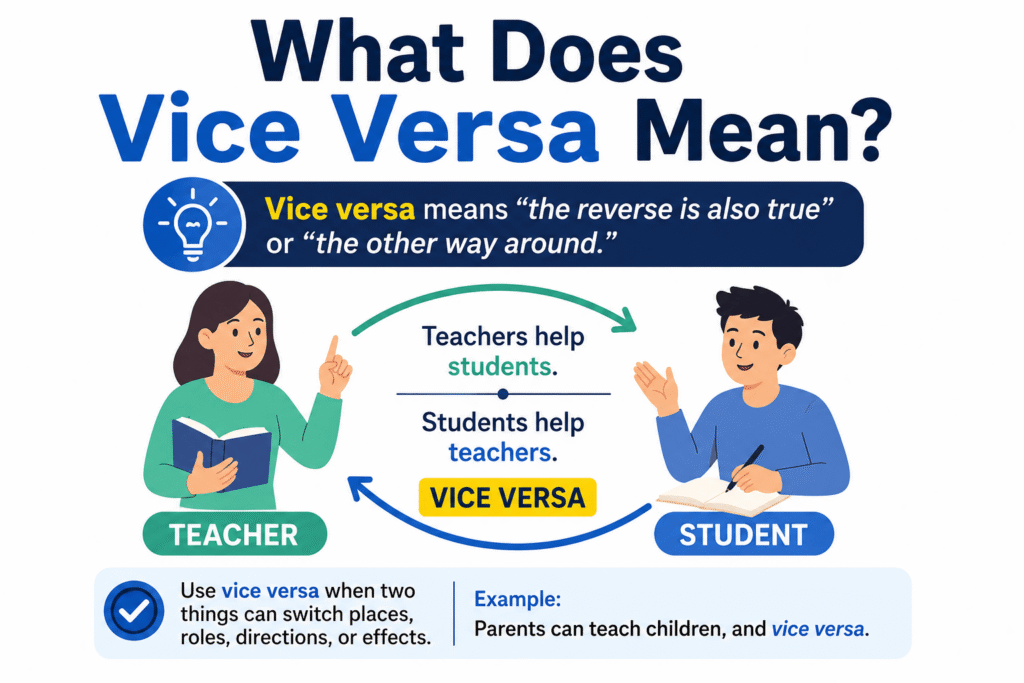
Vice versa means “the reverse is also true.”
It can also mean:
- the other way around
- in reverse order
- with the relationship reversed
- the same applies in the opposite direction
- the opposite arrangement is also correct
Think of it like a two-way street. If cars can travel from City A to City B, and cars can also travel from City B to City A, you can say:
You can drive from City A to City B, or vice versa.
The phrase saves you from repeating the same idea twice. Instead of writing a long sentence, you can use vice versa to keep it sharp.
Compare these two sentences:
Long version:
Teachers can influence students, and students can influence teachers.
Shorter version:
Teachers can influence students, and vice versa.
Both sentences mean the same thing. The second one sounds cleaner because vice versa carries the reverse idea.
Read this also: nk Meaning in Text: What NK Means and How to Use It
Definition of Vice Versa in Simple Words
In simple terms, vice versa means:
“The same thing is true when the two parts are switched.”
Here’s an easy way to understand it.
If you say:
Good communication builds trust, and vice versa.
You mean:
Good communication builds trust, and trust also builds good communication.
That’s the whole idea. Vice versa takes the first relationship and flips it.
Why Visa Versa Is Incorrect
Visa versa is incorrect because visa and vice are different words with different meanings.
A visa is an official document or permission that lets someone enter, stay in, or leave a country. For example:
- a student visa
- a tourist visa
- a work visa
- a travel visa
On the other hand, vice versa has nothing to do with travel. It refers to a reversed relationship.
Here’s the difference:
| Word or Phrase | Meaning | Example |
| Visa | Travel permission | She applied for a student visa. |
| Vice versa | The reverse is also true | Dogs may chase cats, and vice versa. |
So, unless you’re talking about immigration, airports, passports, or travel documents, visa probably isn’t the word you need.
The phrase should always be written as vice versa, never visa versa.
Why Do People Write Visa Versa?
People write “visa versa” because they usually hear the phrase before they see it.
That’s normal. English has plenty of phrases that sound different from how they look. Since vice versa comes from Latin, it doesn’t follow the spelling patterns many English speakers expect.
Here are the main reasons for the mistake:
- The phrase sounds fast in speech. When people say it quickly, “vice” can sound like “visa.”
- Visa is a familiar English word. Many people know the word from travel, so the brain grabs the familiar spelling.
- Vice versa looks foreign. The phrase doesn’t look like a typical English expression.
- People rarely study the phrase directly. They learn it from conversation, not grammar books.
- Autocorrect may not always help. Some tools won’t flag “visa versa” if both words appear real enough.
This mistake is understandable. Still, in polished writing, visa versa looks wrong.
Where Does Vice Versa Come From?
Vice versa comes from Latin. English borrowed the phrase long ago, and it stayed because it does a useful job.
The phrase carries the idea of a position or relationship being turned around. That’s why it works so well when two things switch places.
English has many Latin expressions that still appear in modern writing. Some are formal. Others have become common. Vice versa sits somewhere in the middle. You can use it in casual conversation, business writing, academic essays, and everyday emails.
Other Latin-based phrases you may know include:
- et cetera — and other things
- per se — by itself
- ad hoc — for a specific purpose
- bona fide — genuine
- status quo — the existing state of things
Unlike some Latin phrases, vice versa doesn’t sound too stiff when used correctly. It’s short, useful, and widely understood.
How to Pronounce Vice Versa
In American English, vice versa is commonly pronounced like:
VY-suh VUR-suh
Some speakers pronounce the first word closer to vice, like the word in vice president. Others say it more smoothly, so it almost sounds like vī-suh.
That’s exactly why people confuse vice versa with visa versa.
The safest pronunciation tip is this:
Say vice like the word vice in vice president, then say versa like VUR-suh.
Try it slowly:
Vice ver-sa.
Then say it naturally:
Vice versa.
Even if your pronunciation sounds close to “visa versa,” your spelling should still be vice versa.
How to Use Vice Versa in a Sentence
Use vice versa when the reverse meaning is clear.
The basic pattern looks like this:
A relates to B, and vice versa.
That means:
A relates to B, and B relates to A.
Here are some clean examples:
- Teachers influence students, and vice versa.
- Good leaders support their teams, and vice versa.
- You can convert dollars to euros, or vice versa.
- Stress can affect sleep, and vice versa.
- The phone can connect to the laptop, or vice versa.
In each sentence, two things can switch places. That’s the key.
If the reverse meaning doesn’t make sense, don’t use vice versa.
For example:
I drank coffee, and vice versa.
That sentence fails because coffee didn’t drink you. Unless you’re writing a weird cartoon, the reverse idea doesn’t work.
Grammar Rule: Use Vice Versa Only With a Logical Reverse
The most important grammar rule is simple:
Only use vice versa when the opposite relationship makes sense.
Let’s test it.
Works:
Employees should respect managers, and vice versa.
Meaning: managers should also respect employees.
Doesn’t work:
Employees attended the meeting, and vice versa.
Meaning: the meeting attended the employees? That makes no sense.
A quick test helps:
Ask yourself, “Can I flip the two parts and still have a meaningful sentence?”
If yes, vice versa may work.
If no, choose a different phrase.
Vice Versa vs The Other Way Around
Vice versa and the other way around often mean the same thing, but they don’t always feel the same.
| Phrase | Tone | Best Use |
| Vice versa | Polished, concise | Essays, reports, emails, clear comparisons |
| The other way around | Casual, plain | Everyday speech, simple explanations |
| Conversely | Formal, analytical | Academic or professional contrast |
| In reverse | Practical, directional | Steps, process, order, movement |
Here’s a comparison:
Vice versa:
You can move the meeting from Monday to Friday, or vice versa.
The other way around:
You can move the meeting from Monday to Friday, or the other way around.
Both work. However, vice versa sounds shorter and more polished.
For readers who want quick clarity, the other way around may sound friendlier. For concise professional writing, vice versa often works better.
Is Vice Versa Formal or Informal?
Vice versa works in both formal and informal English.
You can use it in:
- essays
- business emails
- academic writing
- reports
- workplace messages
- casual conversations
- instructions
- technical explanations
Here are examples by tone:
Casual:
I can visit you, or vice versa.
Professional:
The sales team shares customer insights with marketing, and vice versa.
Academic:
Language influences culture, and vice versa.
The phrase isn’t slang. It also isn’t too fancy for normal writing. Still, don’t overuse it. If every other paragraph says vice versa, the phrase starts to feel like a squeaky door.
Is Vice Versa One Word or Two?
Vice versa is always written as two words.
Correct:
- vice versa
Incorrect:
- viceversa
- vice-versa
- visa versa
- vica versa
- vise versa
Some people add a hyphen because the words feel connected. However, the standard spelling is vice versa with a space and no hyphen.
Should You Use a Comma Before Vice Versa?
You often use a comma before vice versa, especially when it appears at the end of a sentence.
Examples:
- Managers should listen to employees, and vice versa.
- You can send the file to me, or vice versa.
- Healthy sleep supports mental focus, and vice versa.
The comma helps the sentence breathe.
However, punctuation depends on sentence structure. In most everyday writing, the pattern “, and vice versa” or “, or vice versa” looks natural.
A simple rule works well:
If vice versa comes after a full idea, use a comma before it.
Can You Start a Sentence With Vice Versa?
You can start a sentence with vice versa, but it usually sounds awkward.
For example:
Vice versa, children can teach parents.
That sentence feels stiff because readers need the original relationship first. Vice versa works best after you explain the first part.
Better:
Parents can teach children, and vice versa.
Or:
Children can teach parents, too.
In most cases, place vice versa after the first idea. That way, readers know what relationship you’re reversing.
Key Differences Between Vice Versa and Visa Versa
The difference is not subtle. One is correct. The other is a mistake.
| Feature | Vice Versa | Visa Versa |
| Correct spelling | Yes | No |
| Meaning | The reverse is also true | No accepted meaning |
| Word origin | Latin | Mistaken form |
| Common in English | Yes | No |
| Suitable for formal writing | Yes | No |
| Related to travel | No | “Visa” is travel-related |
| Example | Trust builds loyalty, and vice versa. | Incorrect spelling |
The clean takeaway: Use vice versa when you mean the reverse. Use visa only when you mean travel permission.
Real-Life Examples of Vice Versa
Examples help more than definitions. So, let’s look at how vice versa works in real situations.
Vice Versa in Everyday Conversation
- I can call you tonight, or vice versa.
- She visits her brother often, and vice versa.
- You can help me with math, and I can help you with English — vice versa in action.
In daily speech, the phrase helps avoid repetition. It keeps the sentence short without losing meaning.
Vice Versa in Emails
- You can send the signed form to me, or vice versa if that’s easier.
- Our team can share the report with your department, and vice versa.
- I’m happy to review your draft, and vice versa whenever needed.
In emails, vice versa sounds professional but not cold.
Vice Versa in Business Writing
- Marketing should share campaign results with sales, and vice versa.
- Customer feedback can shape product decisions, and vice versa.
- Strong internal communication improves project delivery, and vice versa.
Business writing often involves two-way relationships. That makes vice versa useful.
Vice Versa in Academic Writing
- Economic policy can influence public behavior, and vice versa.
- Language shapes identity, and vice versa.
- Technology affects social habits, and vice versa.
In academic writing, the phrase can express reciprocal influence clearly.
Vice Versa in Technology
- The software converts Word files to PDFs and vice versa.
- Data can move from the phone to the computer, or vice versa.
- The app syncs desktop changes to mobile devices and vice versa.
Technology examples often involve conversions, syncing, and two-way transfers.
Vice Versa in Travel
- The train runs from Chicago to Detroit, and vice versa.
- You can fly from New York to London, or vice versa.
- The shuttle takes passengers from the hotel to the airport and vice versa.
Notice something funny here: travel examples may use vice versa, but the spelling still isn’t visa versa.
Common Mistakes With Vice Versa
Even when people know the correct spelling, they may still use the phrase incorrectly. Here are the mistakes to avoid.
Mistake: Writing Visa Versa
Incorrect:
Students can learn from teachers, and visa versa.
Correct:
Students can learn from teachers, and vice versa.
This is the most common mistake. Remember, visa belongs to passports and travel.
Mistake: Writing Viceversa as One Word
Incorrect:
Trust improves teamwork and viceversa.
Correct:
Trust improves teamwork, and vice versa.
Always use two words.
Mistake: Using Vice Versa Without a Reverse Meaning
Incorrect:
I ordered pizza, and vice versa.
Correct:
I ordered pizza.
There’s no reverse action here. Pizza didn’t order you.
Mistake: Using Vice Versa With “Each Other”
Clunky:
The two companies support each other, and vice versa.
Better:
The two companies support each other.
The phrase each other already means the relationship goes both ways. Adding vice versa repeats the idea.
Mistake: Using Vice Versa Too Often
Weak writing:
The team helps the manager, and vice versa. The client updates the agency, and vice versa. The designer guides the writer, and vice versa.
Better writing:
The team and manager help each other. The client and agency exchange updates. The designer and writer guide the project together.
Variety matters. Use vice versa when it earns its place.
Memory Tricks to Remember Vice Versa
Spelling gets easier when you connect the phrase to something memorable.
Think “Reverse,” Not “Travel”
Vice versa means a relationship reverses.
Visa means travel permission.
So ask yourself:
Am I talking about reversal or travel?
If it’s reversal, write vice versa.
Remember Vice President
The word vice appears in vice president. A vice president can stand in another position or take over a role.
That role-switching idea can help you remember vice versa.
Pair Vice With Versa
Both words in vice versa start with v sounds. Think of them as a matched pair.
Vice + versa = reverse relationship.
Use This Mini Sentence
Memorize this:
“A visa is for travel. Vice versa is for reversal.”
It’s simple. It sticks.
Synonyms for Vice Versa
Sometimes vice versa fits perfectly. Other times, a simpler phrase sounds better.
Here are useful alternatives:
| Synonym or Alternative | Best Use | Example |
| The other way around | Casual clarity | It works the other way around, too. |
| Conversely | Formal contrast | Conversely, lower demand can reduce prices. |
| In reverse | Order or direction | Repeat the steps in reverse. |
| Reciprocally | Mutual action | The two systems interact reciprocally. |
| Mutually | Shared relationship | The benefits are mutually reinforcing. |
| The reverse is also true | Clear explanation | The reverse is also true in this case. |
| Likewise | Similar effect | Likewise, managers need feedback from staff. |
Choose the phrase that matches your tone.
If you want clarity, use the other way around.
If you want a polished, concise phrase, use vice versa.
If you want a more academic tone, use conversely or reciprocally.
Related Words and Phrases
These words often appear near vice versa because they deal with reversal, contrast, or mutual action.
Reverse
Reverse means to turn something around.
Example:
Reverse the order of the names.
Opposite
Opposite means completely different or facing the other way.
Example:
They took opposite sides in the debate.
Mutual
Mutual means shared by two or more sides.
Example:
Their respect was mutual.
Reciprocal
Reciprocal means given, felt, or done in return.
Example:
They had a reciprocal agreement.
Conversely
Conversely introduces an opposite or contrasting idea.
Example:
High prices may reduce demand. Conversely, low prices may increase it.
These words don’t always replace vice versa, but they live in the same neighborhood.
Mini Case Studies: How Vice Versa Changes Meaning
A small phrase can change how readers understand a sentence. These examples show why vice versa needs a clear two-way relationship.
Case Study: Workplace Communication
Sentence:
Managers need honest feedback from employees, and vice versa.
Meaning:
Employees also need honest feedback from managers.
Why it works:
The relationship can move both ways. Both sides give and receive feedback.
Case Study: File Conversion
Sentence:
The tool converts images to PDFs and vice versa.
Meaning:
The tool can also convert PDFs to images.
Why it works:
The two items can switch roles in the conversion process.
Case Study: Bad Usage
Sentence:
The office opens at nine, and vice versa.
Meaning:
There’s no logical reverse. Nine doesn’t open the office.
Better sentence:
The office opens at nine.
Why it fails:
No two-way relationship exists.
Practice: Choose the Right Phrase
Try these quick examples.
| Sentence | Best Choice | Why |
| You can transfer money from savings to checking, or ____. | vice versa | Money can move both ways |
| She applied for a travel ____. | visa | This refers to travel permission |
| The teacher helps the student, and ____. | vice versa | The student can also help the teacher |
| I ate lunch, and ____. | Not vice versa | Lunch didn’t eat you |
| The app syncs phone data to the laptop and ____. | vice versa | Syncing can happen both ways |
This quick test shows the difference clearly. Vice versa needs a reversible relationship. Visa belongs to travel.
See this also: OK Meaning in Text: What Does OK Mean in Texting and Social Media?
FAQs About Vice Versa or Visa Versa
The correct phrase is vice versa. The spelling visa versa is incorrect. Use vice versa when you mean “the other way around” or “the reverse is also true.”
Vice versa means the same idea also works in reverse. For example, parents can teach children, and vice versa means children can also teach parents.
No. Visa versa is not the correct English phrase. It’s a common misspelling caused by the way vice versa sounds in speech.
People often say or write visa versa because vice versa can sound like it in fast speech. Also, visa is a familiar English word, so the mistake feels natural.
Vice versa works in both formal and informal writing. You can use it in essays, emails, reports, and everyday conversations.
Yes, you can use vice versa in an essay. Just make sure the sentence has a clear reverse relationship. If the reverse meaning isn’t obvious, rewrite the sentence.
Yes. Vice versa comes from Latin. English still uses it because it expresses a reversed relationship in a short, useful way.
No. Vice versa is two words. Don’t write it as viceversa, vice-versa, or visa versa.
No. American English and British English both use vice versa. The spelling doesn’t change by region.
You can say the other way around, the reverse is also true, conversely, in reverse, mutually, or reciprocally. The best choice depends on the sentence.
Yes. In many sentences, vice versa means the relationship works both ways. For example, trust improves communication, and vice versa means trust improves communication, and communication also improves trust.
Usually, yes. A comma often appears before vice versa, especially in sentences like: Employees should respect managers, and vice versa.
Conclusion: Vice Versa Is Correct, Visa Versa Is Not
The correct answer to “is it vice versa or visa versa?” is simple: write vice versa.
Vice versa means “the reverse is also true” or “the other way around.” It’s useful when two things can switch places, roles, directions, or effects. You can use it in everyday speech, professional emails, academic writing, technology explanations, and business communication.
However, visa versa is not correct. A visa is a travel document. It has nothing to do with reversal unless you’re making a passport joke.
Here’s the easiest way to remember it:
A visa is for travel. Vice versa is for reversal.
So next time the phrase pops into your head, don’t second-guess it. Write vice versa, keep your sentence clear, and move on like a grammar pro.