

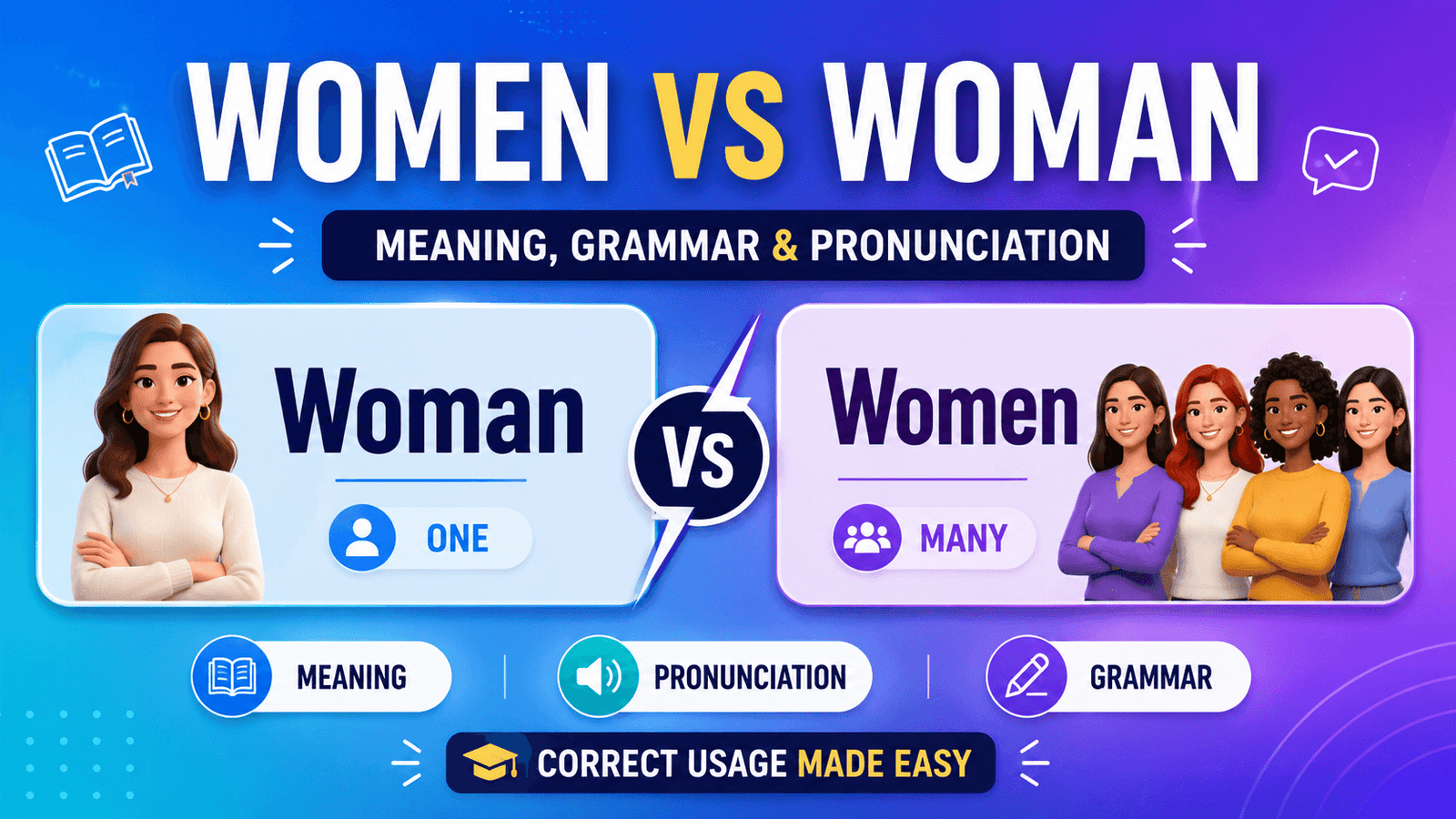
women vs woman is easy to understand when you link the word to number: woman means one, and women means many.
The core difference is that woman is a singular noun for one female, one adult female, or one female person. Women is the plural form for more than one female, more than one person, or a group. The plural of woman is women, not womans, because it is an irregular plural with a vowel change.
In real English usage, this rule improves grammar accuracy, sentence clarity, and credibility in writing. Say woman like wo-man and women like wim-in. I often see this common mistake in emails, business communication, formal writing, meetings, quick notes, and project management updates.
Use this memory tip: O means One, and E can remind you of Eleven or many. So write “a woman,” not “a women,” and “many women,” not “many woman.”
Quick Answer: Women vs Woman
The quick answer is simple:
| Word | Meaning | Number | Example |
| woman | one adult female person | singular | A woman entered the room. |
| women | more than one adult female person | plural | Three women entered the room. |
Use woman when you are talking about one person.
Use women when you are talking about two or more people.
Here is the easiest rule:
Woman = one
Women = more than one
So, if your sentence means only one adult female person, use woman. If your sentence means a group, use women.
What Does Woman Mean?
Woman is a singular noun. It refers to one adult female person.
For example:
- She is a kind woman.
- That woman is my teacher.
- One woman asked a question.
- A woman was waiting outside.
The word woman is used when the sentence is about one person only. It often comes after singular words such as a, one, this, that, each, or every.
Common Words Used with Woman
| Singular marker | Correct phrase |
| a | a woman |
| one | one woman |
| this | this woman |
| that | that woman |
| each | each woman |
| every | every woman |
| another | another woman |
These words all point to one person. Therefore, they need the singular form woman.
Examples of Woman in Sentences
- A woman called the office this morning.
- The woman beside me was very polite.
- This woman works as a lawyer.
- Every woman in the room had a chance to speak.
- One woman stayed after the meeting.
- She became the first woman to lead the department.
- A young woman helped the child cross the street.
In each sentence, woman refers to only one adult female person.
What Does Women Mean?
Women is the plural form of woman. It refers to two or more adult female people.
For example:
- Many women attended the event.
- These women are doctors.
- Two women were standing near the entrance.
- The company supports women in leadership.
Use women when the sentence talks about a group, a category, or more than one person.
Common Words Used with Women
| Plural marker | Correct phrase |
| two | two women |
| many | many women |
| several | several women |
| these | these women |
| those | those women |
| all | all women |
| some | some women |
| few | few women |
These words point to more than one person. Therefore, they need the plural form women.
Examples of Women in Sentences
- Many women joined the training program.
- These women are engineers.
- Several women spoke during the conference.
- The women in the office organized the event.
- Two women were selected for the award.
- Women play an important role in every profession.
- The campaign supports women entrepreneurs.
In each sentence, women refers to more than one adult female person.
Women vs Woman: Key Difference
The main difference between women vs woman is number.
Woman is singular.
Women is plural.
That means the choice depends on whether you are talking about one person or more than one person.
| Point of difference | Woman | Women |
| Number | Singular | Plural |
| Meaning | One adult female person | More than one adult female person |
| Used with | a, one, this, that, each, every | two, many, these, those, several, all |
| Verb form | singular verb | plural verb |
| Example | The woman is here. | The women are here. |
| Possessive form | woman’s | women’s |
Here is a simple comparison:
- Correct: A woman is speaking.
- Correct: The women are speaking.
The noun changes from singular to plural. The verb also changes from is to are.
That is why you must pay attention to the full sentence, not just the word itself.
Woman vs Women Pronunciation
Pronunciation is one of the biggest reasons people confuse woman and women.
The spelling changes only slightly, but the pronunciation changes more clearly.
| Word | Simple pronunciation | Meaning |
| woman | WUH-muhn | one adult female person |
| women | WI-min | more than one adult female person |
The first syllable is different.
Woman sounds like wuh-muhn.
Women sounds like wi-min.
The second syllable is also light and unstressed in both words. So the clearest difference is usually in the first vowel sound.
Pronunciation Examples
Say these sentences aloud:
- The woman is here.
- The women are here.
Now compare:
- One woman came early.
- Three women came early.
When speaking, the difference may feel small at first. However, with practice, it becomes easier to hear and say.
A useful speaking tip is to connect the word with its number:
- one woman
- many women
This helps your brain remember both the meaning and the sound.
Grammar Rules for Woman and Women
To use woman and women correctly, you need to understand how they work in a sentence.
The word you choose affects articles, determiners, verbs, and possessive forms.
Use Woman with Singular Verbs
Because woman is singular, it usually takes a singular verb.
| Correct sentence | Why it is correct |
| The woman is waiting. | One person = singular verb |
| A woman has called. | One person = singular verb |
| This woman works hard. | One person = singular verb |
| Every woman deserves respect. | Every refers to each single person |
More examples:
- The woman is a doctor.
- A woman has the right to speak.
- That woman owns a small business.
- Each woman brings a different skill.
Notice the verbs: is, has, works, deserves, owns, and brings. These are singular verb forms.
Use Women with Plural Verbs
Because women is plural, it usually takes a plural verb.
| Correct sentence | Why it is correct |
| The women are waiting. | More than one person = plural verb |
| Many women have called. | More than one person = plural verb |
| These women work hard. | More than one person = plural verb |
| Several women deserve recognition. | More than one person = plural verb |
More examples:
- The women are doctors.
- Many women have started businesses.
- These women work in technology.
- Several women lead major teams.
- Some women prefer flexible working hours.
Notice the verbs: are, have, work, lead, and prefer. These are plural verb forms.
Use Woman with Singular Articles and Determiners
A common mistake is saying a women. This is incorrect because a means one.
The correct phrase is a woman.
| Incorrect | Correct |
| a women | a woman |
| one women | one woman |
| this women | this woman |
| that women | that woman |
| each women | each woman |
| every women | every woman |
Examples:
- Incorrect: She is a women.
- Correct: She is a woman.
- Incorrect: One women was selected.
- Correct: One woman was selected.
- Incorrect: This women is my manager.
- Correct: This woman is my manager.
The rule is simple: when the sentence points to one person, use woman.
Use Women with Plural Numbers and Determiners
Another common mistake is saying many woman or these woman. These are incorrect because many and these are plural.
The correct forms are many women and these women.
| Incorrect | Correct |
| two woman | two women |
| many woman | many women |
| several woman | several women |
| these woman | these women |
| those woman | those women |
| all woman | all women |
Examples:
- Incorrect: Many woman joined the class.
- Correct: Many women joined the class.
- Incorrect: These woman are talented.
- Correct: These women are talented.
- Incorrect: I met three woman yesterday.
- Correct: I met three women yesterday.
If the sentence means more than one, use women.
Woman’s vs Women’s
The possessive forms are also important.
Woman’s means something belongs to one woman.
Women’s means something belongs to more than one woman or to women as a group.
| Possessive form | Meaning | Example |
| woman’s | belonging to one woman | The woman’s bag is black. |
| women’s | belonging to more than one woman | The women’s team won. |
| women’s | related to women as a group | Women’s health is important. |
Examples of Woman’s
- The woman’s phone was on the table.
- A woman’s voice came from the hallway.
- The woman’s idea helped the team.
- That woman’s story was inspiring.
In these examples, the thing belongs to one specific woman.
Examples of Women’s
- The women’s team won the final.
- Women’s rights are human rights.
- The clinic focuses on women’s health.
- The company launched a women’s leadership program.
In these examples, women’s refers to a group or category.
Important Note About Women’s
The word women is already plural. So you do not write womens as a standard possessive form.
Correct: women’s health
Incorrect: womens health
Correct: women’s rights
Incorrect: womens rights
The apostrophe matters because it shows possession or association.
Common Mistakes with Woman and Women
Mistakes with woman vs women usually happen because the writer focuses on the noun but ignores the words around it.
Here are the most common errors and how to fix them.
Mistake: A Women
Incorrect:
- She is a women.
- I saw a women at the gate.
- He spoke to a women from the company.
Correct:
- She is a woman.
- I saw a woman at the gate.
- He spoke to a woman from the company.
Why?
The article a means one. So the noun must be singular: woman.
Mistake: Many Woman
Incorrect:
- Many woman attended the seminar.
- Many woman work in healthcare.
- The program helped many woman.
Correct:
- Many women attended the seminar.
- Many women work in healthcare.
- The program helped many women.
Why?
Many means more than one. So the noun must be plural: women.
Mistake: These Woman
Incorrect:
- These woman are my colleagues.
- These woman run successful businesses.
- I respect these woman.
Correct:
- These women are my colleagues.
- These women run successful businesses.
- I respect these women.
Why?
These is plural. It must be followed by a plural noun.
Mistake: One of the Woman
Incorrect:
- One of the woman spoke first.
- One of the woman in the group asked a question.
Correct:
- One of the women spoke first.
- One of the women in the group asked a question.
Why?
The phrase one of the means one person from a larger group. The group must be plural.
So the correct phrase is one of the women.
Other examples:
- One of the students answered.
- One of the teachers arrived early.
- One of the women gave a presentation.
Mistake: Women Is
Incorrect:
- The women is waiting.
- These women is ready.
- Many women is working.
Correct:
- The women are waiting.
- These women are ready.
- Many women are working.
Why?
Women is plural. It needs a plural verb such as are, have, work, or do.
Mistake: Woman Are
Incorrect:
- The woman are waiting.
- A woman are speaking.
- This woman are ready.
Correct:
- The woman is waiting.
- A woman is speaking.
- This woman is ready.
Why?
Woman is singular. It needs a singular verb such as is, has, works, or does.
Correct Usage in Real-Life Examples
Understanding women vs woman becomes easier when you see how the words appear in real contexts.
In Professional Writing
Correct:
- The company hired a woman as its new director.
- The company supports women in leadership.
- Several women applied for senior roles.
- A woman from the finance team presented the report.
Why it matters:
Professional writing should be clear and accurate. A mistake like “a women” can make an email, report, or resume look unpolished.
In Academic Writing
Correct:
- The study included 150 women between the ages of 25 and 40.
- One woman from each group was interviewed.
- The research focused on women’s access to education.
- Each woman completed a written survey.
Why it matters:
Academic writing depends on precision. Singular and plural nouns can affect the meaning of research findings.
For example, one woman and 150 women clearly describe different sample sizes.
In Social Media Captions
Correct:
- Celebrating women’s achievements today and every day.
- She is a woman with courage and vision.
- These women are changing the future.
- Honoring the women who inspire us.
Why it matters:
Social media posts are public. Grammar mistakes are easy to notice and share. Correct usage helps your message look more credible.
In Job Applications and Resumes
Correct:
- Organized a mentorship program for women in technology.
- Collaborated with a woman founder on a startup project.
- Supported women’s career development through training.
- Interviewed several women leaders for a research project.
Why it matters:
A resume or cover letter should show attention to detail. Grammar mistakes can weaken your professional impression.
In Everyday Conversation
Correct:
- A woman asked me for directions.
- Two women were sitting near us.
- That woman is my neighbor.
- Those women work at the hospital.
Why it matters:
Even in casual speech, correct usage helps your English sound natural and fluent.
Woman or Women in Common Phrases
Some phrases use woman, while others use women or women’s. Learning these common phrases can help you write more naturally.
| Phrase | Correct form | Why |
| women’s rights | women’s | Refers to rights of women as a group |
| women’s health | women’s | Refers to health issues related to women |
| women in business | women | Refers to more than one woman or women as a group |
| women in leadership | women | Refers to women as a group |
| a woman’s choice | woman’s | Refers to one woman or an individual choice |
| one-woman show | woman | Refers to one person |
| businesswoman | woman | Singular compound noun |
| businesswomen | women | Plural compound noun |
| spokeswoman | woman | One female spokesperson |
| spokeswomen | women | More than one female spokesperson |
Examples in Sentences
- Women’s health is an important public issue.
- The event focused on women in business.
- She performed a one-woman show.
- Several businesswomen attended the conference.
- A businesswoman opened the meeting.
- The article discussed women’s rights around the world.
These phrases are common in news, business, education, and everyday English.
Synonyms for Woman
A synonym is a word with a similar meaning. However, not every synonym works in every context.
The word woman is the most neutral and standard term for one adult female person.
| Synonym | Best use | Note |
| female | formal, biological, statistical, or descriptive contexts | Can sound impersonal if used as a noun |
| lady | polite or traditional contexts | Sometimes formal or old-fashioned |
| adult female | technical or explanatory contexts | Clear but less conversational |
| girl | young female person | Not usually correct for an adult |
| businesswoman | work or business context | Refers to a woman in business |
| spokeswoman | media or representative context | Refers to one female spokesperson |
Important Usage Note
Use woman when referring respectfully to an adult female person.
Use girl for a child or young female person. In professional or adult contexts, calling an adult woman a girl may sound disrespectful or too casual.
For example:
- Better: She is a successful woman.
- Too casual in formal writing: She is a successful girl.
Synonyms for Women
The word women is the standard plural form. It is clear, respectful, and widely used.
| Synonym or related term | Best use | Note |
| females | scientific, statistical, or biological contexts | Can sound impersonal in social contexts |
| ladies | polite or informal contexts | Can sound old-fashioned depending on context |
| adult females | technical or explanatory contexts | Clear but formal |
| girls | children or young female people | Not usually correct for adult women |
| businesswomen | professional context | Women in business |
| spokeswomen | media or representative context | More than one female spokesperson |
Example Differences
- Neutral: Many women attended the event.
- Formal/statistical: The survey included 500 adult females.
- Professional: Several businesswomen joined the panel.
- Informal: The ladies met for lunch.
In most situations, women is the safest and clearest choice.
Related Words and Forms
The words woman and women appear in several related forms.
| Word | Meaning | Example |
| woman | one adult female person | A woman arrived. |
| women | more than one adult female person | Three women arrived. |
| woman’s | belonging to one woman | The woman’s coat is red. |
| women’s | belonging to women | The women’s room is upstairs. |
| womanhood | the state or experience of being a woman | The book explores womanhood. |
| womanly | traditionally associated with women | She showed womanly grace. |
| businesswoman | one woman in business | She is a businesswoman. |
| businesswomen | women in business | Many businesswomen attended. |
These related words help you understand how the singular and plural forms work in larger vocabulary patterns.
How to Choose Between Woman and Women
When you are not sure which word to use, ask one simple question:
Am I talking about one adult female person or more than one?
If the answer is one, use woman.
If the answer is more than one, use women.
Decision Table
| Sentence idea | Correct word | Example |
| One person | woman | A woman entered the room. |
| Two people | women | Two women entered the room. |
| A group | women | The women entered the room. |
| A general category | women | Women in science need equal opportunities. |
| One person’s possession | woman’s | The woman’s name was on the list. |
| Group possession/category | women’s | Women’s education matters. |
This table works for most common situations.
Memory Tricks for Women vs Woman
Here are simple ways to remember the difference.
Woman Means One
The word woman refers to one person.
Think:
- one woman
- a woman
- this woman
- that woman
If the sentence points to one person, choose woman.
Women Means More Than One
The word women refers to more than one person.
Think:
- two women
- many women
- these women
- those women
If the sentence points to a group, choose women.
Use the “A Test”
If the word a comes before it, the answer is almost always woman.
Correct:
- a woman
Incorrect:
- a women
Why?
Because a means one.
Use the “Many Test”
If the word many comes before it, the answer is women.
Correct:
- many women
Incorrect:
- many woman
Why?
Because many means more than one.
Use the Verb Test
Look at the verb.
- Woman is
- Women are
Examples:
- The woman is ready.
- The women are ready.
This trick helps when the noun is connected to a verb.
Practice Section: Woman or Women?
Choose the correct word.
| Sentence | Answer |
| A _____ was waiting outside. | woman |
| These _____ are engineers. | women |
| Every _____ deserves respect. | woman |
| Many _____ joined the event. | women |
| One of the _____ answered the question. | women |
| That _____ is my aunt. | woman |
| Several _____ applied for the job. | women |
| The _____ is speaking now. | woman |
| The _____ are speaking now. | women |
| This _____ owns a bakery. | woman |
Practice Explanation
- Use woman with a, every, that, the when the sentence means one person.
- Use women with these, many, several, or when the sentence refers to a group.
- Use women after one of the because the phrase refers to one member of a plural group.
Mini Case Study: Why One Letter Changes the Meaning
Consider these two sentences:
- A woman spoke at the conference.
- Women spoke at the conference.
The first sentence means one adult female person spoke.
The second sentence means more than one adult female person spoke, or it may refer generally to women as a group.
Now look at these:
- The woman’s speech was powerful.
- The women’s speeches were powerful.
The first sentence refers to one woman and one speech.
The second sentence refers to more than one woman and likely more than one speech.
This shows why woman vs women is not just a spelling issue. It changes the meaning, grammar, and clarity of the sentence.
Common Correct and Incorrect Examples
| Incorrect sentence | Correct sentence | Reason |
| She is a women. | She is a woman. | “A” means one. |
| I met two woman. | I met two women. | “Two” means plural. |
| These woman are leaders. | These women are leaders. | “These” is plural. |
| Every women has a story. | Every woman has a story. | “Every” treats people one by one. |
| The women is here. | The women are here. | “Women” is plural. |
| The woman are here. | The woman is here. | “Woman” is singular. |
| The womens team won. | The women’s team won. | Possessive plural needs an apostrophe. |
| One of the woman left. | One of the women left. | “One of the” refers to a plural group. |
This table covers the most frequent errors learners make.
Expert Grammar Notes
The word woman is an irregular noun because its plural is not made by simply adding -s.
Regular nouns usually form plurals like this:
- book → books
- teacher → teachers
- car → cars
But woman changes internally:
- woman → women
- man → men
This is called an irregular plural.
The vowel changes inside the word instead of adding s at the end.
That is why womans is not the correct plural form.
Correct:
- one woman
- two women
Incorrect:
- two womans
The same pattern appears in:
- man → men
- woman → women
However, the pronunciation of women is especially confusing because it sounds like wi-min, not woh-men.
FAQs
Q1: What is the difference between woman and women?
Woman means one adult female person. Women means more than one adult female person. For example, “A woman is speaking” means one person, while “Many women are speaking” means more than one person.
Q2: Is it correct to say “a women”?
No, a women is incorrect. The word a means one, so you must use the singular form woman. The correct phrase is a woman.
Q3: Why is the plural of woman women, not womans?
The plural of woman is women because it is an irregular plural noun. It does not follow the normal rule of adding s. Instead, the vowel sound changes from woman to women.
Q4: How do you pronounce woman and women?
Woman is pronounced like wo-man or wuh-muhn. Women is pronounced like wim-in. This pronunciation difference is one reason many English learners confuse the two words.
Q5: How can I remember woman vs women easily?
Use this simple memory trick: woman = one, and women = many. You can also remember: one woman, many women. This works in writing, speaking, formal English, and everyday English.
Conclusion
Understanding women vs woman becomes simple when you remember the basic rule: woman is singular, and women is plural. Use woman when you mean one adult female person, and use women when you mean more than one.
This small grammar difference can make your English clearer and more professional. It helps you avoid common mistakes like a women, many woman, or womans. Whether you are writing emails, speaking in class, preparing business content, or improving everyday English, the rule stays the same: one woman, many women.