

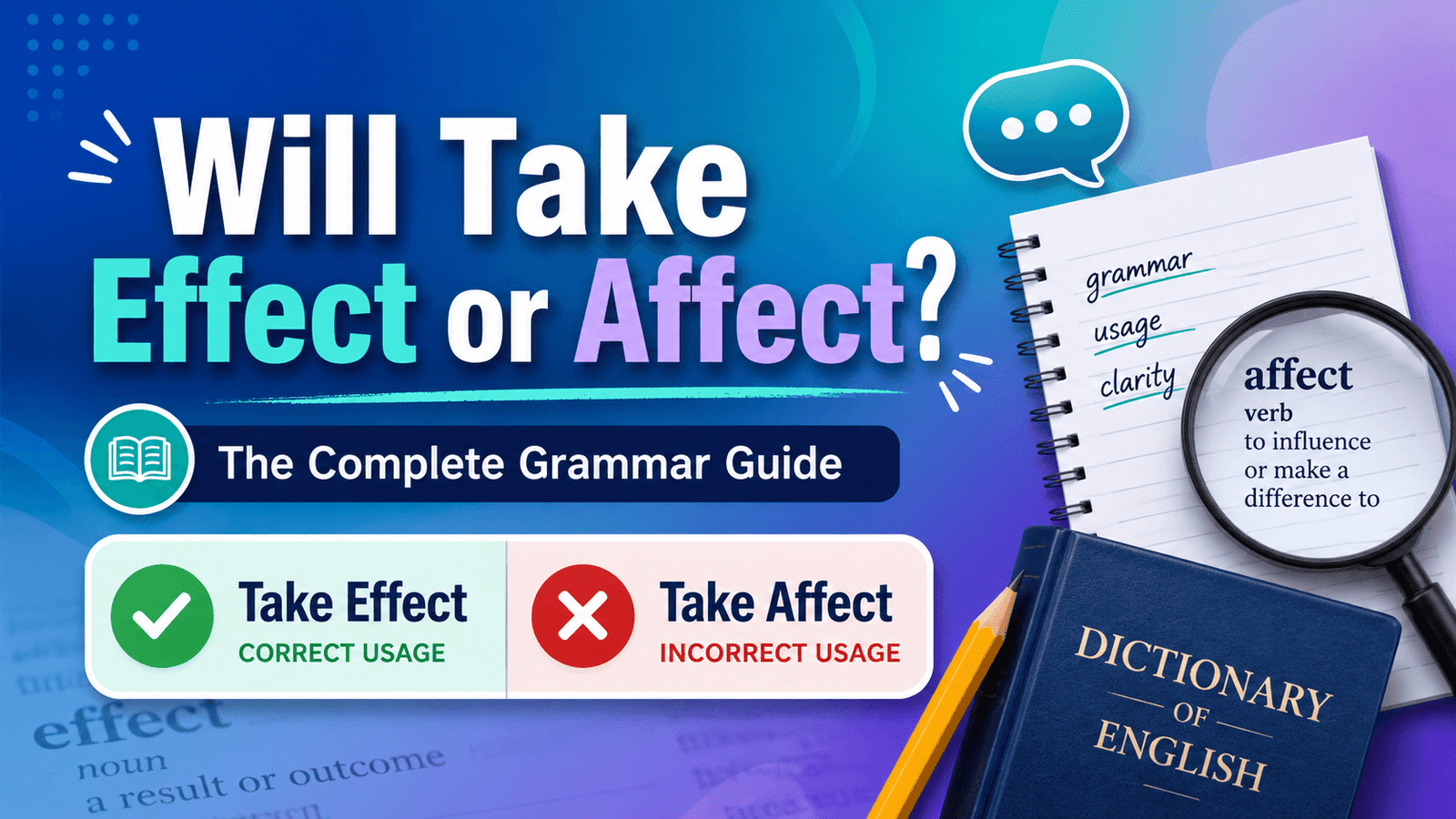
If you wonder will take effect or affect, the answer becomes simple once you know the difference. In English, affect is generally a verb, while effect is a noun. This basic guideline helps you choose the correct phrase in most situations without worry. Although the words are homophones that sound alike, their meanings and usage are different.
Think of affect as a verb, an action word that can produce an effect upon, create impact, or cause change. Effect as a noun refers to the result, results, or outcome of that action. For example, the weather affected your mood, while computers have made a huge difference in our lives. This explains why Take Effect is the right phrase, whereas Take Affect is an incorrect phrase, usually caused by a typo or spelling mistake.
Many learners, especially those whose first language is not English, find these commonly confused words difficult because their meanings overlap. From personal experience, simple memory tricks, careful writing, and reviewing grammar rules make it easier to clarify meanings, confirm proper usage, and avoid grammatically incorrect mistakes. While a few exceptions exist, this guideline keeps your English grammar clear and straight.
Will Take Effect or Affect? The Short Answer
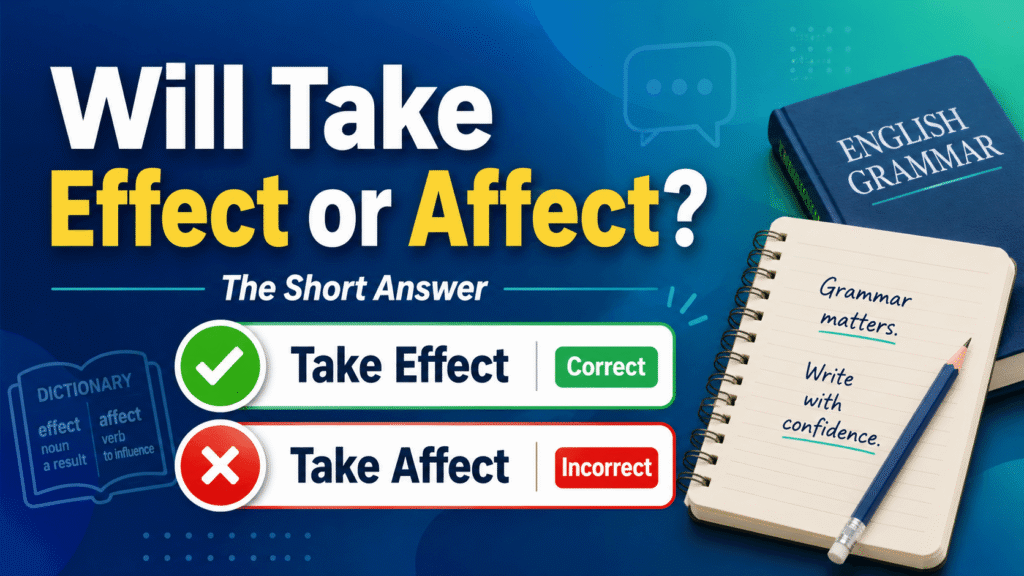
Here’s the quick answer:
✅ Correct: Will take effect
❌ Incorrect: Will take affect
The phrase take effect means to begin operating, become active, or start producing results.
Examples
- The new tax law will take effect on January 1.
- The medication will take effect within 30 minutes.
- Your insurance coverage will take effect next week.
- The updated pricing will take effect tomorrow morning.
Writing “will take affect” is incorrect because affect is normally a verb, while take effect requires the noun effect.
Quick Comparison
| Phrase | Correct? | Meaning |
| Will take effect | ✅ Yes | Will become active or start working |
| Will take affect | ❌ No | Grammatically incorrect in standard English |
If you’re ever unsure, remember this simple rule:
Things don’t “take affect.” They “take effect.”
What Does “Take Effect” Mean?
The expression take effect means to begin working, become legally valid, or start producing the intended result.
People use this phrase in both formal and everyday English. You’ll often see it in official announcements, legal documents, contracts, news articles, business communications, and medical instructions.
Think of it this way:
Before something takes effect, it exists only as a plan, rule, or promise.
After it takes effect, it becomes real and starts changing things.
For example, imagine your employer announces a new vacation policy in November. Employees know about the policy, but nothing changes immediately. Once January arrives and the policy officially starts, it has taken effect.
That’s exactly what this phrase describes.
Common Situations Where “Take Effect” Is Used
The phrase appears across many industries because it describes the moment something officially begins.
Laws and Regulations
Governments often announce legislation weeks or months before enforcement begins.
Examples include:
- New tax laws
- Traffic regulations
- Immigration rules
- Environmental standards
- Consumer protection laws
Example
The revised regulations will take effect on July 1.
The rule exists before July 1. It simply doesn’t apply until that date.
Medications and Medical Treatments
Doctors frequently explain how long medicine needs before patients notice results.
Examples include:
- Pain relievers
- Allergy medicine
- Antibiotics
- Sleeping pills
- Local anesthesia
Example
The medication should take effect within twenty minutes.
Here, take effect means the medicine begins producing its intended medical benefit.
Company Policies
Businesses regularly introduce changes that become active later.
Examples include:
- Remote work policies
- Employee benefits
- Dress codes
- Payroll adjustments
- Holiday schedules
Example
The updated attendance policy will take effect next Monday.
Employees know about the change before it begins.
Contracts and Agreements
Contracts usually specify an effective date.
Typical examples include:
- Employment agreements
- Rental contracts
- Insurance policies
- Service agreements
- Partnership contracts
Example
This agreement will take effect after both parties sign it.
Only after the stated condition is met does the agreement become legally active.
Technology and Software
Technology companies also use this phrase when introducing updates.
Examples include:
- Software patches
- Security updates
- Subscription changes
- Pricing adjustments
- New platform features
Example
The latest security update will take effect after you restart your computer.
Until the restart happens, the update hasn’t started working.
Why “Take Affect” Is Incorrect
Many people write take affect because affect and effect sound nearly identical.
They’re homophones, which means they share the same pronunciation while having different meanings and spellings.
That’s where the confusion begins.
However, the phrase take affect doesn’t work because affect usually functions as a verb, while take effect requires a noun.
Let’s look at each word separately.
Affect
Most of the time, affect means:
To influence or change something.
Examples:
- Stress can affect your sleep.
- Weather can affect road conditions.
- Exercise positively affects your health.
Notice that affect describes an action.
Effect
Effect usually means:
A result, consequence, or outcome.
Examples:
- The new policy had a positive effect.
- The medicine produced an immediate effect.
- Exercise has beneficial effects on heart health.
Since effect is a noun, it fits naturally after the verb take.
Think about similar expressions:
- take action
- take responsibility
- take control
- take ownership
- take effect
Each phrase uses take + noun.
That’s why take effect is grammatically correct.
Why This Mistake Happens So Often
Several factors make this error surprisingly common.
- Both words sound the same.
- Spellcheck may not catch the mistake because both are real words.
- Many people remember that the words are related but forget which one is the noun.
- Fast typing often leads to choosing the wrong spelling.
Fortunately, once you understand the grammar, the distinction becomes much easier to remember.
Affect vs. Effect Explained Simply
Although these words often confuse writers, their everyday uses are actually straightforward.
The easiest way to remember them is to focus on what each word does in a sentence.
Affect as a Verb
In most situations, affect is a verb.
It describes an action that influences, changes, or impacts someone or something.
Formula
Someone or something affects something else.
Examples
- Lack of sleep affects concentration.
- High temperatures affect crop production.
- Customer reviews affect purchasing decisions.
- Inflation affects household budgets.
- Good leadership affects employee morale.
In every sentence above, something is actively changing or influencing something else.
Effect as a Noun
In everyday English, effect is usually a noun.
It refers to the result that follows an action or event.
Formula
Something has an effect.
Examples
- The policy had a noticeable effect.
- The rain produced little effect on traffic.
- The campaign achieved the desired effect.
- The vaccine had minimal side effects.
- Education has a lasting effect on society.
Instead of describing an action, effect describes the outcome.
Side-by-Side Comparison
| Affect | Effect |
| Usually a verb | Usually a noun |
| Means to influence | Means a result or outcome |
| Describes an action | Describes what happens afterward |
| “The weather affects travel.” | “The weather had little effect.” |
| Used before the result | Refers to the result itself |
A Helpful Way to Think About It
Imagine dropping a stone into a calm lake.
Throwing the stone is the action.
The ripples spreading across the water are the effect.
In other words:
- Affect is what changes something.
- Effect is what happens because of that change.
Once you picture it this way, choosing the correct word becomes much easier.
The Rare Exceptions
English always has exceptions, and these words are no different.
Occasionally, effect can be a verb that means to bring about or accomplish.
Example:
The CEO hopes to effect major organizational change.
Likewise, affect can be a noun in psychology, where it refers to a person’s observable emotional expression.
Example:
The patient displayed a flat affect during the examination.
These uses are uncommon and mostly appear in specialized fields such as psychology, medicine, or formal academic writing.
For everyday communication, remember this simple guideline:
- Affect = usually a verb.
- Effect = usually a noun.
- Take effect = always the correct expression.
Quick Reference Table
| Question | Correct Answer |
| Is will take effect correct? | ✅ Yes |
| Is will take affect correct? | ❌ No |
| What does take effect mean? | To become active or start working |
| Is affect usually a verb? | ✅ Yes |
| Is effect usually a noun? | ✅ Yes |
| Can effect be a verb? | Yes, but only in rare formal contexts |
| Can affect be a noun? | Yes, but mainly in psychology |
| Which phrase should I use in normal writing? | Will take effect |
Will Take Effect vs. Will Go Into Effect
If you’ve seen both “will take effect” and “will go into effect,” you may wonder whether they mean the same thing. The short answer is yes. Both phrases describe the moment when something officially begins or becomes active.
However, there are subtle differences in tone and usage. Understanding those differences can help you choose the most natural expression for your writing.
Are They Interchangeable?
In most situations, yes.
Whether you’re writing about a law, policy, contract, or software update, either phrase is grammatically correct.
For example:
- The new law will take effect on January 1.
- The new law will go into effect on January 1.
Both sentences communicate the same idea.
That said, take effect is usually more concise. Because it uses fewer words, many professional writers prefer it for formal documents and business communication.
When to Use “Take Effect”
Use take effect when you want to emphasize that something starts working or producing results.
Examples include:
- A medication begins working.
- A contract becomes legally binding.
- A software update becomes active.
- A policy officially starts.
- A discount becomes available.
Examples
- Your membership will take effect immediately after payment.
- The insurance policy will take effect on July 15.
- The new pricing structure will take effect next quarter.
- The security update will take effect after restarting your device.
Notice how the phrase highlights the moment something begins functioning.
When to Use “Go Into Effect”
Go into effect carries the same meaning. However, it often appears in government announcements, legal notices, news reports, and official publications.
Examples
- The revised regulations will go into effect next month.
- The travel restrictions will go into effect at midnight.
- The city’s parking ordinance will go into effect on Monday.
- The updated building code will go into effect next year.
Many news organizations use this phrase because it sounds slightly more formal and emphasizes an official start date.
Which Phrase Sounds More Natural?
Both are correct, but they fit slightly different writing styles.
| Phrase | Best Used For |
| Take effect | Business writing, everyday English, contracts, healthcare, workplace communication |
| Go into effect | Government announcements, legal documents, news reports, official notices |
For most blog posts, emails, and business documents, take effect usually reads more smoothly because it’s shorter and more direct.
Other Similar Expressions
English offers several alternatives that express the same idea.
Depending on the context, you can also say:
- Become effective
- Become active
- Begin operating
- Come into force
- Enter into force
- Start applying
- Become enforceable
- Become valid
Each option has a slightly different tone.
For example:
- International treaties often enter into force rather than take effect.
- A phone plan usually becomes active.
- New workplace rules generally take effect.
- Laws frequently go into effect.
Choosing the right phrase makes your writing sound more natural.
Real-World Examples of “Will Take Effect”
One of the easiest ways to understand this expression is to see it in everyday situations.
Below are examples from industries where take effect appears regularly.
Government and Legal Examples
Governments announce laws before they become enforceable. The period between announcement and implementation allows citizens and organizations to prepare.
Examples
- The revised tax rates will take effect on January 1.
- The new immigration policy will take effect next month.
- Updated traffic regulations will take effect on Monday.
- The revised labor law will take effect after presidential approval.
- New environmental standards will take effect next year.
In legal writing, this phrase clearly identifies the official effective date.
Healthcare Examples
Doctors, pharmacists, and hospitals commonly use take effect when discussing treatments and medications.
Examples
- The pain medication will take effect within thirty minutes.
- The anesthesia will take effect before surgery begins.
- The vaccine will take effect after your immune system responds.
- The allergy medicine should take effect quickly.
- The treatment plan will take effect after your first appointment.
Here, the phrase describes when the treatment begins producing its intended results.
Business and Workplace Examples
Companies regularly announce operational changes before they become active.
Examples
- Employee bonuses will take effect next quarter.
- The updated dress code will take effect on Monday.
- The salary adjustment will take effect immediately.
- The revised attendance policy will take effect next month.
- New overtime rules will take effect at the beginning of the fiscal year.
Business communication often favors take effect because it’s concise and professional.
Education Examples
Schools and universities also use this phrase for academic policies and administrative updates.
Examples
- The revised grading policy will take effect this semester.
- Tuition changes will take effect in the fall.
- The updated attendance requirements will take effect next academic year.
- New scholarship guidelines will take effect immediately.
- The revised examination schedule will take effect after approval.
Banking and Finance Examples
Financial institutions rely on effective dates to avoid confusion.
Examples
- The new interest rate will take effect tomorrow.
- Credit card benefits will take effect after activation.
- The revised loan agreement will take effect once signed.
- Banking fees will take effect next month.
- The updated investment policy will take effect immediately.
Precise wording matters because customers need to know exactly when changes begin.
Technology and Software Examples
Technology companies frequently announce updates before users receive them.
Examples
- The security patch will take effect after installation.
- Your subscription upgrade will take effect instantly.
- Privacy changes will take effect after you accept the new terms.
- The server update will take effect during scheduled maintenance.
- The new feature will take effect after restarting the application.
Correct vs. Incorrect Usage
Although the rule is simple, writers still mix up effect and affect.
The following table makes the difference clear.
| ✅ Correct | ❌ Incorrect |
| The policy will take effect tomorrow. | The policy will take affect tomorrow. |
| The medicine will take effect soon. | The medicine will take affect soon. |
| The contract will take effect immediately. | The contract will take affect immediately. |
| The discount will take effect on Friday. | The discount will take affect on Friday. |
| The software update will take effect tonight. | The software update will take affect tonight. |
| The insurance coverage will take effect next week. | The insurance coverage will take affect next week. |
| The revised rules will take effect this month. | The revised rules will take affect this month. |
A quick review before publishing can prevent this common mistake.
Common Expressions That Use “Effect”
Learning a few common expressions makes it easier to remember when effect is the correct choice.
These phrases appear frequently in everyday English.
Take Effect
Meaning: To become active or begin working.
Examples:
- The warranty takes effect today.
- The changes will take effect next month.
Go Into Effect
Meaning: To become officially active or enforceable.
Examples:
- The ordinance goes into effect tomorrow.
- New safety regulations will go into effect next year.
In Effect
Meaning: Currently active or in force.
Examples:
- The emergency order remains in effect.
- Temporary restrictions are still in effect.
Have an Effect On
Meaning: To influence or produce a result.
Examples:
- Sleep has a significant effect on memory.
- Inflation has an effect on consumer spending.
- Exercise has a positive effect on mental health.
Side Effects
Meaning: Secondary results, especially from medicine or treatment.
Examples:
- Mild headaches are common side effects.
- Always discuss possible side effects with your doctor.
Cause and Effect
Meaning: The relationship between an action and its result.
Examples:
- Scientists study cause and effect every day.
- Understanding cause and effect improves critical thinking.
Special Effects
Meaning: Visual or sound techniques used in movies, television, and entertainment.
Examples:
- The film won awards for its special effects.
- Modern special effects create realistic action scenes.
Personal Effects
Meaning: A person’s belongings or possessions.
Examples:
- Travelers should collect their personal effects before leaving.
- The hotel returned all of her personal effects.
Synonyms for “Take Effect”
Using synonyms can improve your writing and prevent repetition. However, choose the replacement that best fits your context.
| Synonym | Best Context |
| Become active | Technology, subscriptions |
| Become effective | Formal writing |
| Begin operating | Equipment, systems |
| Start working | Everyday English |
| Come into force | Laws and regulations |
| Enter into force | International agreements |
| Become enforceable | Legal documents |
| Become valid | Contracts and policies |
| Commence | Formal or academic writing |
| Start applying | Rules and procedures |
For example:
- The contract becomes valid after signing.
- The software becomes active immediately.
- The international treaty enters into force next year.
Using the right synonym adds variety while preserving clarity.
Related Words You Should Know
Although they have different meanings, these words often appear in the same discussions.
| Word | Meaning |
| Affect | To influence |
| Effect | A result or outcome |
| Impact | A strong influence or consequence |
| Influence | The power to change something |
| Outcome | The final result |
| Consequence | Something that happens because of an action |
| Result | What happens after an event |
| Implementation | The process of putting something into action |
| Activation | The process of making something operational |
| Enforcement | The act of making a rule or law effective |
Understanding these related terms strengthens both your grammar and your vocabulary, especially when writing in professional or academic settings.
Easy Memory Tricks to Remember the Difference
Even experienced writers occasionally hesitate before choosing affect or effect. Fortunately, you don’t need to memorize complicated grammar rules. A few simple techniques can help you make the right choice every time.
Think: Action vs. Result
This is the easiest rule to remember.
- Affect is usually the action.
- Effect is usually the result.
Imagine watering a plant.
The water affects the plant.
The plant’s growth is the effect.
In other words:
Affect changes something. Effect is what happens because of that change.
Once you connect each word to its role, the distinction becomes much clearer.
Use the “Result” Test
Whenever you write take effect, replace effect with result.
If the sentence still makes sense, you’ve chosen the correct word.
Examples
Correct
- The new policy will take effect next month.
- The new policy will take result next month.
The second sentence sounds awkward, but the idea still points to a result, not an action.
Now try the incorrect version:
- The new policy will take affect next month.
Since affect means “to influence,” the phrase doesn’t make grammatical sense.
Remember: “A” Comes Before “E”
Another helpful trick is alphabetical.
- Affect begins with A, just like Action.
- Effect begins with E, just like End Result.
Think of it like this:
| Letter | Word | Meaning |
| A | Affect | Action |
| E | Effect | End result |
This simple association works well because it matches how the words are most often used.
Focus on the Phrase, Not the Individual Word
Sometimes it’s easier to memorize the complete expression.
Instead of thinking about effect, simply remember:
- Take effect
- Go into effect
- In effect
These are fixed expressions in English.
Likewise, remember that you say:
- Affect performance
- Affect health
- Affect decisions
The more often you see these combinations, the more natural they become.
Common Mistakes Writers Make
Although the rule is straightforward, the same mistakes appear repeatedly in emails, blog posts, news articles, and even professional documents.
Here are the most common errors and how to avoid them.
Writing “Take Affect”
This is by far the most frequent mistake.
Incorrect
The updated policy will take affect tomorrow.
Correct
The updated policy will take effect tomorrow.
Whenever you use the verb take, the correct noun is effect.
Confusing a Verb With a Noun
Many people know the meanings of both words but forget which grammatical role each one plays.
| Word | Most Common Role |
| Affect | Verb |
| Effect | Noun |
Ask yourself one question:
Am I describing an action or a result?
If it’s an action, choose affect.
If it’s a result, choose effect.
Assuming Spell Check Will Catch It
Spell check only looks for misspelled words.
Since affect and effect are both correctly spelled English words, many writing tools won’t identify the mistake.
That’s why proofreading is still important.
Using the Wrong Word in Business Writing
Professional communication demands precision.
Compare these examples.
Incorrect
- Benefits will take affect next month.
- The revised contract takes affect immediately.
Correct
- Benefits will take effect next month.
- The revised contract takes effect immediately.
Small grammar mistakes can reduce credibility, especially in legal, financial, and corporate documents.
Grammar Tips for Professional Writing
Whether you’re writing an email, preparing a report, or drafting a contract, these habits will help you use affect and effect correctly.
Keep these tips in mind:
- Use affect when something influences another thing.
- Use effect when referring to a result or outcome.
- Always write take effect, never take affect.
- Read the sentence aloud if you’re unsure.
- Replace effect with result to test your sentence.
- Replace affect with influence to see whether it still makes sense.
These quick checks take only a few seconds and prevent one of English’s most common grammar errors.
Key Differences at a Glance
The table below summarizes everything covered in this guide.
| Feature | Affect | Effect |
| Most common part of speech | Verb | Noun |
| Basic meaning | To influence | A result or outcome |
| Describes | An action | The consequence |
| Example | Stress affects sleep. | Stress has an effect on sleep. |
| Used after “take” | ❌ No | ✅ Yes |
| Used in “will take effect” | ❌ Never | ✅ Always |
| Common in everyday English | Yes | Yes |
| Rare alternate use | Noun in psychology | Verb meaning “to bring about” |
Frequently Asked Questions
Q1: Is “will take effect” grammatically correct?
Yes. Will take effect is the correct phrase in standard English. It means something will begin working, become active, or become legally valid.
Q2: Is “will take affect” ever correct?
No.
In standard English, take affect is incorrect because affect doesn’t function as the noun required by the expression take effect.
Q3: What does “take effect” mean?
It means to begin operating, become active, become enforceable, or start producing results.
Examples include laws, medications, software updates, contracts, and company policies.
Q4: When does a law take effect?
A law takes effect on its officially designated effective date. Before that date, it may have been passed or signed, but it isn’t yet enforceable.
Q5: Can “effect” be a verb?
Yes, although it’s uncommon.
As a verb, effect means to bring about, accomplish, or cause something to happen.
Example:
The committee hopes to effect meaningful reform.
This usage is mostly found in formal or academic writing.
Q6: Can “affect” be a noun?
Yes, but only in specialized fields such as psychology and psychiatry.
In that context, affect describes a person’s outward display of emotion.
Example:
The patient displayed a cheerful affect.
Most everyday writers never need this meaning.
Q7: Is “go into effect” the same as “take effect”?
Yes.
Both phrases mean something becomes active or officially begins.
The difference is mainly stylistic.
- Take effect is shorter and more conversational.
- Go into effect often appears in legal documents and government announcements.
Q8: What are some synonyms for “take effect”?
Depending on the context, you can also say:
- Become active
- Become effective
- Begin operating
- Become valid
- Come into force
- Enter into force
- Become enforceable
- Start working
Choose the expression that best matches your audience and writing style.
Q9: Why do people confuse affect and effect?
There are three main reasons:
- They sound almost identical.
- Their meanings are closely related.
- Both are common English words, so spell check often misses the mistake.
Learning the action-versus-result rule usually eliminates the confusion.
Key Takeaways
Before you finish writing, remember these essential points.
- Will take effect is the correct phrase.
- Will take affect is incorrect in standard English.
- Affect usually means to influence and functions as a verb.
- Effect usually means a result and functions as a noun.
- The phrase take effect means to become active or start working.
- Laws, contracts, medications, policies, software updates, and business changes all take effect on a specific date.
- If you’re unsure, think Action = Affect and End Result = Effect.
Keeping these rules in mind will help you avoid one of the most common grammar mistakes in English.
Conclusion: Will Take Effect or Affect?
If you remember only one thing from this guide, let it be this:
The correct phrase is always “will take effect.”
Whether you’re talking about a law, company policy, insurance plan, software update, or medication, the expression take effect means that something begins to work, becomes active, or officially comes into force.
The confusion between affect and effect is understandable because the words sound alike. However, their roles are different. Affect usually describes an action that influences something, while effect refers to the result of that action. That’s exactly why the phrase take effect is grammatically correct and take affect is not.
Whenever you hesitate, ask yourself a simple question:
Am I describing an action or a result?
If it’s an action, use affect.
If it’s a result, use effect.
With that one rule and the examples in this guide, you’ll be able to choose the correct word confidently in everyday conversations, academic writing, professional emails, and formal documents.
The next time you write “will take effect or affect,” you’ll know the answer instantly: “will take effect” is the correct choice.
1 thought on “Will Take Effect or Affect? Which Phrase Is Correct? The Complete Grammar Guide”