

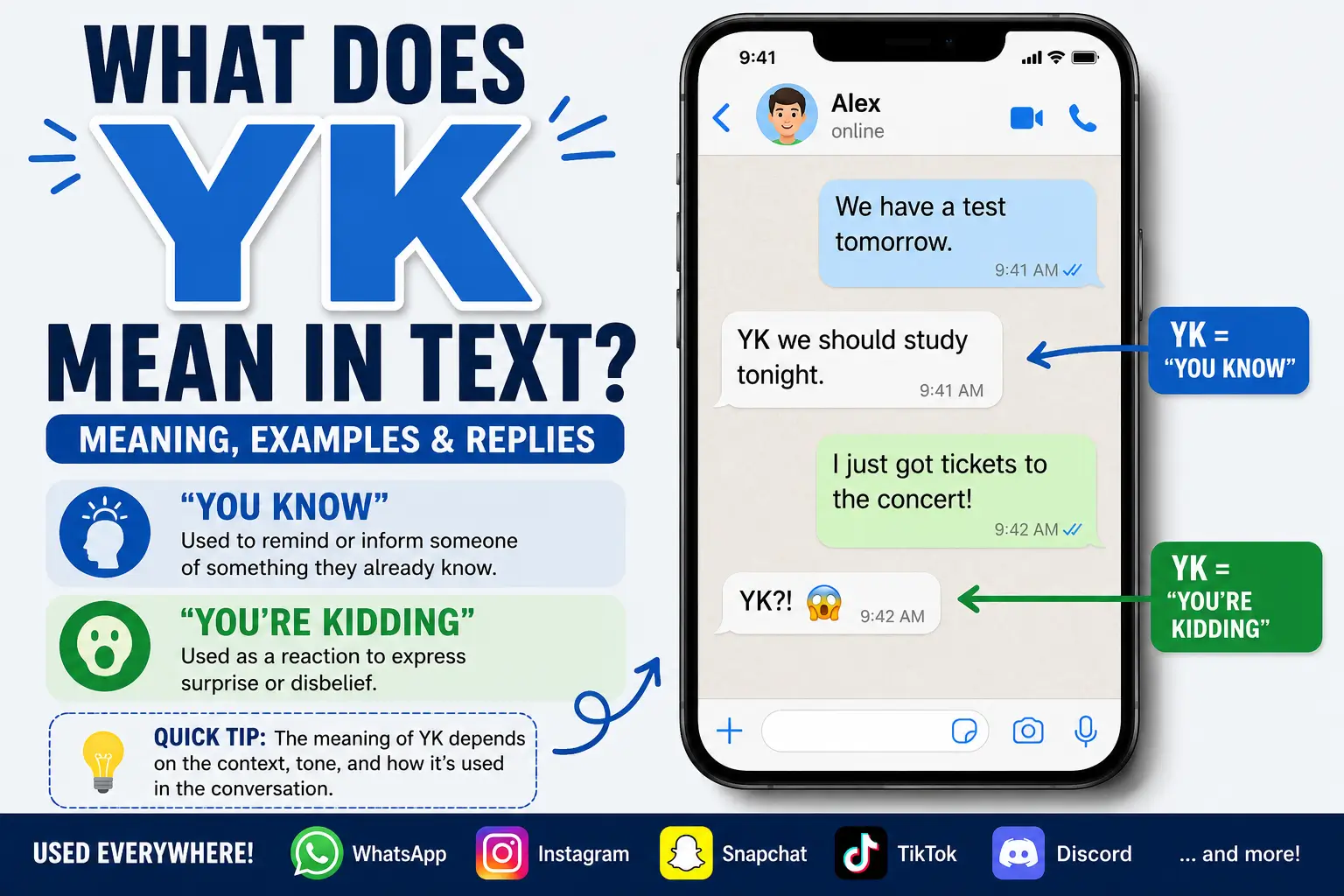
A two-letter message can create more confusion than a full sentence. You open a chat, see “YK,” and immediately wonder what the sender means. Are they saying “you know” or reacting with “you’re kidding”?
In most text conversations, YK means “you know.” People use it to seek agreement, refer to shared information, or make a message sound more casual. For example, someone might write, “That restaurant gets crowded on Fridays, yk?” Here, the sender expects you to understand or agree.
However, YK can also mean “you’re kidding” when it appears as a stand-alone reaction. If someone shares surprising news and receives “YK?” in response, the abbreviation may express shock or disbelief.
The correct YK meaning in text depends on the sentence, punctuation, tone, and previous messages. Its meaning usually stays consistent across Snapchat, TikTok, Instagram, WhatsApp, Discord, and regular text messages. The platform matters less than the context.
This guide explains what does YK mean in text, how to identify the intended definition, and how to use the abbreviation naturally. You’ll also find realistic chat examples, reply ideas, grammar tips, common mistakes, memory tricks, and comparisons with related slang such as IK, IKR, YKW, and IYKYK.
Quick Answer: What Does YK Mean in Text?
YK usually means “you know” in texting and online conversations.
For example:
“The new teacher seems strict, yk?”
The sender means:
“The new teacher seems strict, you know?”
In this sentence, YK asks whether the reader understands or agrees.
However, YK can also mean “you’re kidding” when someone uses it as a reaction:
Ava: They canceled the concert an hour before it started.
Mason: YK?
Here, Mason likely means:
“You’re kidding?”
A simple rule helps:
- Inside or at the end of a sentence: usually “you know”
- Alone after surprising news: possibly “you’re kidding”
Context always makes the final decision.
YK Meaning and Definition
YK is an informal abbreviation used in text messages, social media posts, comments, gaming chats, and direct messages.
It commonly represents one of two phrases:
| YK meaning | Purpose | Typical position | Example |
|---|---|---|---|
| You know | Requests agreement or assumes shared understanding | Inside or after a sentence | “It felt awkward, yk?” |
| You’re kidding | Expresses shock, doubt, or disbelief | Usually sent alone | “YK? That really happened?” |
The first meaning appears far more naturally in complete sentences. The second usually works as a short reaction.
Because written messages lack vocal tone, the reader must use other signals. Punctuation, capitalization, emojis, and previous messages often reveal the intended meaning.
The Primary Meaning of YK: “You Know”
In everyday texting, YK most often stands for “you know.”
People use the full phrase constantly in spoken English. It can connect thoughts, invite agreement, or signal that two people share the same background knowledge.
Texting simply shortens that familiar expression.
Consider this example:
“I didn’t want to make the situation worse, yk?”
The sender isn’t asking whether the reader knows a fact. Instead, they want emotional understanding.
The message means something closer to:
“I didn’t want to make the situation worse. Do you understand what I mean?”
That subtle function explains why YK appears in personal conversations. It creates a softer, more conversational tone.
YK Can Ask for Agreement
A sender may add YK because they expect the reader to share an opinion.
“That movie was way too long, yk?”
The implied meaning becomes:
“You agree that the movie was too long, right?”
The writer isn’t requesting detailed information. They want confirmation.
YK Can Signal Shared Knowledge
Sometimes, both people already understand the topic.
“Let’s not invite him. YK how he gets at parties.”
The sender expects the reader to remember the person’s behavior.
In this context, YK means:
“You already know how he behaves.”
YK Can Soften an Opinion
Direct statements can sound harsh in text because readers can’t hear a friendly voice.
Compare these messages:
“Her response was rude.”
“Her response felt rude, yk?”
The second version sounds less final. It invites the other person to share their view.
YK Can Create a Natural Pause
People sometimes use “you know” while searching for the right words. YK can copy that speaking habit in writing.
“I wanted to explain, but, yk, everything felt complicated.”
Here, YK works like a brief pause. It gives the message a spoken rhythm.
However, too many fillers can weaken a sentence. One thoughtful use feels conversational. Five uses feel like verbal clutter.
YK Can Hint at Something Unspoken
Writers may use YK when they expect the reader to understand an implication.
“We stayed at the party pretty late, yk 😏”
The writer may be suggesting more than the literal sentence states.
Still, YK doesn’t carry a romantic or sexual definition by itself. The surrounding words, relationship, and emoji create that tone.
The Secondary Meaning of YK: “You’re Kidding”
YK sometimes means “you’re kidding.”
People use this interpretation when they react to unexpected, frustrating, exciting, or unbelievable information.
For example:
Ella: My flight got delayed for nine hours.
Jack: YK?
Ella: I wish I were.
Jack’s response expresses disbelief. Expanding YK to “you know” wouldn’t fit the conversation.
Punctuation often strengthens this meaning:
- YK? suggests doubt or surprise.
- YK! shows stronger shock.
- YK… may express suspicion or disappointment.
- YK 😂 can signal amused disbelief.
- YK?? shows intense surprise.
This interpretation appears less often inside full sentences.
A message such as “I felt nervous, YK?” almost certainly means “you know.” Meanwhile, a stand-alone “YK?” after major news may mean “you’re kidding.”
How to Identify the Correct YK Meaning
The easiest method involves replacing YK with both possible phrases.
Consider this sentence:
“That restaurant always gets crowded, yk?”
Try the first meaning:
“That restaurant always gets crowded, you know?”
It sounds natural.
Now try the second:
“That restaurant always gets crowded, you’re kidding?”
It doesn’t work.
Therefore, YK means “you know.”
Now examine another message:
“YK? You won the entire competition?”
Test both options:
“You know? You won the entire competition?”
That sounds awkward.
“You’re kidding? You won the entire competition?”
That fits the reaction.
This replacement test solves most cases within seconds.
YK Meaning Based on Position
Placement offers one of the strongest clues.
| Position of YK | Most likely meaning | Example |
|---|---|---|
| At the end of a statement | You know | “The traffic gets awful, yk?” |
| In the middle of a sentence | You know | “I was, yk, trying to help.” |
| Before familiar information | You know | “YK how she hates surprises.” |
| Alone after shocking news | You’re kidding | “YK?” |
| Before a surprised follow-up | You’re kidding | “YK? They did that again?” |
No rule works perfectly in every private conversation. People develop personal shortcuts and inside jokes.
Still, position gives you a reliable starting point.
YK Across Texting and Social Media Platforms
The abbreviation keeps the same basic meanings across most platforms. Snapchat doesn’t assign one official definition while TikTok assigns another.
Users carry their language from one app to another.
YK in Text Messages
Personal texts often use YK to create a relaxed tone.
“I just needed a little space, yk?”
The sender wants understanding rather than a factual answer.
YK on Snapchat
Snapchat messages and captions often contain quick abbreviations.
“Long day, yk.”
In this example, YK means “you know.”
However, someone may reply “YK?” after seeing surprising news. That response could mean “you’re kidding.”
YK on TikTok
TikTok users may include YK in captions or comments to describe relatable experiences.
“When the group project becomes a solo project, yk.”
The phrase invites viewers to recognize a familiar situation.
YK on Instagram
Instagram captions and direct messages may use YK for a conversational effect.
“Keeping things simple this year, yk?”
The writer wants the caption to sound like a casual chat rather than a polished announcement.
YK on WhatsApp
In WhatsApp conversations, YK often appears in personal or group messages.
“We should leave before rush hour, yk how bad it gets.”
The sender refers to shared knowledge.
YK on Discord
Discord users may write YK while discussing games, communities, or shared interests.
“The server gets chaotic after updates, yk?”
The meaning remains “you know.”
YK in Gaming Chats
Gaming conversations move quickly. Players often shorten familiar phrases.
“That boss fight was impossible, yk?”
YK asks for agreement.
A player might also send:
“YK? We lost by one point?”
Here, the abbreviation may express disbelief.
YK on Dating Apps
In dating chats, YK can make a message sound playful or suggestive.
“You seem like someone who enjoys spontaneous plans, yk?”
The abbreviation itself doesn’t indicate flirting. The complete sentence creates the mood.
Comparison Table: YK and Similar Slang
Several abbreviations resemble YK but perform different jobs.
| Abbreviation | Full meaning | Main use | Example |
|---|---|---|---|
| YK | You know | Invites understanding or agreement | “It was uncomfortable, yk?” |
| YK | You’re kidding | Shows surprise or disbelief | “YK? That happened?” |
| IK | I know | Confirms understanding | “IK, we talked about it.” |
| IKR | I know, right? | Shows enthusiastic agreement | “That ending was wild.” “IKR?” |
| IYKYK | If you know, you know | Signals insider knowledge | “The hidden menu item. IYKYK.” |
| YKW | You know what | Introduces an idea or decision | “YKW, let’s leave early.” |
| JK | Just kidding | Reveals a joke | “I ate your fries. JK.” |
| IDK | I don’t know | Expresses uncertainty | “IDK when they close.” |
| FR | For real | Emphasizes truth or surprise | “You did that FR?” |
| TBH | To be honest | Introduces an honest opinion | “TBH, I expected more.” |
These terms can appear in the same conversation because they serve different purposes.
Key Differences Between YK and IYKYK
People often confuse YK with IYKYK, but they don’t mean the same thing.
YK means “you know.” It usually speaks directly to another person and asks for understanding.
“The café near the library, yk?”
IYKYK means “if you know, you know.” It refers to an inside joke, shared experience, niche reference, or piece of knowledge that outsiders may not understand.
“That side entrance after midnight. IYKYK.”
The difference involves the audience.
- YK addresses the reader directly.
- IYKYK identifies a group with special context.
- YK can seek a response.
- IYKYK often stands as a complete statement.
- YK works in ordinary conversation.
- IYKYK often creates exclusivity or mystery.
Using YK instead of IYKYK may make a caption unclear.
Key Differences Between YK, IK, and IKR
These three abbreviations revolve around knowledge and agreement.
YK Means “You Know”
The speaker expects the listener to understand.
“YK how busy the highway gets.”
IK Means “I Know”
The writer confirms their own understanding.
“IK. That’s why I’m leaving early.”
IKR Means “I Know, Right?”
The writer strongly agrees with another person.
Person A: The prices have gone up again.
Person B: IKR?
An easy direction trick helps:
- YK points toward you.Person
- IK points toward me.
- IKR points toward agreement.
Real-Life YK Examples
Definitions help, but conversations reveal the real tone.
Seeking Agreement
Nora: The second season wasn’t as good, yk?
Leah: Yeah, the story felt rushed.
Nora uses YK to ask for agreement.
Referring to Shared Knowledge
Ben: Should we take the downtown route?
Ryan: YK how bad parking gets there.
Ben: True. Let’s take the train.
Ryan assumes Ben remembers the parking problem.
Softening Criticism
Maya: I like the presentation. The final slide feels crowded, yk?
Zoe: I see it. I’ll shorten the list.
Maya uses YK to keep her criticism constructive.
Expressing Disbelief
Ethan: I accidentally sent the message to the whole office.
Lucas: YK?
Ethan: Sadly, no.
Lucas means “you’re kidding.”
Showing Excitement
Grace: We got upgraded to front-row seats.
Chloe: YK! That’s incredible.
The exclamation point suggests excited disbelief.
Creating a Friendly Tone
Isaac: I didn’t want to rush the decision, yk?
Owen: That makes sense. It’s a big choice.
YK helps Isaac explain his feelings without sounding defensive.
Hinting at an Inside Meaning
Sophie: We ended up at that old diner again, yk 😄
Emma: The one with the terrible karaoke?
Sophie: Exactly.
The abbreviation signals a shared memory.
Mini Case Studies: How Context Changes YK
Case Study: The Misread Reaction
A friend sends:
“I got accepted into the program!”
You reply:
“YK?”
You intend to say “you’re kidding?” because you feel excited. However, your friend may briefly read it as “you know?”
A clearer reply would be:
“You’re kidding! That’s amazing!”
Lesson: Spell out the phrase when emotion matters. Shortening a reaction can weaken or confuse your response.
Case Study: The Workplace Message
A coworker writes:
“We need the report before lunch, yk?”
They may intend a casual reminder. Yet the message can sound vague or slightly condescending.
A better version would say:
“Please send the report before noon so the team can review it.”
Lesson: Professional communication benefits from precise requests.
Case Study: The Flirty Assumption
Someone on a dating app writes:
“You seem adventurous, yk?”
The reader assumes the message contains a hidden sexual meaning. In reality, the sender may simply be asking for agreement.
Lesson: Don’t assign romantic intent to YK alone. Study the full conversation.
Case Study: The Shared Memory
A sibling sends:
“That rainy vacation, yk 😂”
Both people instantly remember a family trip where everything went wrong.
Lesson: YK can compress an entire shared story into two letters. Context gives it emotional weight.
Grammar Tips for Using YK
Text slang doesn’t follow formal grammar perfectly. Still, punctuation helps readers understand your meaning.
Add a Question Mark When Seeking Agreement
Use a question mark when YK means “you know what I mean?”
“The ending felt unfinished, yk?”
This punctuation shows that the writer expects a response.
Use Commas Around an Interrupting YK
When YK interrupts a sentence, commas can show the pause.
“I was, yk, trying to make things easier.”
However, this structure can feel cluttered. A cleaner sentence may work better:
“I was trying to make things easier, yk?”
Use Uppercase Carefully
Lowercase yk often feels casual and relaxed.
“It was kind of strange, yk?”
Uppercase YK may create emphasis:
“YK? They canceled it again?”
Capitalization changes intensity, not definition.
Avoid Unclear Stand-Alone Uses
A single “YK” may confuse the reader because it could mean either phrase.
When clarity matters, write the full response:
“You know what I mean?”
or:
“You’re kidding, right?”
Don’t Add YK Where It Serves No Purpose
Compare these sentences:
“I went to the store, yk, and bought bread, yk, because we needed it, yk.”
“I went to the store and bought bread because we needed it.”
The first version sounds hesitant and repetitive. The second communicates the same information clearly.
Keep Formal Writing Precise
Avoid YK in:
- Academic essays
- Cover letters
- Résumés
- Business proposals
- Legal documents
- Medical instructions
- Customer support replies
- Official announcements
Instead of writing:
“The numbers don’t match, yk?”
Write:
“The totals don’t match the figures in the previous report.”
Common Mistakes When Using YK
Assuming It Always Means “You Know”
Although “you know” is the primary interpretation, stand-alone reactions can mean “you’re kidding.”
Check the position before deciding.
Assuming It Always Means “You’re Kidding”
This mistake happens when readers rely on older acronym lists without studying the sentence.
In a message such as:
“The weather changes quickly here, yk?”
“You’re With IYKYK
YK doesn’t automatically indicate insider knowledge. Use IYKYK when you mean “if you know, you know.”
Treating It as a Platform-Specific Code
YK doesn’t gain a fixed new meaning on every app.
A Snapchat message, TikTok caption, and WhatsApp chat may all use YK in the same way.
Reading Flirtation Into Every Use
The abbreviation can appear in romantic messages, but it isn’t inherently flirtatious.
Words, emojis, timing, and relationship context create the romantic tone.
Using It With an Unfamiliar Audience
Not everyone recognizes the abbreviation.
Older relatives, clients, new coworkers, and English learners may misunderstand it. Writing “you know” can save time in the long run.
Overusing It
Too much YK makes writing sound uncertain or repetitive.
Use it when it adds warmth, rhythm, or shared context. Remove it when it adds nothing.
Ignoring Punctuation
Compare:
- yk — casual acknowledgment
- yk? — request for agreement
- YK? — possible surprise
- YK! — strong disbelief
- yk… — hesitation or implication
Punctuation doesn’t guarantee a meaning, but it provides a valuable clue.
Memory Tricks for Understanding YK
The Inside-or-Alone Trick
Remember this pattern:
Inside a sentence means “you know.”
Alone after news may mean “you’re kidding.”
Examples:
“That felt awkward, yk?”
Meaning: You know
“YK? You met the actor?”
Meaning: You’re kidding
The Replacement Test
Replace YK with both phrases.
The option that sounds natural usually gives you the correct answer.
The Reaction Test
Ask whether YK reacts to surprising information.
When the answer is yes, “you’re kidding” becomes more likely.
When YK connects a thought or asks for agreement, “you know” becomes more likely.
The Direction Trick
Think about where the knowledge points:
- YK: You understand.
- IK: I understand.
- IKR: We strongly agree.
- IYKYK: Insiders understand.
This trick helps separate several similar abbreviations.
Synonyms and Alternatives for YK
When YK means “you know,” you can use:
- You know what I mean
- Right?
- You understand
- You see?
- Remember?
- You get me
- Know what I mean?
- If that makes sense
- You know how it is
- As you know
Example:
“The process takes time, yk?”
Alternative:
“The process takes time, as you know.”
When YK means “you’re kidding,” alternatives include:
- Seriously?
- Really?
- No way
- Are you joking?
- You can’t be serious
- For real?
- Is that true?
- You’re joking, right?
- I can’t believe it
- That actually happened?
Choose the alternative that matches the situation.
“Seriously?” feels casual. “Is that true?” sounds more neutral. “You can’t be serious” may sound confrontational.
Related Texting Words and Their Meanings
| Texting term | Meaning | Typical use |
|---|---|---|
| IK | I know | Confirms understanding |
| IKR | I know, right? | Shows strong agreement |
| IDK | I don’t know | Expresses uncertainty |
| YKW | You know what | Introduces a new thought |
| IYKYK | If you know, you know | Signals insider knowledge |
| JK | Just kidding | Marks a joke |
| FR | For real | Emphasizes truth or surprise |
| FRFR | For real, for real | Adds stronger emphasis |
| NGL | Not going to lie | Introduces an honest opinion |
| TBH | To be honest | Signals honesty |
| IMO | In my opinion | Introduces a personal view |
| BTW | By the way | Adds related information |
| LMK | Let me know | Requests an update |
| WYM | What you mean? | Requests clarification |
These expressions often appear together:
“NGL, that meeting felt pointless, yk?”
Expanded:
“Not going to lie, that meeting felt pointless, you know?”
Is YK Rude or Offensive?
YK isn’t inherently rude, vulgar, or offensive.
Most people use it as neutral conversational slang. However, the surrounding sentence can make it sound dismissive or patronizing.
Consider:
“You should already understand that, yk.”
Depending on the relationship, this line may sound condescending.
A gentler version would say:
“I thought we covered that earlier, but I can explain it again.”
Likewise, replying “YK?” to serious news may sound as though you doubt the sender.
When someone shares sensitive information, use a complete response:
“That’s difficult to believe. Are you okay?”
Clear language shows care.
Can You Use YK at Work?
YK may work in relaxed chats between close coworkers. However, it doesn’t belong in most formal workplace communication.
A casual internal message might say:
“The printer is acting up again, yk how it gets.”
That message may feel acceptable between familiar colleagues.
However, avoid YK when writing to:
- Clients
- Managers you don’t know well
- Job applicants
- Vendors
- Customers
- Senior leadership
- External partners
Professional alternatives include:
- “As you know”
- “As discussed”
- “For context”
- “Do you agree?”
- “Does that make sense?”
- “Are you familiar with this issue?”
- “I believe we share the same understanding”
Precision builds trust. Slang sometimes makes a message sound careless.
Is YK Safe for Kids and Teenagers?
YK contains no harmful or explicit meaning by itself.
Children and teenagers may encounter it in texts, gaming chats, social media comments, or videos. The abbreviation alone usually presents no concern.
However, context still matters.
A young user should ask:
- Who sent the message?
- What happened earlier in the conversation?
- Does the person want to hide the chat?
- Are they asking for private information?
- Does the message feel threatening or uncomfortable?
- Would a trusted adult understand the context?
Ordinary slang can appear inside inappropriate conversations. Teach children to evaluate the entire exchange rather than fear one abbreviation.
Does YK Change by Region or Generation?
People may interpret YK differently based on their age, community, and online habits.
Someone who frequently uses social media may quickly read sentence-final “yk” as “you know.” Another reader may recognize “YK” as “you’re kidding,” especially when it appears alone.
Still, no reliable rule assigns one definition to a specific country or generation.
Avoid broad claims such as:
- Only teenagers use YK.
- American users always mean “you know.”
- British users always mean “you’re kidding.”
- One generation invented the abbreviation.
Text slang spreads across age groups and platforms. Personal experience often matters more than location.
Frequently Asked Questions About YK
What does YK mean in texting?
YK usually means “you know.” People use it to invite agreement, signal shared knowledge, or make a message sound conversational.
It can also mean “you’re kidding” when sent alone after surprising news.
What does YK mean on Snapchat?
On Snapchat, YK usually means “you know.”
For example:
“Busy week, yk?”
However, a stand-alone “YK?” may mean “you’re kidding?”
What does YK mean on TikTok?
TikTok users often use YK in captions and comments to mean “you know.” It can make a post feel relatable.
“When the weekend disappears in five minutes, yk.”
What does YK mean on Instagram?
In Instagram captions or direct messages, YK often means “you know.” It may invite followers to relate to a thought or experience.
What does YK mean from a girl?
YK doesn’t have a special meaning based on the sender’s gender.
A girl may use it to mean “you know” or “you’re kidding.” Read the full message.
What does YK mean from a guy?
A guy may use YK in the same ways as anyone else.
Inside a sentence, it probably means “you know.” As a surprised reaction, it may mean “you’re kidding.”
Is YK flirting?
Not necessarily.
YK can appear in playful or romantic conversations, but the abbreviation itself isn’t flirtatious. Look for teasing language, compliments, suggestive wording, and emojis.
Does YK have a sexual meaning?
YK has no fixed sexual meaning.
A suggestive conversation can give it an intimate tone, but context creates that interpretation.
Is YK rude?
YK usually isn’t rude. Still, it can sound dismissive, skeptical, or condescending in certain messages.
Is YK professional?
YK isn’t suitable for most formal writing. Use “as you know,” “do you agree?” or another clear phrase instead.
Is YK the same as IYKYK?
No.
YK usually means “you know.” IYKYK means “if you know, you know” and signals insider knowledge or a shared experience.
What does “if YK, YK” mean?
The writer likely means “if you know, you know.” However, IYKYK is the clearer and more common abbreviation for that phrase.
Should YK be uppercase or lowercase?
Both forms appear online.
Lowercase “yk” often feels casual. Uppercase “YK” may show emphasis or reflect the writer’s typing style.
How should you reply to YK?
When YK means “you know,” confirm understanding:
“Yeah, I get what you mean.”
When it means “you’re kidding,” confirm the information:
“No, I’m serious.”
When the meaning remains unclear, ask:
“Do you mean ‘you know’ or ‘you’re kidding’?”
Conclusion
Understanding YK meaning in text becomes simple once you pay attention to placement and context.
In most sentences, YK means “you know.” It can invite agreement, soften an opinion, reference shared knowledge, or make a message sound more conversational. For example, “The ending felt rushed, yk?” asks whether the reader understands or agrees.
When YK appears alone after unexpected news, it may mean “you’re kidding.” A response such as “YK? That happened today?” usually expresses surprise or disbelief.
Remember the easiest rule:
Inside a sentence usually means “you know.”
Alone as a reaction may mean “you’re kidding.”
You can also replace YK with both phrases. The option that sounds natural will usually reveal the correct meaning.
Although people use YK across Snapchat, TikTok, Instagram, WhatsApp, gaming chats, and dating apps, its definition doesn’t automatically change between platforms. The surrounding conversation always provides the strongest clue.
Ultimately, knowing what does YK mean in text helps you understand casual messages without overthinking them. When the meaning still feels unclear, ask the sender directly. One quick question can prevent an entire conversation from going sideways.