

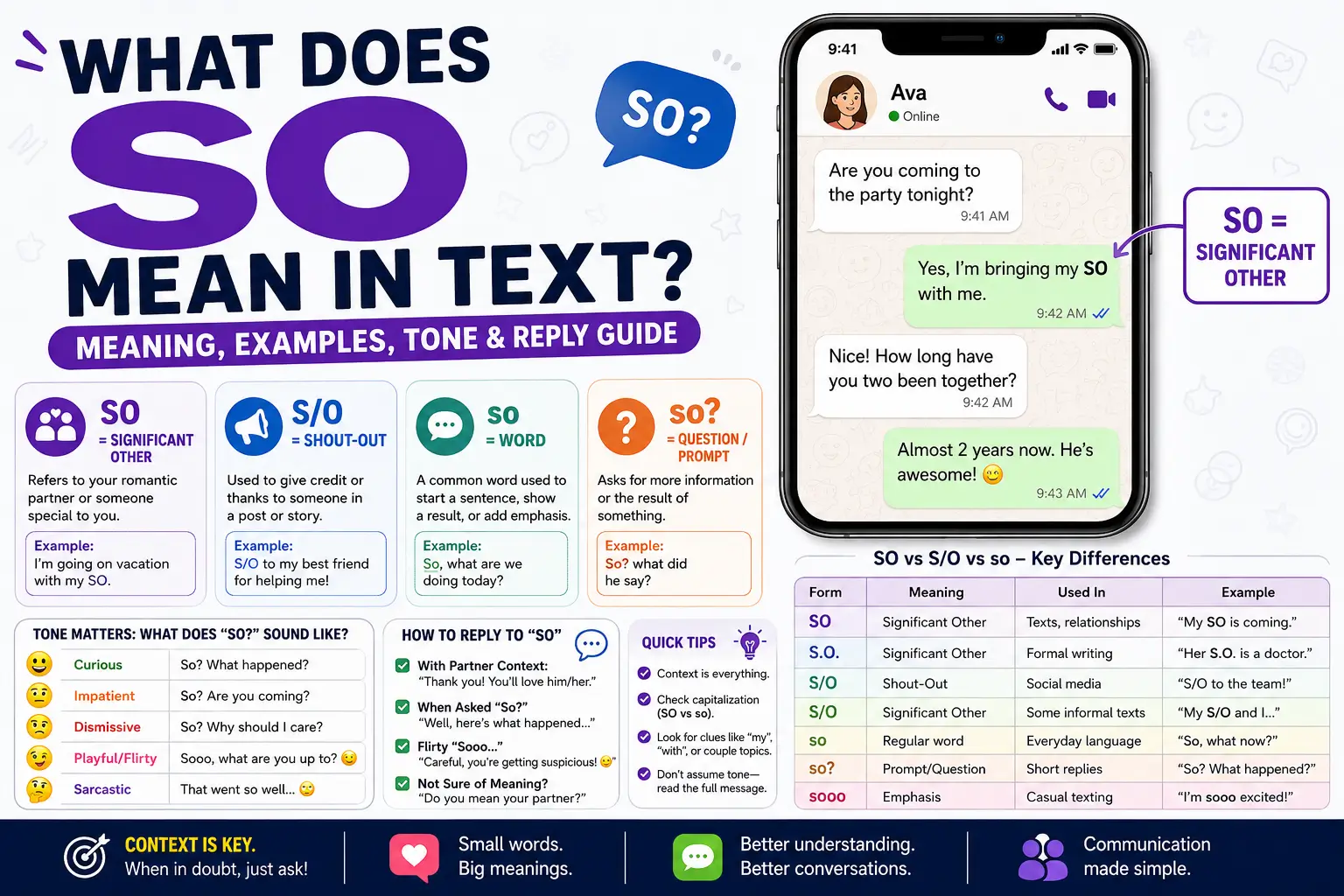
A short message can hide more meaning than expected. Someone writes, “I’m bringing my SO,” and you wonder whether those letters name a person, express an emotion, or shorten another phrase.
In most relationship conversations, SO means “significant other.” The term refers to someone’s romantic partner. That person could be a boyfriend, girlfriend, spouse, fiancé, fiancée, or long-term partner.
However, formatting changes everything. Lowercase “so” usually works as an ordinary English word. It can begin a conversation, show a result, strengthen a description, or prompt someone to continue.
Meanwhile, S/O often means “shout-out” on social media. Some people also use that form for “significant other,” which can create confusion.
So, What Does SO Mean in Text? You need to check the capitalization, slash, sentence position, and surrounding conversation. This guide explains those clues with practical examples, reply ideas, grammar tips, and clear comparisons.
Quick Answer: SO Meaning in Text
Uppercase SO most commonly means “significant other.”
A significant other is someone’s romantic partner.
“My SO and I are going on vacation.”
In this sentence, SO refers to the writer’s partner.
Lowercase “so” usually isn’t an abbreviation.
“So, what happened next?”
Here, “so” introduces a question.
The slash form S/O often means “shout-out.”
“S/O to everyone who helped with the event.”
Here, the writer publicly thanks or recognizes a group.
| Form | Most likely meaning | Example |
|---|---|---|
| SO | Significant other | “My SO is joining us.” |
| S.O. | Significant other | “Her S.O. works nearby.” |
| S/O | Shout-out | “S/O to the entire team.” |
| S/O | Significant other in some contexts | “My S/O planned the trip.” |
| so | Regular English word | “So, what should we do?” |
| so? | Prompt, question, or challenge | “So? Did you get the job?” |
| sooo | Extra emotional emphasis | “That’s sooo exciting.” |
SO Meaning: “Significant Other”
The most common abbreviation meaning of SO is “significant other.”
People use this term when they want a broad, gender-neutral label for a romantic partner. It works without revealing whether the couple is dating, engaged, married, or living together.
For example:
“Can employees bring their SO to the party?”
The speaker wants to know whether employees may bring their romantic partners.
The phrase offers flexibility. Someone may prefer “significant other” because another label feels too specific or doesn’t fit their relationship.
Who Can Be a Significant Other?
An SO may be someone’s:
- Boyfriend
- Girlfriend
- Husband
- Wife
- Spouse
- Fiancé
- Fiancée
- Domestic partner
- Long-term partner
- Romantic partner
- Life partner
The abbreviation doesn’t reveal the person’s gender.
It also doesn’t confirm a legal relationship. A spouse can be an SO, but an SO doesn’t have to be a spouse.
Examples of SO Meaning “Significant Other”
“My SO surprised me with dinner.”
“I’m spending the weekend with my SO.”
“Her SO helped her move.”
“Can I bring my SO to the wedding?”
“My SO and I adopted a dog.”
Each sentence discusses a romantic partner.
The possessive words “my,” “her,” and “his” often provide a strong clue. Relationship activities such as dates, anniversaries, vacations, and couple plans offer more context.
Read this also: What Does ICL Mean in Slang? Meaning, Text Examples, and How to Reply
What Does SO Mean in a Relationship?
In a relationship, SO refers to a romantic partner.
People often choose the abbreviation when they want neutral wording. It can feel more inclusive than assuming everyone uses “boyfriend,” “girlfriend,” “husband,” or “wife.”
For example:
“Partners and SOs are welcome at the event.”
The sentence includes different types of relationships.
Still, SO doesn’t tell you the couple’s exact status. It doesn’t automatically mean they are:
- Married
- Engaged
- Living together
- In a long-term relationship
- Dating exclusively
- Planning a wedding
You’ll need more context for those details.
Lowercase “So” in Text Messages
Lowercase “so” usually functions as a regular word rather than an abbreviation.
It performs several jobs in everyday conversation. That flexibility explains why one tiny word can sound curious, excited, sarcastic, impatient, or dismissive.
“So” Can Start a Conversation
People often use “so” to introduce a new topic.
“So, how was your interview?”
“So, I have something to tell you.”
“So, are we still meeting tonight?”
The word creates a soft entrance. It helps the speaker move into the subject without sounding abrupt.
“So” Can Continue a Story
The word may encourage someone to keep talking.
“So, what happened after you left?”
“So… what did she say?”
“So then what?”
In these examples, “so” asks for the next part of the story.
The dots may create suspense or hesitation. A question mark makes the request more direct.
“So” Can Redirect the Conversation
Sometimes, “so” helps people return to the main topic.
“So anyway, what time should we leave?”
“So, back to the original question.”
“So, what have we decided?”
This use keeps a discussion organized.
“So” Can Show a Result
“So” can connect a cause with its result.
“The store was closed, so we went home.”
“I missed the bus, so I called a taxi.”
“She felt tired, so she canceled the trip.”
In each sentence, the second event happens because of the first.
“So” Can Strengthen a Description
“So” can intensify an adjective or adverb.
“That movie was so funny.”
“I’m so tired.”
“You answered so quickly.”
“The food tasted so good.”
Removing “so” makes the sentence less intense.
Compare:
“The concert was loud.”
“The concert was so loud.”
The second sentence carries more emotion.
“So” Can Replace a Repeated Idea
People also use “so” in short expressions.
- “I think so.”
- “I hope so.”
- “I guess so.”
- “I believe so.”
- “It seems so.”
- “Apparently so.”
Consider this exchange:
Ava: Is the restaurant still open?
Mia: I think so.
Mia avoids repeating the entire statement. “So” replaces “the restaurant is still open.”
What Does “So?” Mean in a Text?
A stand-alone “So?” can carry several meanings.
Tone depends on the previous message, punctuation, and relationship between the speakers.
| Message | Likely purpose | Possible tone |
|---|---|---|
| “So? Did you pass?” | Requests the result | Curious |
| “So… what happened?” | Encourages the story | Interested |
| “So?” | Questions why something matters | Dismissive |
| “Sooo, are we going?” | Pushes for a decision | Playful or impatient |
| “So what?” | Rejects a point’s importance | Defiant |
| “And so?” | Asks for the conclusion | Direct |
A single word can feel friendly in one exchange and cold in another.
Consider these conversations:
Liam: I finally spoke to the manager.
Noah: So? What did he say?
Noah sounds curious.
Now compare:
Liam: Everyone else bought the new phone.
Noah: So?
Here, Noah may mean:
“Why should that matter?”
The previous statement changes the tone.
Is “So?” Rude in Text?
“So?” isn’t automatically rude. However, it can sound abrupt.
Text messages don’t include facial expressions or vocal tone. As a result, one-word replies often feel sharper than intended.
Compare these messages:
“So?”
“So, what happened next?”
“Okay, and what did they say?”
The first version leaves the tone open to interpretation. The others sound more clearly interested.
A stand-alone “So?” may feel rude when it:
- Dismisses someone’s concern
- Challenges why a fact matters
- Pushes an impatient response
- Follows a serious or emotional message
- Lacks any sign of empathy
For sensitive conversations, add a few words.
Instead of:
“So?”
Try:
“What happened after that?”
or:
“How did it turn out?”
Clarity softens the edge.
Is “So” Flirty in Text?
“So” doesn’t have an automatic flirty meaning.
However, it may support flirtation when the rest of the message sounds playful, romantic, or suggestive.
| Message | Likely tone |
|---|---|
| “So, what time is the meeting?” | Practical |
| “Sooo, are you seeing anyone?” | Possibly flirty |
| “You looked so good tonight.” | Complimentary |
| “So… when are you taking me out? 😉” | Playful or flirty |
| “I’m so happy you texted.” | Warm |
| “Sooo, did you miss me?” | Teasing |
The meaning comes from the full sentence.
Emojis, compliments, teasing, and personal questions create the romantic tone. The word “so” simply adds emphasis or opens the conversation.
Don’t assume attraction from one word. Look for a pattern across several messages.
Can “So” Sound Sarcastic?
Yes. “So” can support sarcasm, especially when it intensifies a statement that the writer doesn’t mean literally.
For example:
“That went so well 🙄”
The eye-roll emoji suggests the event went badly.
Another example:
“SO helpful.”
The capitalization may show frustration. The speaker probably means the opposite.
Other sarcastic examples include:
“So glad we waited two hours.”
“That was so organized.”
“You’re so subtle.”
“Well, that worked so perfectly.”
Without vocal tone, readers rely on context, emojis, quotation marks, and capitalization.
Still, sarcasm can backfire in text. When the relationship is formal or tense, direct wording works better.
SO, S.O., S/O, and “So”: Key Differences
Formatting provides one of the strongest clues.
| Form | Meaning | Common setting | Example |
|---|---|---|---|
| SO | Significant other | Texts and relationship discussions | “My SO loves hiking.” |
| S.O. | Significant other | Traditional written abbreviation | “Her S.O. joined us.” |
| S/O | Shout-out | Captions and social posts | “S/O to the volunteers.” |
| S/O | Significant other | Some informal relationship posts | “My S/O planned the surprise.” |
| so | Connector, intensifier, or conversation marker | Everyday language | “So, what’s the plan?” |
| so? | Prompt or challenge | Short replies | “So? Did they agree?” |
| sooo | Emotional emphasis | Informal chats | “That’s sooo cute.” |
| SO inside a sentence | Strong emphasis | Emotional writing | “I’m SO excited.” |
The last row requires special attention.
In this message:
“I’m SO tired.”
SO doesn’t mean “significant other.” The capital letters simply emphasize the regular word “so.”
Sentence structure solves the confusion. A romantic partner wouldn’t fit grammatically.
What Does S/O Mean on Social Media?
On social media, S/O often means “shout-out.”
A shout-out gives public praise, thanks, credit, or recognition.
For example:
“S/O to my sister for helping me move.”
The writer publicly thanks their sister.
Other examples include:
“Big S/O to everyone who supported the launch.”
“S/O to the photographer for these pictures.”
“S/O to the team for an amazing season.”
Tags and public praise make the meaning clear.
S/O Can Also Mean “Significant Other”
Some writers use S/O instead of SO for a romantic partner.
“My S/O surprised me with tickets.”
The word “my” signals a relationship meaning.
Compare these two sentences:
“S/O to Alex for helping.”
Meaning: Shout-out
“My S/O Alex helped me.”
Meaning: Significant other
The slash alone doesn’t guarantee the definition. Sentence structure still matters.
What Does SO Mean on Instagram?
On Instagram, SO often means “significant other” in relationship captions and comments.
Examples include:
“Weekend trip with my SO.”
“Tag your SO.”
“My SO took this picture.”
Meanwhile, S/O may mean “shout-out.”
“S/O to the designer who created this outfit.”
Instagram doesn’t assign official definitions to these terms. Users bring everyday slang onto the platform.
Look for clues such as:
- The word “my”
- Couple photos
- Anniversary captions
- Partner tags
- Public praise
- Thank-you language
What Does SO Mean on Snapchat?
On Snapchat, uppercase SO usually refers to a significant other when the conversation involves dating or relationships.
For example:
“Are you and your SO coming tonight?”
Lowercase “so” keeps its regular English role.
“So, are you coming tonight?”
The first sentence asks about a partner. The second starts a question.
A Snap showing a couple with “my SO” likely refers to a romantic partner.
However, “You look SO good” uses capital letters for emphasis. It doesn’t refer to a relationship label.
SO on TikTok, Discord, and WhatsApp
SO may appear across TikTok, Discord, WhatsApp, forums, dating apps, and group chats.
Its core meaning usually stays the same.
On TikTok, creators may mention their SO in relationship videos.
“My SO tried to choose my outfit.”
On Discord, users may discuss their partners inside community chats.
“My SO and I play this game together.”
On WhatsApp, SO may appear while planning an event.
“Can everyone bring their SO?”
The app doesn’t determine the definition. The conversation does.
What Does SO Mean From a Girl or Guy?
The sender’s gender doesn’t change the meaning of SO.
When a girl writes “my SO,” she means her significant other.
When a guy writes “my SO,” he also means his significant other.
The abbreviation doesn’t reveal the partner’s gender either.
Avoid assumptions based on stereotypes. Instead, study:
- The sentence structure
- Previous messages
- Relationship context
- Possessive words
- Capitalization
- Emojis
Context beats guesswork every time.
Real-Life SO Examples in Conversations
Referring to a Partner
Avery: Are you going to the wedding alone?
Jordan: No, I’m bringing my SO.
SO means significant other because Jordan discusses a wedding guest.
Asking About Someone’s Partner
Mia: How’s your SO doing after the move?
Leah: Much better now.
The possessive word “your” creates a relationship meaning.
Starting a Topic
Noah: So, did you hear back from the company?
Ethan: Yes. They offered me the job.
Here, lowercase “so” introduces a question.
Requesting the Outcome
Ava: I finally talked to him.
Zoe: So? What did he say?
Zoe wants the result.
Sounding Dismissive
Sam: Everyone online agrees with me.
Riley: So?
Riley challenges the importance of Sam’s statement.
Giving Public Credit
Caption: S/O to the volunteers who made today possible.
S/O means shout-out.
Using Emphasis
Lena: I’m SO excited about the trip.
The capital letters intensify “so.” They don’t mean significant other.
Mini Case Studies: Avoiding Common Misreadings
The Invitation Mix-Up
A coworker sends:
“You can bring your SO.”
A new employee thinks SO means a department or job title. They arrive alone and later discover that partners were welcome.
A clearer invitation would say:
“You may bring your spouse or partner.”
Lesson: Common abbreviations may still confuse unfamiliar readers.
The Shout-Out Confusion
Someone posts:
“S/O to Jamie.”
A reader assumes Jamie is the writer’s romantic partner. However, the caption thanks Jamie for taking photos.
Lesson: Public praise often signals “shout-out,” especially without “my.”
The One-Word Reply
A friend shares a stressful problem. The reader responds:
“So?”
They intend to ask what happened next. The friend reads it as dismissive.
A warmer response would say:
“So, what happened after that?”
Lesson: One extra phrase can rescue the tone.
How to Reply When Someone Uses SO
Your response should match the intended meaning.
Replies About a Significant Other
- “That sounds great. Will your partner join us?”
- “I’d love to meet them.”
- “How long have you been together?”
- “I hope you both enjoy the trip.”
- “Feel free to bring your partner.”
Replies to “So?”
- “Yes, I got the job.”
- “Nothing happened after that.”
- “I’m still waiting for an answer.”
- “Let me finish the story.”
- “Why do you ask?”
- “I haven’t decided yet.”
Replies to a Flirty “Sooo…”
- “Depends. What did you have in mind?”
- “Are you asking me out?”
- “Go on. I’m listening.”
- “That sounds suspiciously like a plan.”
- “Sooo, should I be nervous?”
Replies When You’re Confused
- “Do you mean your significant other?”
- “Does S/O mean shout-out here?”
- “Are you asking what happened next?”
- “What do you mean by ‘so’?”
- “Who does SO refer to?”
Direct questions prevent awkward assumptions.
Grammar and Punctuation Tips
Capitalize SO When It Means “Significant Other”
Capitalization separates the abbreviation from the ordinary word.
Clear:
“My SO is coming.”
Less clear:
“My so is coming.”
The lowercase version looks like a typo.
Use a Comma After Introductory “So”
When “so” works as a conversation marker, a comma often improves readability.
“So, what should we order?”
“So, I have an idea.”
Informal texts may omit the comma. Still, adding it makes the structure easier to read.
Don’t Add a Comma When “So” Shows a Result Incorrectly
In a complete sentence, place a comma before “so” when it joins two independent clauses.
“The restaurant was full, so we left.”
However, you don’t need a comma when the second part isn’t an independent clause.
“The restaurant was so crowded.”
Here, “so” intensifies “crowded.”
Use Extra Letters Carefully
Writers often stretch “so” to add emotion:
- Sooo
- Soooo
- Sooooo
The extra letters may show:
- Excitement
- Teasing
- Impatience
- Suspense
- Sarcasm
- Hesitation
For example:
“Sooo, did you text her?”
The spelling creates a playful or suspicious tone.
Avoid stretched spelling in formal communication.
Use All Caps for Emphasis Sparingly
Compare:
“That’s so funny.”
“That’s SO funny.”
The second sentence feels stronger.
Too much capitalization may look like shouting. Use it only when the emotion matters.
When to Use SO
SO works well in casual relationship discussions.
Good situations include:
- Texting friends
- Talking about partners in group chats
- Writing relationship captions
- Discussing invitations
- Posting in online communities
- Using gender-neutral language
- Referring to a partner without naming them
For example:
“My SO and I will arrive around seven.”
The context makes the abbreviation clear.
When Not to Use SO
Avoid SO when readers may not recognize it.
Poor situations include:
- Legal forms
- Medical instructions
- Formal contracts
- Emergency communication
- Messages to unfamiliar audiences
- Documents requiring exact relationship status
- Sentences where SO could look like emphasis
In formal settings, use:
- Partner
- Spouse
- Husband
- Wife
- Fiancé
- Fiancée
- Guest
Precision matters more than brevity.
Can You Use SO at Work?
SO may work in relaxed conversations between familiar coworkers.
“My SO is picking me up after work.”
However, professional messages often benefit from clearer wording.
| Informal wording | Clearer alternative |
|---|---|
| “My SO will attend.” | “My partner will attend.” |
| “Can employees bring an SO?” | “Can employees bring a spouse or partner?” |
| “Bring your SO.” | “You may bring one guest.” |
| “My SO has an appointment.” | “My partner has an appointment.” |
Use the wording that best fits the workplace and audience.
SO in Medical, Legal, or Technical Documents
Abbreviations can carry specialized meanings outside texting.
Therefore, don’t assume SO means “significant other” inside:
- Medical records
- Legal documents
- Technical reports
- Business forms
- Scientific notes
- Government paperwork
The organization may use SO for a completely different term.
Check the document’s abbreviation key. You can also ask the professional who created it.
Context becomes especially important when accuracy affects health, money, or legal rights.
Common Mistakes With SO
Treating SO and “so” as Identical
Uppercase SO usually works as an abbreviation.
Lowercase “so” usually works as a normal word.
Compare:
“My SO called me.”
“So, she called me.”
The first mentions a partner. The second introduces an event.
Confusing SO With S/O
SO most often means significant other.
S/O often means shout-out on social media. However, it may also refer to a significant other.
Use the complete sentence to decide.
Assuming SO Means Spouse
A spouse qualifies as a significant other. Still, the abbreviation can describe an unmarried partner.
Don’t assume a legal status.
Assuming SO Reveals Gender
The term stays gender-neutral.
It tells you that someone has a romantic partner. It doesn’t identify that partner’s gender.
Reading Flirtation Into Every “So…”
Elongated spelling can sound flirty. It can also show excitement, hesitation, sarcasm, or impatience.
Study the full message.
Claiming Every Platform Has a Different Meaning
Users carry the same language across apps.
Instagram, Snapchat, TikTok, and WhatsApp don’t create automatic new definitions.
Misreading Emphasized “SO”
In this sentence:
“I’m SO hungry.”
SO means “very,” not significant other.
Grammar reveals the difference.
Memory Tricks for Understanding SO
The Capitalization Test
Remember:
- SO: usually significant other
- so: usually the normal word
This test solves many messages immediately.
The Slash Test
Use the surrounding words:
- S/O to someone: probably shout-out
- my S/O: probably significant other
The Replacement Test
Replace the term with each possible meaning.
Original:
“My SO loves cooking.”
Replacement:
“My partner loves cooking.”
The sentence works.
Now test:
“S/O to everyone who donated.”
Replacement:
“Shout-out to everyone who donated.”
That version fits.
The Relationship Test
Look for clues involving:
- Dating
- Marriage
- Couples
- Anniversaries
- Vacations
- Invitations
- Romantic plans
- Shared homes
Those clues support “significant other.”
Synonyms and Alternatives
Alternatives to SO Meaning “Significant Other”
- Partner
- Spouse
- Boyfriend
- Girlfriend
- Husband
- Wife
- Fiancé
- Fiancée
- Domestic partner
- Romantic partner
- Life partner
- Other half
Choose the label that matches the relationship.
Alternatives to “So?” as a Prompt
- What happened?
- And then?
- What did they say?
- What was the result?
- Go on
- Tell me more
- How did it turn out?
- What happened next?
These options usually sound warmer.
Alternatives to S/O Meaning “Shout-Out”
- Special thanks
- Credit to
- Appreciation for
- Recognition for
- Thanks to
- Big thanks
- Acknowledgment for
Related Texting and Relationship Terms
| Term | Meaning | Example |
|---|---|---|
| BF | Boyfriend or sometimes best friend | “My BF is coming.” |
| GF | Girlfriend | “His GF joined us.” |
| Bae | Romantic partner or affectionate nickname | “Dinner with bae.” |
| LDR | Long-distance relationship | “We’ve been in an LDR for a year.” |
| S/O | Shout-out or significant other | “S/O to the whole team.” |
| PDA | Public display of affection | “They avoid PDA.” |
| ILY | I love you | “Goodnight, ILY.” |
| ILYSM | I love you so much | “Thanks for everything, ILYSM.” |
| WCW | Woman Crush Wednesday | “My forever WCW.” |
| MCM | Man Crush Monday | “My MCM every week.” |
| OTP | One true pairing | “They’re my favorite fictional OTP.” |
Frequently Asked Questions About SO Meaning in Text
Q1: What does SO mean in texting?
Uppercase SO usually means “significant other.”
It refers to someone’s romantic partner.
“My SO is meeting us later.”
Q2: What does S.O. mean in a relationship?
S.O. means “significant other.”
The term can refer to a boyfriend, girlfriend, spouse, fiancé, fiancée, or long-term partner.
Q3: Is SO the same as spouse?
Not always.
A spouse can be an SO. However, an SO may be an unmarried romantic partner.
Q4: What does S/O mean on Instagram?
S/O often means “shout-out” in captions or public posts.
“S/O to my friend for taking these photos.”
It may mean “significant other” when relationship context appears.
“My S/O took this picture.”
Q5: What does SO mean on Snapchat?
SO usually means significant other in relationship conversations.
Lowercase “so” remains a regular English word.
Q6: What does SO mean from a girl?
SO usually means significant other, regardless of the sender’s gender.
The abbreviation doesn’t reveal the partner’s gender.
Q7; What does SO mean from a guy?
It carries the same meaning. A guy may use SO to refer to his romantic partner.
Q8: Is “so” rude in a text?
Not by itself.
However, a stand-alone “So?” may sound impatient or dismissive. The previous message and relationship determine the tone.
Q9: Is “so” flirty?
It can support a flirty message. Still, it doesn’t create flirtation alone.
Compliments, teasing, emojis, and romantic context matter more.
Q10: Can “so” sound sarcastic?
Yes.
Messages such as “That went so well 🙄” use “so” to strengthen sarcasm.
Conclusion
Understanding What Does SO Mean in Text becomes much easier when you notice the formatting.
Uppercase SO usually means “significant other.” It refers to a romantic partner without specifying gender, marital status, or relationship length.
Lowercase “so” works as an ordinary English word. It can start a topic, show a result, strengthen a description, or ask someone to continue.
Meanwhile, S/O often means “shout-out” on social media. In some relationship posts, it may also mean significant other.
Remember these quick clues:
SO = significant other
so = regular word
S/O to someone = shout-out
my S/O = possibly significant other
When the meaning still feels unclear, use the replacement test. Swap SO with “partner” or S/O with “shout-out.” The version that fits naturally usually gives you the right answer.
And when two letters still leave you scratching your head, ask the sender. A quick question beats an awkward misunderstanding every time.