
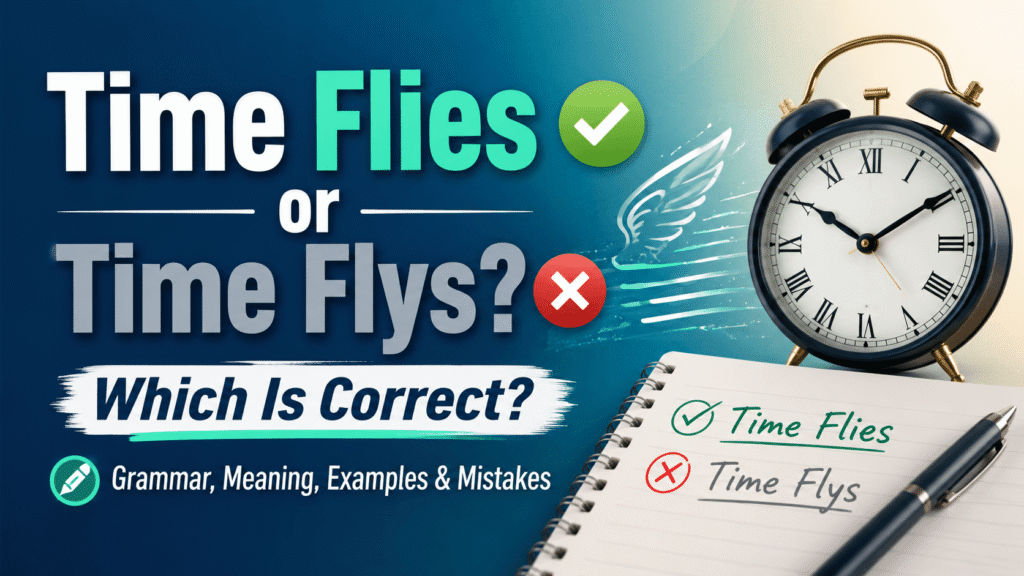

Have you ever paused while writing “time flies” and wondered whether it should actually be “time flys”? You’re not alone. Thousands of people search for this grammar question every month because the two spellings look similar. However, only one is correct in standard English.
The short answer is simple: time flies is correct, while time flys is a spelling mistake in almost every situation.
The confusion usually happens because English spelling rules aren’t always obvious. The verb fly changes to flies when used with a third-person singular subject like time, yet many writers assume they can simply add an -s. That isn’t how this particular word works.
In this guide, you’ll learn:
- Why “time flies” is correct
- The grammar rule behind flies
- Why time flys is incorrect
- What the expression time flies really means
- How to use it naturally in everyday writing
- Examples, grammar tips, and common mistakes to avoid
By the end, you’ll know exactly which spelling to use and why it works.
Quick Answer: Is Time Flies or Time Flys Correct?
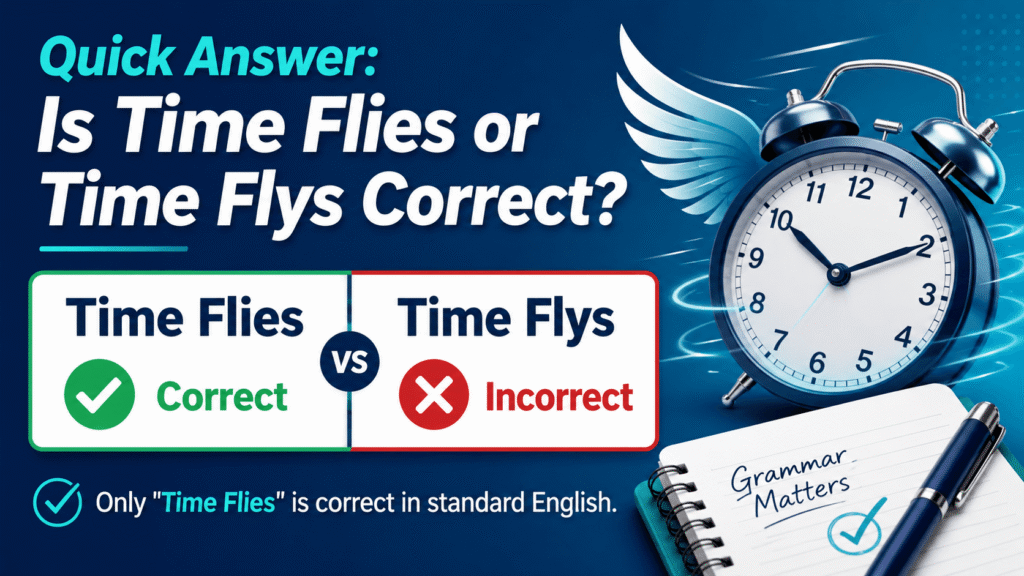
If you’re looking for the fastest answer, here it is.
The correct phrase is “time flies.”
“Time flys” is not correct in standard English.
Here’s a quick comparison.
| Phrase | Correct? | Explanation |
| Time flies | ✅ Yes | Correct grammar and standard English |
| Time flys | ❌ No | Misspelling of flies |
| Time flies by | ✅ Yes | Correct variation of the idiom |
| Time flew | ✅ Yes | Correct past tense |
| Time has flown | ✅ Yes | Correct present perfect form |
Whenever you’re describing how quickly time seems to pass, always write time flies.
What Does Time Flies Mean?
The phrase time flies is an idiom. That means you shouldn’t understand it literally.
Time doesn’t grow wings and fly through the air. Instead, the expression describes a feeling that time passes much faster than expected.
For example:
“It feels like summer just started. Time flies.“
In this sentence, the speaker isn’t talking about physical movement. They’re expressing surprise at how quickly weeks or months have passed.
People often use this expression when they:
- Celebrate birthdays
- Finish a school year
- Reflect on childhood memories
- Watch children grow up
- Complete a long project
- Meet friends after many years
The idiom captures a universal experience. Almost everyone has looked back and wondered where the time went.
Read this also: OC OC Meaning: What Does OC Mean in Text?
Why Flies Is Correct and Flys Is Wrong
The answer comes from a basic English spelling rule.
When a verb ends in a consonant followed by the letter Y, you usually replace the Y with IES when forming the third-person singular present tense.
Here’s how it works.
| Base Verb | Third-Person Singular |
| Fly | Flies |
| Try | Tries |
| Carry | Carries |
| Study | Studies |
| Worry | Worries |
Notice the pattern.
The Y changes to IES.
Because the subject time is singular, the verb must also be singular.
- Time flies. ✅
- Time flys. ❌
This rule applies every time you use the verb fly with a singular subject.
Think of it this way
You wouldn’t write:
- She flys.
- He flys.
- The bird flys.
Instead, you naturally write:
- She flies.
- He flies.
- The bird flies.
The same rule applies to time flies.
Why Doesn’t English Simply Add an “S”?
This is one of the most common questions learners ask.
Many English verbs simply add -s.
For example:
- walk → walks
- jump → jumps
- run → runs
- eat → eats
However, verbs ending in a consonant plus Y follow a different spelling pattern.
Instead of adding S, they change to IES.
Compare these examples.
| Verb | Correct Form |
| Fly | Flies |
| Cry | Cries |
| Reply | Replies |
| Hurry | Hurries |
| Marry | Marries |
Once you recognize the pattern, flies becomes much easier to remember.
Why Do So Many People Write Time Flys?
If time flies is correct, why do so many people search for time flys?
There are several reasons.
The pronunciation sounds almost identical.
When spoken aloud, flies and flys sound the same.
Because English has many irregular spelling rules, people often write words based on how they hear them.
The spelling rule is easy to forget.
Many people remember adding S to verbs but forget the special rule for words ending in Y.
That leads them to type:
- flys
- trys
- carrys
Each of these is incorrect.
Fast typing causes mistakes.
Even experienced writers occasionally type flys by accident, especially when writing quickly.
Fortunately, grammar checkers usually catch the mistake.
What Does the Idiom Time Flies Really Express?
At its core, time flies communicates emotion rather than fact.
It often expresses:
- Surprise
- Nostalgia
- Gratitude
- Reflection
- Appreciation
- Regret
Consider these examples.
“Our vacation is already over. Time flies.“
The speaker feels surprised.
“I can’t believe my daughter is graduating today. Time flies.“
Here, the expression reflects nostalgia and pride.
“We’ve worked together for ten years already. Time flies.“
Now it highlights how quickly a long period seems to have passed.
Notice something important.
The phrase almost always appears after people look back on a period of time.
That’s what gives the idiom its emotional impact.
How to Use Time Flies Correctly
Although the phrase is simple, using it naturally makes your writing sound more fluent.
Here are the most common situations.
Everyday Conversations
Native English speakers use time flies constantly in casual speech.
Examples include:
- “Time flies when you’re busy.”
- “Wow, time flies.”
- “Time flies once you have kids.”
- “Time flies during the holidays.”
The expression feels warm and conversational.
Professional Writing
The idiom also works in business communication when the tone is friendly.
For example:
“It’s hard to believe we’ve reached another successful year together. Time flies, and we’re grateful for your continued support.”
This sounds natural in newsletters, company updates, and anniversary messages.
However, avoid overusing idioms in highly formal documents such as legal contracts or academic papers.
Social Media Posts
The phrase appears frequently in captions.
Examples include:
- “Five years already. Time flies!“
- “Weekend gone already? Time flies.“
- “Our little puppy is now a giant. Time flies.“
The expression quickly communicates emotion without needing many words.
Greeting Cards
You’ll often see time flies in birthday cards, graduation messages, and retirement notes.
Examples:
“Happy birthday! Time flies, but great memories last forever.”
“Congratulations on your graduation. Time flies, and you’ve achieved so much.”
The phrase adds warmth while acknowledging an important milestone.
Quick Grammar Tip
A simple grammar test can save you from writing time flys.
Replace time with he.
If the sentence becomes:
- He flies ✅
then your original sentence should also be:
- Time flies ✅
If he flys looks wrong to you, then time flys is also wrong.
This quick substitution works almost every time.
Key Takeaways So Far
Before moving on, remember these essential points.
- Time flies is the only correct spelling.
- Time flys is a spelling mistake in standard English.
- Flies follows the consonant + Y spelling rule.
- Time flies is an idiom that means time seems to pass quickly.
- The phrase appears naturally in conversations, writing, speeches, greetings, and social media.
- When in doubt, replace time with he. If he flies sounds correct, your sentence is correct too.
Correct Examples of “Time Flies” in Everyday English
Understanding the grammar rule is only half the battle. The next step is learning how native English speakers actually use time flies in real conversations and writing.
The examples below show how the expression fits naturally into different situations.
Everyday Conversation Examples
These are the kinds of sentences you’ll hear in daily life.
- Time flies when you’re spending time with family.
- I can’t believe it’s already Friday. Time flies.
- Time flies once summer vacation begins.
- We started this project only yesterday, yet time flies.
- It feels like we just met. Time flies, doesn’t it?
- Time flies when you’re doing something you enjoy.
- Our children have grown up so quickly. Time flies.
- Looking back, time flies faster than we realize.
Professional Writing Examples
The idiom also works well in emails, newsletters, and workplace messages when the tone is friendly.
- Time flies, and another successful year has come to an end.
- It’s amazing how time flies when a team works toward the same goal.
- Five years have passed since our company launched. Time flies.
- Time flies, and we’re grateful for your continued support.
- Looking back on this project, time flies when you’re solving exciting challenges.
Social Media Caption Examples
Many people use this phrase in short captions because it instantly connects with readers.
- One year later… time flies.
- Weekend already over? Time flies!
- From tiny puppy to full-grown dog. Time flies.
- College graduation already? Time flies.
- Vacation ended way too soon. Time flies.
Greeting Card Examples
The phrase works especially well in messages that celebrate milestones.
Birthday
Happy Birthday! Time flies, but wonderful memories last forever.
Graduation
Congratulations on your graduation. Time flies, and your hard work has truly paid off.
Anniversary
Happy Anniversary! It’s incredible how time flies when two people build a life together.
Retirement
Congratulations on your retirement. Time flies, and you’ve built an amazing career.
Storytelling Examples
The idiom often appears when someone reflects on the past.
It feels like yesterday that we moved into our first home. Now our children are adults. Time flies, and every stage of life brings something worth remembering.
Common Mistakes to Avoid
Even experienced writers occasionally confuse flies, flys, and similar forms. Knowing the most common errors makes them much easier to avoid.
Mistake: Writing “Time Flys”
❌ Time flys when you’re having fun.
✅ Time flies when you’re having fun.
This is the most common mistake because many writers simply add -s instead of changing y to ies.
Mistake: Confusing “Flies” with “Fly’s”
Another frequent error involves the apostrophe.
Compare the two forms.
| Word | Meaning | Example |
| Flies | Verb or plural noun | Time flies quickly. |
| Fly’s | Possessive form | The fly’s wings are transparent. |
Remember that apostrophes show possession, not plural forms or verb endings.
Mistake: Mixing Up Verb Forms
Many learners accidentally use the wrong tense.
| Incorrect | Correct |
| Time fly yesterday. | Time flew yesterday. |
| Time has flew. | Time has flown. |
| Time flys quickly. | Time flies quickly. |
Learning the basic verb forms solves this problem.
The Complete Grammar Breakdown of “Fly”
The word fly changes depending on tense and sentence structure.
Here’s a complete reference table.
| Verb Form | Word | Example |
| Base form | fly | Birds fly south every winter. |
| Third-person singular | flies | Time flies quickly. |
| Present participle | flying | The airplane is flying overhead. |
| Past tense | flew | Time flew during our vacation. |
| Past participle | flown | The years have flown by. |
This pattern follows standard English grammar.
Notice that only the present tense with a singular subject uses flies.
Why the Plural of “Fly” Is “Flies”
The word flies isn’t only a verb. It can also be the plural form of the noun fly, meaning the insect.
Examples include:
- Several flies landed on the window.
- House flies become more active during warm weather.
- The farmer tried to keep flies away from the animals.
The spelling stays exactly the same, although the meaning changes.
Context tells readers whether flies is functioning as a verb or a noun.
Compare these sentences.
| Sentence | Meaning |
| Time flies quickly. | Verb |
| The flies are buzzing. | Plural noun |
Although both use the same spelling, their grammatical roles differ completely.
Other Words That Follow the Same Rule
The spelling pattern behind flies appears throughout English.
Whenever a word ends with a consonant followed by y, the y usually changes to ies.
Here are some common examples.
| Singular | Plural or Third-Person Form |
| Baby | Babies |
| City | Cities |
| Lady | Ladies |
| Story | Stories |
| Party | Parties |
| Family | Families |
| Fly | Flies |
| Try | Tries |
| Carry | Carries |
| Study | Studies |
| Hurry | Hurries |
Recognizing this pattern helps you spell hundreds of English words correctly.
Are There Any Exceptions?
Yes, but they follow a different rule.
If a word ends in a vowel followed by y, simply add -s.
Examples include:
| Base Word | Correct Form |
| Play | Plays |
| Enjoy | Enjoys |
| Stay | Stays |
| Buy | Buys |
| Employ | Employs |
Notice the difference.
- Fly → Flies
- Play → Plays
The letter before y determines which spelling rule applies.
Popular Expressions That Use “Fly”
The verb fly appears in many English idioms.
Learning these expressions expands your vocabulary and helps you understand native speakers more easily.
| Expression | Meaning |
| Time flies. | Time seems to pass quickly. |
| Time flies when you’re having fun. | Enjoyable experiences make time feel shorter. |
| Fly by. | To pass quickly. |
| Fly off the handle. | To lose your temper suddenly. |
| Fly the coop. | To leave home or escape. |
| Fly on the wall. | Someone who secretly observes events. |
| When pigs fly. | Something will never happen. |
Each expression uses the verb fly, but the meaning changes depending on the context.
“Time Flies,” “Time Flies By,” “Time Flew,” and “Time Has Flown”
Many writers wonder which version fits different situations.
Here’s a simple comparison.
| Expression | When to Use It |
| Time flies | Present tense; describing a general truth. |
| Time flies by | Present tense; slightly more conversational. |
| Time flew | Past tense; talking about a completed period. |
| Time has flown | Present perfect; connecting the past to the present. |
Examples
Time flies
Time flies when you’re learning something new.
Time flies by
The weekend always flies by.
Time flew
The vacation flew by before we realized it.
Time has flown
It’s hard to believe ten years have passed. Time has flown.
Each version is grammatically correct. The tense simply changes to match the situation.
Related Words and Synonyms
Although time flies is an established idiom, you can express the same idea in different ways.
Some useful alternatives include:
- Time passes quickly.
- The days go by fast.
- The years slip away.
- Before you know it…
- In the blink of an eye.
- In no time.
- Before long.
- Time races by.
- Time moves quickly.
- The months disappear before you notice.
These alternatives help you avoid repetition while keeping the same overall meaning.
Quick Grammar Tip
Whenever you’re unsure, ask yourself this question:
Would I write “he flies” or “he flys”?
If he flies sounds correct, then time flies is also correct.
That simple check eliminates the mistake almost every time.
Why Do So Many People Search for Time Flys?
If time flies is the correct phrase, why do so many people type time flys into search engines?
The answer comes down to how people learn language. Most English speakers hear the expression long before they write it. Since flies and flys sound almost identical, many people spell the word the way they think it should look.
Several factors contribute to the confusion.
- Pronunciation: Both spellings sound the same in everyday speech.
- Simple assumptions: Many writers believe every verb forms the third-person singular by adding -s.
- Typing quickly: Fast typing often leads to spelling mistakes.
- Learning English: Non-native speakers may not know the consonant + y spelling rule.
- Autocorrect limitations: Some spelling tools miss errors if the surrounding context isn’t clear.
The good news is that once you understand the grammar rule, the mistake becomes easy to avoid.
Remember: Standard English recognizes time flies, not time flys.
Easy Memory Tricks to Remember the Correct Spelling
Grammar rules become much easier to remember when you connect them to simple patterns.
Here are a few practical memory tricks.
Remember the “Baby → Babies” Rule
If you know this word pair:
- Baby → Babies
Then you already know:
- Fly → Flies
Both words follow the same spelling rule.
Think About “He Flies”
Ask yourself:
Would you write He flies or He flys?
The answer is obvious.
Because He flies is correct, Time flies must also be correct.
This quick substitution works in almost every situation.
Look at Similar Verbs
Many common verbs follow the same pattern.
| Base Verb | Correct Form |
| Try | Tries |
| Cry | Cries |
| Carry | Carries |
| Study | Studies |
| Worry | Worries |
| Fly | Flies |
Instead of memorizing one word, remember the entire pattern.
Picture the Expression
Imagine watching an enjoyable vacation end far too quickly.
You smile and say:
“Time flies when you’re having fun.”
Visual memories often stick better than grammar rules.
American English vs. British English
Some spelling differences exist between American and British English.
For example:
| American English | British English |
| Color | Colour |
| Favorite | Favourite |
| Center | Centre |
| Theater | Theatre |
However, time flies is not one of those differences.
Both varieties of English use exactly the same spelling.
| Phrase | American English | British English |
| Time flies | ✅ Correct | ✅ Correct |
| Time flys | ❌ Incorrect | ❌ Incorrect |
Whether you’re writing for readers in the United States, Canada, the United Kingdom, Australia, or New Zealand, the correct phrase remains time flies.
Quick Reference Table
Use this table whenever you need a fast reminder.
| Question | Answer |
| Correct phrase | Time flies |
| Incorrect phrase | Time flys |
| Grammar rule | Consonant + y changes to ies |
| Is it an idiom? | Yes |
| Does British English spell it differently? | No |
| Can “flys” ever be used? | Only as part of certain proper names, brands, or surnames—not as the standard verb form. |
| Meaning | Time seems to pass very quickly. |
Key Differences Between Time Flies and Time Flys
Sometimes a side-by-side comparison makes everything clearer.
| Feature | Time Flies | Time Flys |
| Standard English | ✅ Yes | ❌ No |
| Correct spelling | ✅ Yes | ❌ No |
| Used by native writers | ✅ Yes | ❌ Rarely |
| Found in dictionaries | ✅ Yes | ❌ Not as the standard verb form |
| Appropriate for school and business writing | ✅ Yes | ❌ No |
If you’re writing essays, emails, articles, or social media posts, always choose time flies.
Grammar Tips for Better Writing
Learning one grammar rule often helps you avoid several mistakes.
Keep these tips in mind.
- Change y to ies after a consonant.
- Keep the y when it follows a vowel.
- Match the verb with the subject.
- Read your sentence aloud.
- Proofread before publishing.
Here are two quick examples.
Correct:
- She studies every evening.
- He tries his best.
- Time flies quickly.
Incorrect:
- She studys.
- He trys.
- Time flys.
The correct pattern becomes easier every time you practice it.
Read this also: DHZ Meaning in Text: What It Means and How to Reply
Frequently Asked Questions
Q1: Is it time flies or time flys?
The correct phrase is time flies. The spelling time flys is incorrect in standard English because the verb fly changes to flies in the third-person singular.
Q2: Why is flies spelled with ies?
English spelling rules require most verbs ending in a consonant + y to change y to ies.
Examples include:
- fly → flies
- try → tries
- carry → carries
- study → studies
Q3: Is time flies an idiom?
Yes.
It is an idiomatic expression that means time seems to pass very quickly, especially during enjoyable or memorable experiences.
Q4: Can I ever write time flys?
No, not in standard English.
The only time you may see Flys is as part of a proper noun, such as a family name, business name, or brand. It is not the correct verb form.
Q5: Is time flies when you’re having fun grammatically correct?
Yes.
This is one of the most common English idioms. It means enjoyable activities often make time feel shorter than it really is.
Q6: Is time flies by also correct?
Yes.
Both expressions are correct.
- Time flies.
- Time flies by.
Adding by simply makes the expression a little more conversational.
Q7: What is the past tense of fly?
The past tense is flew.
Example:
Our vacation flew by.
The past participle is flown.
Example:
The years have flown by.
Q8: What is the plural of fly?
The plural noun is flies.
Example:
Several flies landed on the picnic table.
Although the spelling matches the verb form, the meaning depends on the sentence.
Key Takeaways
Here’s a quick recap of everything covered in this guide.
- Time flies is the only correct spelling in standard English.
- Time flys is a spelling mistake.
- Flies follows the consonant + y spelling rule.
- The phrase time flies is an idiom that means time seems to pass quickly.
- Both American and British English use time flies.
- The word flies can function as both a verb and the plural form of the noun fly.
- Simple memory tricks can help you remember the correct spelling every time.
Conclusion
If you’ve ever hesitated between time flies and time flys, you now have a clear answer.
Time flies is the correct expression in standard English. The verb fly changes to flies because it follows the consonant + y → ies spelling rule. As a result, time flys is considered a spelling error in everyday, academic, and professional writing.
Beyond the grammar, time flies has become one of the most recognizable English idioms because it captures a feeling almost everyone shares. Whether you’re celebrating a birthday, remembering childhood, finishing a vacation, or marking a career milestone, the phrase reminds us how quickly life’s moments seem to pass.
Whenever you’re unsure, use this simple test:
He flies. Time flies.
If the first sentence looks right, the second one is right too.
Keep this rule in mind, and you’ll never have to wonder whether to write time flies or time flys again.


Pingback: Is Jit a Slur? Meaning, Context, and Examples