
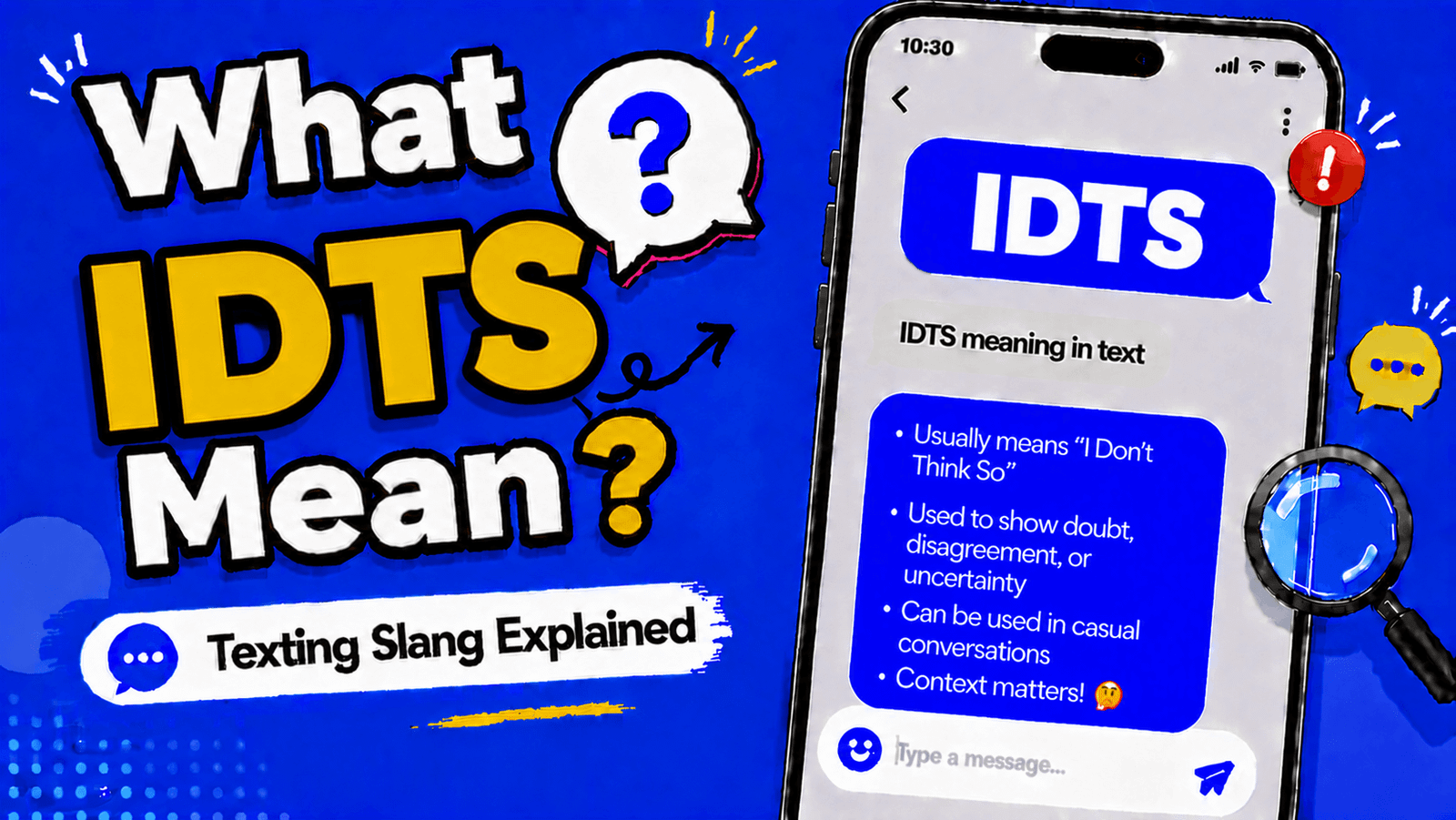
IDTS meaning in Text is simple once you know the short form. IDTS usually means “I don’t think so” in a text message, chat, or casual message.
You may see this abbreviation on Snapchat, Instagram, TikTok, in a DM, or inside a group chat. However, the exact meaning can change with the context, tone, platform, and the person using it. Sometimes it sounds polite. Other times, it can feel blunt, unsure, or even sarcastic.
So, if someone sends you IDTS, read the full conversation before you reply. In most cases, they are showing doubt, mild disagreement, or a soft “no.” Next, the examples and replies will help you understand how to use it naturally.
Quick Answer: What Does IDTS Mean?
IDTS means “I don’t think so” in text. People use it to express doubt, mild disagreement, or a soft “no” in casual conversations. It can sound polite, unsure, sarcastic, or dismissive depending on the context, tone, and relationship between the people chatting.
Quick Facts About IDTS
| Detail | Meaning |
| Abbreviation | IDTS |
| Common Meaning | I don’t think so |
| Used In | Text messages, Snapchat, Instagram, TikTok, DMs, group chats |
| Tone | Casual, doubtful, unsure, sometimes sarcastic |
| Best For | Saying “probably not” or politely disagreeing |
| Example | “IDTS, I’m busy tonight.” |
| Can It Have Other Meanings? | Rarely, but context matters |
What Does IDTS Mean in Text?
In texting, IDTS means “I don’t think so.” It is a short way to say you doubt something, disagree with someone, or do not believe something will happen.
For example, if someone asks, “Are they coming tonight?” and you reply, “IDTS,” you mean, “I don’t think so.”
The tone depends on the message. Sometimes, IDTS sounds soft and polite. However, it can also sound dry or sarcastic if the conversation is tense.
In simple words, IDTS is like saying:
“I doubt it.”
“Probably not.”
“I don’t believe so.”
“I’m not sure that’s true.”
So, before you reply, read the full message. The words around IDTS will help you understand the real meaning.
How People Use IDTS in Conversations
People use IDTS when they want to respond quickly. It is common in casual online conversations where short replies are normal.
Text Messages
In text messages, IDTS is often used as a quick answer.
Example:
“Are we still going?”
“IDTS, it’s raining.”
Here, IDTS means the plan probably will not happen.
Snapchat
On Snapchat, IDTS may appear in private chats or story replies.
Example:
“Do you think he likes me?”
“IDTS, sorry.”
This sounds honest but a little direct.
On Instagram, IDTS can show doubt in DMs or comments.
Example:
“Is this outfit too much?”
“IDTS, it looks good.”
Here, IDTS means “I don’t think so,” but in a positive way.
TikTok Comments
On TikTok, people may use IDTS to disagree with a video, comment, or opinion.
Example:
“IDTS, that theory makes no sense.”
In this case, IDTS shows disagreement.
Group Chats
In group chats, IDTS can help someone reply fast without typing a full sentence.
Example:
“Can we finish this project tonight?”
“IDTS, we need more time.”
Here, it sounds practical and realistic.
Dating Chats
In dating chats, IDTS can sound gentle or awkward depending on the message.
Example:
“Do you think we should meet today?”
“IDTS, I’m really tired.”
This is a soft way to say no.
Friendly Conversations
Friends may use IDTS in a casual or funny way.
Example:
“You’re paying for everyone, right?”
“IDTS.”
Here, IDTS sounds playful.
Examples of IDTS in Text Messages
Example 1:
Person A: Are you coming to the party?
Person B: IDTS, I have work early.
Here, IDTS means “I don’t think so.” Person B probably cannot come.
Example 2:
Person A: Is she mad at me?
Person B: IDTS, she seemed fine.
In this case, IDTS means the person does not believe she is mad.
Example 3:
Person A: Will it rain later?
Person B: IDTS, the sky looks clear.
Here, IDTS shows doubt about the rain.
Example 4:
Person A: Do you think we passed?
Person B: IDTS, that test was hard.
This means Person B does not feel confident.
Example 5:
Person A: Is my message rude?
Person B: IDTS, it sounds normal.
Here, IDTS means “I don’t think it is rude.”
Example 6:
Person A: Should I text him again?
Person B: IDTS, give it time.
In this example, IDTS is advice. Person B thinks texting again is not a good idea.
Example 7:
Person A: Are they still open?
Person B: IDTS, it’s already late.
Here, IDTS means the place is probably closed.
Example 8:
Person A: Do you think this is fake?
Person B: IDTS, it looks real to me.
This means Person B does not think it is fake.
Example 9:
Person A: Is this a good idea?
Person B: IDTS, honestly.
Here, IDTS sounds direct. It means Person B disagrees.
Example 10:
Person A: Did I overreact?
Person B: IDTS, you had a reason.
In this case, IDTS gives support.
How to Reply to IDTS
Your reply should match the tone of the conversation.
Friendly Reply
“Yeah, you’re probably right.”
“That makes sense.”
“Okay, I get it.”
Casual Reply
“Fair.”
“Same.”
“Probably not then.”
Flirty Reply
“IDTS? Now I need to convince you.”
“Maybe I can change your mind.”
“Okay, but I still think yes.”
Confused Reply
“What does IDTS mean?”
“Do you mean ‘I don’t think so’?”
“Wait, are you saying no?”
Polite Reply
“Thanks for being honest.”
“I understand.”
“No problem.”
Funny Reply
“Wow, straight to the point.”
“IDTS was cold.”
“Okay, message received.”
Other Possible Meanings of IDTS
IDTS almost always means “I don’t think so” in texting. Still, context matters because people may use abbreviations in different ways.
| Meaning | Where It Is Used | Example | How to Understand It |
| I don’t think so | Texting and social media | “IDTS, he forgot.” | The person doubts something. |
| I do think so | Rare typo or mistaken use | “IDTS, it’s true.” | The sentence may not fit, so ask. |
| IDT + S typo | Fast typing | “IDTS what to do.” | They may have typed incorrectly. |
| Custom meaning | Private chats or inside jokes | “That’s so IDTS.” | Ask if it does not make sense. |
In most cases, you should read IDTS as “I don’t think so.” However, if the sentence feels strange, the person may have made a typo.
IDTS Meaning on Snapchat, Instagram, and TikTok
The IDTS meaning on Snapchat, Instagram, and TikTok is usually the same. It means “I don’t think so.”
On Snapchat, IDTS often appears in private chats. For example, someone may use it to answer a question quickly.
On Instagram, it can appear in DMs, captions, or comments. Someone might use it to disagree with an opinion or answer a friend.
Meanwhile, on TikTok, IDTS is often used in comments. People use it when they doubt a claim, reject a theory, or disagree with a take.
However, tone matters on every platform. IDTS can sound gentle, serious, sarcastic, or blunt.
Emotional or Practical Meaning of IDTS
IDTS is not only a short form. It also shows how someone feels about the situation.
It can show doubt, hesitation, disagreement, or careful thinking. For example, “IDTS” can sound softer than a direct “no.”
Still, it can also sound cold if there is no extra context. Because of this, adding a short reason can make the message clearer.
Instead of only saying “IDTS,” someone might say, “IDTS, but I could be wrong.” That sounds more polite.
How IDTS Is Used in Daily Life
People use IDTS in daily life when they want to keep a chat short. It works well when the answer is not a strong yes or no.
You may see it in conversations about plans, school, dating, drama, weather, games, or social media posts.
For example, a friend may ask, “Will the teacher check homework?” You could reply, “IDTS.” That means you do not think the teacher will check it.
So, IDTS is useful when you want to sound casual and quick.
Is IDTS Formal or Informal?
IDTS is informal. It is best for casual texting and social media chats.
| Situation | Should You Use IDTS? |
| Texts with friends | Yes |
| Social media comments | Yes |
| Dating apps | Sometimes |
| Work emails | No |
| School assignments | No |
| Professional messages | No |
You can use IDTS with friends, classmates, or people who understand texting slang.
However, avoid it in work emails, school papers, or serious messages. Instead, write “I don’t think so” or “I’m not sure that is correct.”
Common Mistakes People Make With IDTS
One common mistake is thinking IDTS is always rude. It is not rude by itself. However, it can sound rude if the conversation is serious.
Another mistake is using IDTS with people who may not know texting slang. If they do not understand it, your message may confuse them.
Also, some people use IDTS when they should give more detail. For example, “IDTS” may feel too short if someone is asking for advice.
Before replying, check the full message. Ask yourself: Is the person being polite, sarcastic, unsure, or dismissive?
Similar Text Abbreviations and Slang
| Slang Term | Meaning | How It Is Different from IDTS |
| IDK | I don’t know | Shows lack of knowledge, not disagreement |
| IDC | I don’t care | Sounds more careless or blunt |
| IDGAF | I don’t give a f*** | Much stronger and more rude |
| IMO | In my opinion | Shares a view instead of saying no |
| TBH | To be honest | Introduces honesty or opinion |
| NGL | Not gonna lie | Adds honesty, often before an opinion |
| FR | For real | Shows agreement or surprise |
| Nah | No | More direct than IDTS |
Easy Way to Remember IDTS
A simple way to remember IDTS is:
IDTS = I Don’t Think So
Think of it as a softer version of “no.” If someone says IDTS, they usually mean “probably not” or “I doubt it.”
FAQs About IDTSmeaning in Text
Q1.What does IDTS mean in texting?
IDTS means “I don’t think so” in texting. People use it to show doubt, disagreement, or uncertainty in a short way.
Q2.What does IDTS mean on Snapchat?
On Snapchat, IDTS usually means “I don’t think so.” It may be used in private chats, story replies, or quick answers between friends.
Q3.What does IDTS mean on Instagram?
On Instagram, IDTS means “I don’t think so.” People may use it in comments or DMs when they disagree or doubt something.
Q4.What does IDTS mean on TikTok?
On TikTok, IDTS often appears in comments. It usually means the person disagrees with a claim, theory, or opinion.
Q5.Is IDTS rude?
IDTS is not always rude. However, it can sound blunt if the message is serious or if no reason is given.
Q6.How do I reply to IDTS?
You can reply with “fair,” “why not?” or “that makes sense.” If you are confused, simply ask, “What do you mean by IDTS?”
Q7.Can IDTS have more than one meaning?
In most casual chats, IDTS means “I don’t think so.” However, it can be misused as a typo or private joke, so context matters.
Conclusion
IDTS meaning in text is simple once you know the full form. IDTS usually means “I don’t think so.”
People use it to show doubt, disagreement, or a soft no in texting and social media chats.
However, the tone can change depending on the context. It may sound polite, unsure, sarcastic, or direct.
If you are not sure what someone means, ask for clarification. That is better than guessing the wrong tone.