

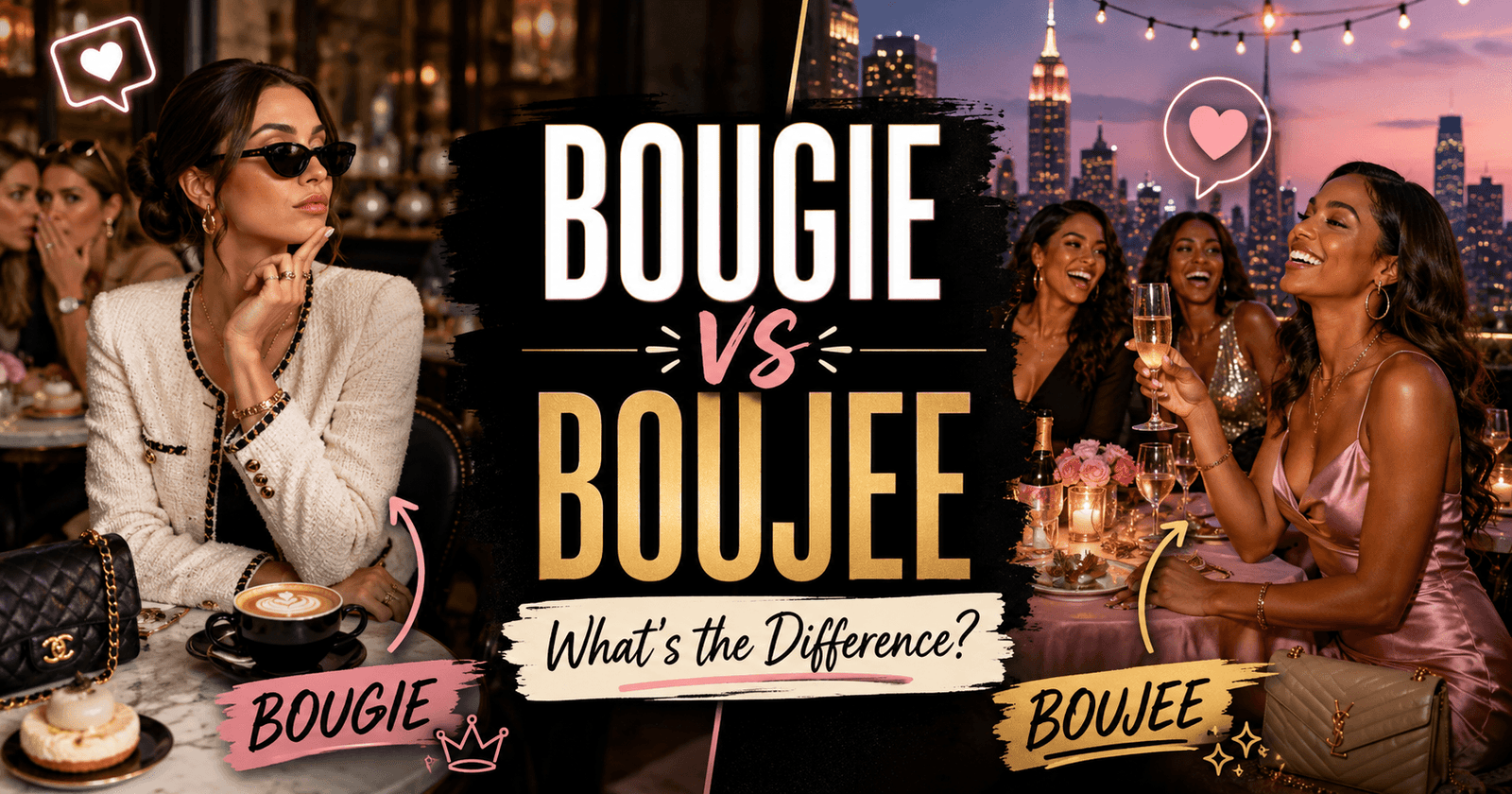
If you’ve ever wondered whether you should say bougie or boujee, you’re not alone. These two spellings are often used interchangeably in text messages, social media posts, captions, and everyday conversations, but they can carry slightly different meanings depending on the context. Both words are connected to ideas of luxury, expensive tastes, high-class lifestyles, and sometimes pretending to be more sophisticated or wealthy than you really are.
The confusion becomes even greater when words like bourgeoisie and bourgie enter the conversation. So, is bougie the correct spelling? Is boujee just slang? And why do people use these words to describe everything from fancy restaurants and designer clothes to friends with expensive tastes?
In this complete guide, you’ll learn the bougie vs boujee meaning, the difference between the two terms, their historical roots, and how modern slang and pop culture changed their usage. You’ll also see real examples that make it easier to understand when to use bougie, boujee, or neither. By the end, you’ll be able to use these popular slang terms confidently in texts, conversations, and social media captions.
Quick Answer: Bougie vs Boujee in Simple Words
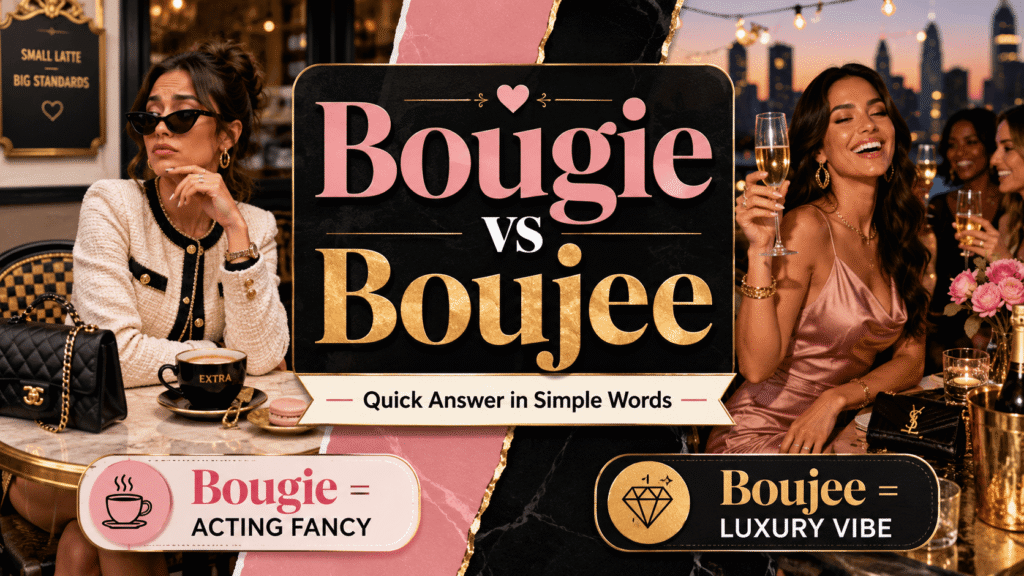
- Bougie → Acting high-class or trying too hard to appear fancy
- Boujee → Living or enjoying a luxury lifestyle with confidence
Simple way to remember:
- Bougie = judgment vibe
- Boujee = lifestyle vibe
If someone says, “That café is so bougie,” they often mean it feels overly fancy or pretentious.
If someone says, “I’m feeling boujee today,” they’re embracing luxury energy.
What Does Bougie Mean? (Real Definition Explained)
The word bougie comes from bourgeois, a French term that originally described the middle class.
Over time, English slang reshaped it.
Today, bougie describes people, habits, or choices that seem overly classy, expensive, or trying too hard to appear elite.
Key traits of “bougie” behavior:
- Preferring luxury brands over practicality
- Choosing “aesthetic” over comfort or value
- Acting superior because of lifestyle choices
- Over-polishing everyday things
Example:
- “He refuses normal coffee and only drinks artisan cold brew. That’s so bougie.”
Important nuance:
Bougie is not always an insult. Sometimes it’s playful teasing. But tone matters.
As linguist Dr. Lauren Hall notes:
“Bougie often reflects social observation, not just insult. It highlights lifestyle performance more than wealth itself.”
Read this also: What Does MYF Mean in Text?
What Does Boujee Mean? (Modern Slang Breakdown)
Unlike bougie, boujee is modern, expressive, and tied to pop culture.
It became widely known after the song “Bad and Boujee” by Migos, which pushed it into mainstream internet language.
Boujee means:
- Living or acting in a luxury-inspired way
- Enjoying expensive things confidently
- Showing off success or upgrades without shame
Key traits of “boujee” behavior:
- Posting luxury trips or meals online
- Celebrating small wins with big energy
- Dressing stylish even for casual events
- Enjoying “soft life” aesthetics
Example:
- “We booked a rooftop dinner just for fun. Very boujee vibes.”
Important nuance:
Boujee is usually positive or self-empowering. It’s about owning your lifestyle.
Bougie vs Boujee: The Real Differences Explained
Let’s simplify the contrast clearly.
| Feature | Bougie | Boujee |
| Tone | Slightly sarcastic or critical | Positive or confident |
| Meaning | Trying to look fancy | Enjoying luxury lifestyle |
| Origin | Bourgeois (French class term) | Pop culture + music slang |
| Emotion | Judgment or teasing | Celebration or pride |
| Usage | “He is so bougie” | “She is living boujee life” |
The real takeaway:
- Bougie judges behavior
- Boujee embraces identity
Where These Words Came From (Cultural Origin Story)
Understanding origin helps you never forget the difference.
Bougie origin:
- Comes from French word bourgeoisie
- Refers to middle-class society
- In history, it described people focused on comfort and material lifestyle
- Entered English slang as “bougie” meaning pretentious or upscale behavior
Boujee origin:
- Modern American slang evolution
- Popularized by hip-hop culture
- Boosted globally by Migos in 2016
- Later spread through TikTok, Instagram, and meme culture
Cultural shift:
Language expert Dr. James Carter explains:
“Boujee shows how slang evolves faster in digital culture than in dictionaries.”
Bougie vs Boujee in Real-Life Situations
Let’s bring it into everyday life so you actually feel the difference.
When someone is “bougie”:
- Orders avocado toast every morning at a fancy café
- Refuses simple brands for aesthetic packaging
- Says things like “I only drink imported water”
👉 Tone: Slightly mocking, observational
When someone is “boujee”:
- Plans a luxury-themed birthday dinner for fun
- Posts vacation photos with confidence
- Enjoys expensive things without apology
👉 Tone: Admiring or playful
Bougie vs Boujee in Social Media Culture
Social media made both words explode.
Bougie online usage:
- Used in memes calling out “fake fancy” behavior
- Often paired with jokes about overpriced habits
- Example caption: “Me being bougie at Starbucks again.”
Boujee online usage:
- Used for aesthetic lifestyles
- Travel, fashion, food content
- Example caption: “Boujee weekend loading…”
Why it matters:
Social platforms reward identity expression. These words became shortcuts for personality types.
Common Mistakes People Make
Even native speakers mix them up.
Mistake 1: Thinking they mean rich
Neither word strictly means wealthy. They describe attitude.
Mistake 2: Using boujee in insults
Boujee is rarely insulting. It usually feels positive.
Mistake 3: Using bougie in formal writing
These are slang terms. They don’t belong in academic or professional documents.
Mistake 4: Interchanging both words
Tone changes completely when swapped.
Example:
- “She’s bougie” → can sound like judgment
- “She’s boujee” → sounds like praise
Easy Memory Tricks to Never Forget Again
Here’s a simple way to lock it in your mind:
- Bougie = “Judge the vibe”
- Boujee = “Enjoy the vibe”
Another trick:
- Bougie has “gie” like “judgie” (judging energy)
- Boujee has extra “ee” like “yee” (excited energy)
Small mental hooks make it stick.
Real-Life Mini Case Study: Two Friends, Two Words
Let’s make it real.
Scenario:
Two friends go out for dinner.
- Friend A orders the cheapest meal and says, “This place is so bougie.”
- Friend B orders a luxury dish and posts it online saying, “Feeling boujee tonight.”
Same restaurant. Same moment. Different mindset.
That’s the real difference.
Synonyms and Related Words
Words similar to bougie:
- Pretentious
- Fancy
- High-maintenance
- Aesthetic-driven
Words similar to boujee:
- Luxe
- Glam
- Extra (in a positive way)
- High-energy lifestyle
Related Confusing Words People Mix
Bourgeois vs Bougie:
- Bourgeois = formal class term
- Bougie = slang adaptation
Bougie vs Fancy:
- Fancy = neutral description
- Bougie = emotional judgment attached
FAQs
Bougie usually means acting fancy or pretentious, while boujee describes enjoying or showing a luxury lifestyle with confidence.
Both are correct. The difference is not spelling but meaning and tone.
Boujee is usually a compliment or playful comment about someone’s stylish or luxury lifestyle.
Bougie comes from the French word bourgeoisie, while boujee became popular through modern music and internet culture.
Yes, both are widely used on social media. Just choose bougie for sarcastic tone and boujee for confident or aesthetic lifestyle posts.
Conclusion
At the end of the day, the boujee or bougie confusion is really about tone, not just spelling. Both words come from the same historical root, yet they evolved in very different directions. One feels like a soft judgment on “trying too hard,” while the other celebrates a flashy, confident lifestyle without apology.
If you remember one simple idea, it will save you every time. Bougie points toward behavior that seems overly fancy or pretentious. Boujee reflects pride in luxury, success, or aesthetic living. Neither word is about actual wealth. It’s more about attitude, expression, and how someone presents their lifestyle.
So next time you’re writing a caption, chatting online, or just joking with friends, think about the vibe first. That’s what really decides which word fits.