
Searching for blog wizzydigital org can lead to a surprisingly mixed set of results. Some pages describe it as a digital marketing guide. Others make it sound like a blogging platform, business toolkit, or all-in-one growth system. Those descriptions often promise more than the website clearly shows.
WizzyDigital.org is best understood as a broad online publication with a strong digital-business theme. Its main navigation focuses on web design, digital marketing, and search engine optimization. However, its wider article feed stretches into artificial intelligence, software development, business operations, gaming, finance, online entertainment, and other specialized industries.
That range can help readers discover new ideas. It can also make the website feel like a crowded marketplace where several conversations happen at once. One article may explain technical SEO. The next may discuss customer relationship management software, online gaming, workplace systems, or financial technology.
Therefore, the smartest approach isn’t to treat every page as equally authoritative. Instead, use the website as a starting point. Find the subject that matters to you, examine the article carefully, and verify important claims before making costly or high-risk decisions.
This guide explains what WizzyDigital.org actually publishes, how its content is organized, who may benefit from it, and where readers should remain cautious.
What Is blog wizzydigital org?
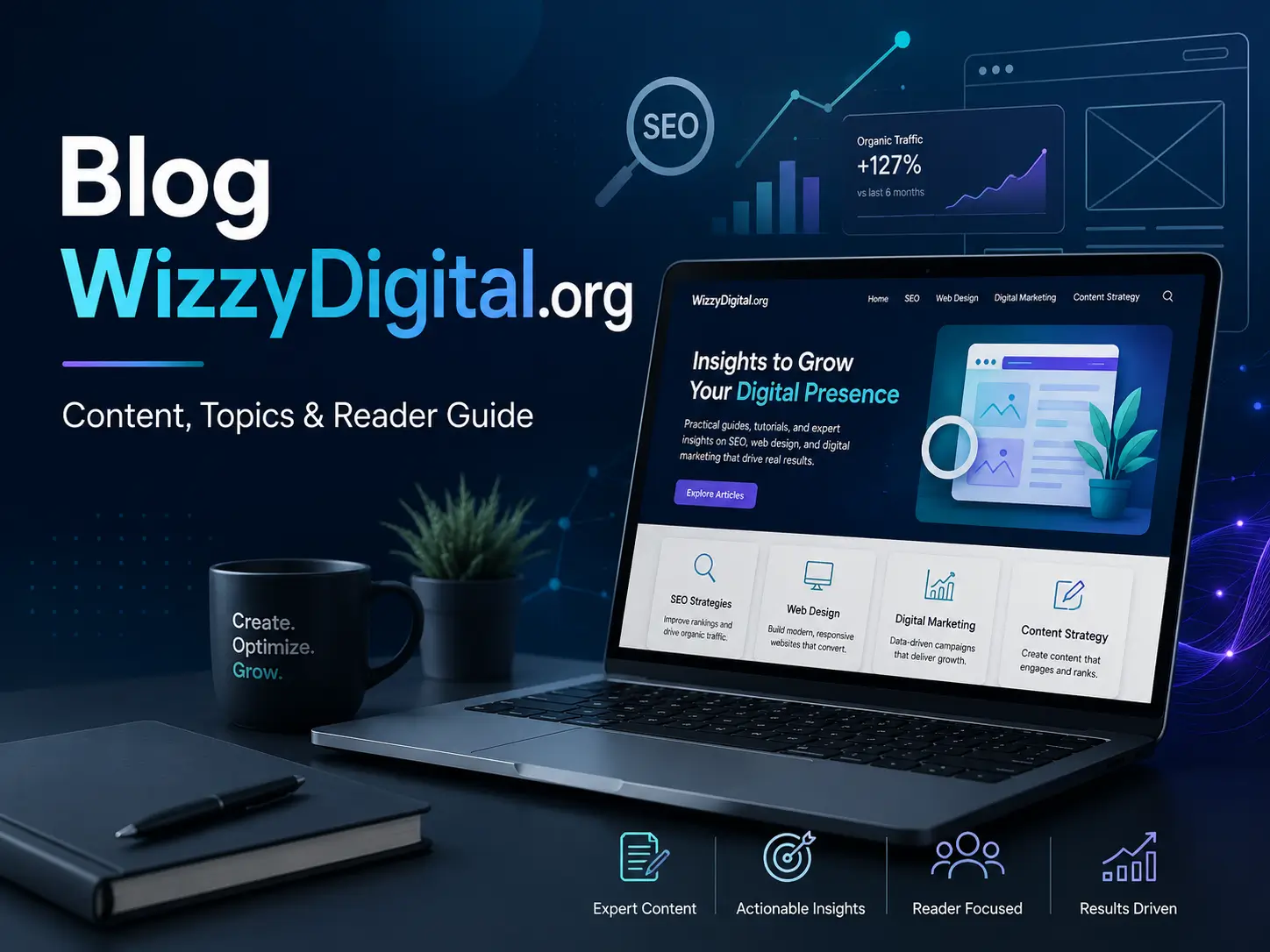
WizzyDigital.org is a content-focused website that presents itself around web design, digital marketing, SEO, and SEM. Its homepage currently includes navigation links for Web Design, Digital Marketing, SEO, About, and Contact. It also displays featured articles and a much larger stream of posts from several industries.
The phrase people type into search engines doesn’t necessarily describe a separate website. In the reviewed navigation, there isn’t a clearly presented public subdomain functioning as an independent blog. Instead, the articles appear within the main WizzyDigital.org domain and its category archives.
That distinction matters. A search phrase may look like a web address even when people simply use it as a keyword. Someone searching for the site’s posts may add words such as “blog,” “posts,” “start,” or “get” without knowing the website’s actual structure.
The Meaning Behind the Search Phrase
When readers use this search term, they may be trying to accomplish several different things:
- Find the official WizzyDigital.org website
- Read its recent articles
- Understand what the publication covers
- Learn whether the site is trustworthy
- Locate its SEO or marketing guides
- Discover whether users can publish their own content
- Find an author, category, or specific article
- Determine whether the site offers digital services
These intentions aren’t identical. A person looking for SEO advice needs different information from someone who wants to create an account or submit a post.
That’s why a useful guide must separate confirmed facts from assumptions. The website clearly contains articles and category archives. It also positions itself around digital services. However, its visible navigation doesn’t clearly advertise an open blogging platform where anyone can register and begin publishing.
A Publication With Service-Oriented Positioning
WizzyDigital.org isn’t presented only as an editorial magazine. Its About page says its mission involves helping businesses and individuals thrive online. It also refers to website design and digital marketing services tailored to different needs.
The homepage uses similar language. It calls the website a:
“gateway to top-tier services in web design, digital marketing, SEO, and SEM.”
That wording creates a dual identity.
On one side, the website functions like a publication. It contains article archives, bylines, category pages, excerpts, and internal navigation.
On the other side, it uses agency-style language about online presence, conversions, traffic, and business growth.
Readers should keep both roles in mind. Educational content may introduce useful concepts. Service-oriented language may also promote expertise or commercial value. Neither is automatically a problem. Still, knowing the difference helps you evaluate the purpose behind each page.
Is the Website Free to Read?
The pages reviewed for this guide opened without a login, paid subscription, or visible membership requirement. Readers could access the homepage, category archives, About page, and individual articles publicly.
That doesn’t guarantee every future resource will remain open. Websites can introduce paid products, gated downloads, or member-only areas over time. At present, though, the main editorial content appears publicly accessible.
This open format makes browsing easy. You can move between categories, compare headlines, and read individual posts without creating an account.
What Does the WizzyDigital.org Blog Actually Cover?
The website’s name and navigation suggest a focused digital publication. In practice, the content library is much broader.
Its core categories remain clear:
- Search engine optimization
- Digital marketing
- Web design
However, the homepage and article archives also include subjects connected to software, artificial intelligence, online platforms, business processes, entertainment, finance, gaming, and regulated industries.
The uploaded collection of site headings shows the same pattern. Alongside SEO and web-design articles, it includes topics involving workflow automation, machine learning, e-commerce, cryptocurrency, gambling, sports, staffing, financial technology, and digital products.
Search Engine Optimization
SEO is one of the website’s most coherent content areas.
The dedicated SEO archive includes articles about link building, medical SEO, crawler tools, click depth, international search strategy, local visibility, landing-page performance, off-page SEO, and search trends. The archive currently spans multiple pages rather than a handful of isolated posts.
Common SEO subjects include:
- Technical website audits
- Internal linking
- Crawl depth
- Search visibility
- Local optimization
- Link acquisition
- Website performance
- Landing-page speed
- International SEO
- Keyword strategy
- Content relevance
- Industry-specific optimization
These subjects appeal to business owners, marketers, bloggers, and website administrators.
A beginner may use an article to understand basic terminology. For example, an SEO crawler article explains how automated tools inspect status codes, metadata, headings, redirects, canonical addresses, indexing controls, and internal links.
An experienced marketer may use the same article as a product-discovery starting point. However, a specialist will probably need deeper technical documentation before choosing or configuring a tool.
That difference is important. Introductory articles help you learn the landscape. They don’t always replace product manuals, controlled tests, official search documentation, or hands-on auditing.
Digital Marketing
The Digital Marketing archive is even broader. Its visible topics include conversion funnels, accessibility, machine learning, search intent, push notification advertising, affiliate links, digital experience monitoring, influencer marketing, and customer loyalty platforms. The category currently contains thirteen pages of archived posts.
This variety reflects how wide digital marketing has become.
A modern marketing strategy may involve:
- Search traffic
- Paid advertising
- Email campaigns
- Influencer partnerships
- Affiliate systems
- Customer retention
- Push notifications
- Content production
- Accessibility
- Analytics
- Automation
- Artificial intelligence
- Conversion design
The archive doesn’t limit itself to theory. Several articles examine specific tools, software platforms, industries, or marketing formats.
That practical angle can help readers understand how a strategy works in context. An article about search intent may explain why a person searching “best accounting app” needs different content from someone searching “how accounting software works.” Another post may compare customer loyalty systems or discuss how brands use visual content.
However, product-focused content deserves careful reading. A detailed article may still reflect a commercial relationship, affiliate incentive, brand contribution, or promotional purpose. Readers should look for clear disclosures and independent evidence before accepting a recommendation.
Website Design and User Experience
The Web Design archive covers subjects such as website security, user decision-making, professional design processes, lightweight digital experiences, interface consistency, managed WordPress hosting, design tools, timed offers, and user experience. It currently spans six archive pages.
This section is useful because web design affects more than appearance.
A strong website must balance several needs:
- Visual clarity
- Navigation
- Accessibility
- Speed
- Mobile responsiveness
- Security
- Conversion flow
- Brand consistency
- Content readability
- Technical stability
Imagine walking into a store where every aisle leads somewhere useful. Signs are clear, checkout is simple, and nothing blocks your path. Good web design works the same way.
Now imagine a store with flashing banners, narrow aisles, hidden prices, and three doors labeled “Checkout.” That experience resembles a poorly designed website.
The archive’s emphasis on speed and usability reflects real concerns. Visitors often abandon confusing or sluggish pages. Yet design advice should still be tested against a specific audience. A minimalist layout may work beautifully for a consulting company. The same layout may frustrate users browsing a large product catalog.
Website Development and Technical Infrastructure
Several articles move beyond visual design into the technical foundation beneath a website.
Covered subjects include:
- Managed hosting
- Frontend systems
- Development tools
- Software stacks
- proxy servers
- Virtual private servers
- Application testing
- Technical debt
- System integrations
- Cross-platform development
These topics matter because a website’s appearance represents only the surface.
Behind every page sits a combination of servers, databases, code, third-party services, security controls, and content-management systems. A polished interface can still fail when the infrastructure underneath it cracks.
For example, choosing a technology stack involves trade-offs. A lightweight solution may launch quickly, while a larger custom system may offer greater control. However, the custom option may require more maintenance, specialized developers, and a bigger budget.
Likewise, managed hosting can simplify security and updates. It can also cost more than basic shared hosting.
The website’s technical articles can introduce these choices. Readers should still compare current product documentation because prices, capabilities, and platform policies change frequently.
Artificial Intelligence and Automation
Artificial intelligence appears across several sections of the site rather than inside one dedicated category.
Current and archived topics reference:
- Machine learning
- Content creation tools
- AI-assisted workflows
- Business application integrations
- Image generation
- Passport-photo tools
- Automated data acquisition
- Customer insights
- Minimum viable product development
This scattered presence mirrors the wider digital market. AI is no longer treated as one isolated subject. It now intersects with marketing, design, software development, customer service, analytics, and content operations.
However, AI articles age quickly.
A feature available today may disappear after a platform update. Pricing may change. A tool may alter its privacy terms, output limits, or licensing rules. Therefore, readers should check:
- The article’s date
- The product’s official documentation
- Current pricing
- Data-handling policies
- Commercial-use terms
- Human review requirements
- Accuracy limitations
A glowing article can make a tool sound magical. Reality is usually messier. AI can save time, but it can also produce errors with breathtaking confidence.
Business Operations and Software
The website also publishes articles about business systems that don’t fit neatly within traditional marketing.
Examples include:
- Customer relationship management platforms
- Human resources automation
- Workflow tools
- Sales operations
- Data governance
- Financial talent management
- Staff augmentation
- Digital signage
- Equipment policies
- Service management software
This material may help managers understand how digital tools affect everyday operations.
A roofing company, for example, may use a CRM system to track leads, schedule estimates, follow up with prospects, and close jobs. That subject touches marketing, sales, and operations at the same time.
A company considering staff augmentation may need to weigh speed against continuity. External specialists can fill a skills gap quickly. However, internal knowledge may walk out the door when the contract ends.
These are valuable business questions. Still, readers should distinguish general guidance from legal, tax, employment, or procurement advice.
Finance, Technology, and Specialized Industries
The broader article feed includes content involving financial technology, trading tools, online payments, cryptocurrency, accounting, business storage, and international financial topics.
It also reaches specialized industries such as:
- Healthcare marketing
- Legal services
- Roofing
- Sports
- Entertainment
- Creator platforms
- Gaming
- E-commerce
- Construction
- Telecommunications
This diversity can expose readers to industries they may not otherwise explore. It also creates uneven expectations.
An SEO article can often remain useful for months with minor updates. A financial article may become outdated after a regulation, rate change, market movement, or policy announcement.
The more sensitive the subject, the more independent verification matters.
Gaming, Gambling, and Other Regulated Niches
The website publishes a substantial amount of material related to online casinos, betting platforms, slot games, promotional codes, gaming markets, and cryptocurrency-based gambling.
This content deserves a separate explanation because it differs from ordinary web-design education.
Regulated entertainment topics may involve:
- Age restrictions
- Licensing
- Advertising rules
- Deposit requirements
- Regional laws
- Tax obligations
- Financial risk
- Responsible-use concerns
- Platform security
An article describing a bonus or gaming platform may explain how an offer works. That doesn’t mean the platform is legal, safe, or appropriate in every location.
Readers should never rely on a marketing-style article alone when money, identity documents, or local laws are involved.
A broad website can help you discover a subject. It shouldn’t become your only source for a high-stakes decision.
Content Coverage at a Glance
| Content area | Typical subjects | Best suited for | What to verify |
|---|---|---|---|
| SEO | Audits, rankings, links, crawling, local search | Marketers, site owners, bloggers | Search documentation and current tool features |
| Digital marketing | Content, ads, funnels, influencers, retention | Businesses and creators | Platform rules, disclosures, and campaign data |
| Web design | UX, speed, hosting, navigation, conversion | Designers, founders, website owners | Technical requirements and user testing |
| Software and AI | Automation, development, machine learning | Teams exploring new tools | Pricing, privacy, licensing, and limitations |
| Business operations | CRM, HR, staffing, workflows | Managers and service companies | Legal, financial, and implementation details |
| Regulated niches | Betting, casinos, finance, crypto | Specialized adult readers | Local law, licensing, risks, and eligibility |
How WizzyDigital.org Organizes Its Content
A broad publication lives or dies by its organization. Without useful categories, readers end up digging through a digital attic.
WizzyDigital.org uses a familiar structure. It has a homepage, primary navigation, category archives, individual article pages, About and Contact pages, and policy links.
Main Navigation
The primary menu currently highlights:
- Home
- Web Design
- Digital Marketing
- SEO
- About
- Contact
This menu tells readers which subjects the website considers central. It also provides a faster path than scrolling through the entire homepage.
The three main editorial categories act like entry doors.
Choose SEO when you need search visibility, technical optimization, or ranking advice.
Choose Digital Marketing when you need information about content, advertising, audience growth, or conversion.
Choose Web Design when your question involves usability, hosting, interface design, speed, or website construction.
Homepage Sections
The homepage combines several formats.
It begins with branding and service-oriented language. It then highlights web-design content, SEO articles, digital marketing features, and editor-selected posts. Below those sections sits a much longer feed of articles covering numerous subjects.
This layout supports discovery. You may arrive for an SEO article and notice a related piece about website speed.
However, the long feed can dilute focus. A visitor seeking straightforward digital guidance may encounter unrelated finance, gaming, sports, or entertainment headlines.
The homepage works best as a browsing tool. The category archives work better when you have a clear goal.
Category Archives
Each main category archive displays:
- Article titles
- Short excerpts
- Category labels
- Author names
- Read-more links
- Pagination
Pagination matters because it shows the website contains a continuing archive rather than one static landing page.
As currently displayed, Digital Marketing contains thirteen pages, Web Design contains six, and SEO contains five. These numbers may change as new content appears or older posts move.
Individual Article Structure
The exact structure varies by post. Still, readers may encounter:
- A keyword-focused title
- An author byline
- A category label
- A table of contents
- H2 and H3 subheadings
- Lists
- Images
- Product mentions
- Conclusion sections
- Previous and next-post navigation
One reviewed SEO crawler article includes a table of contents, tool explanations, selection criteria, and a conclusion. It also compares several technical-audit platforms.
That format can make long articles easier to scan. Yet structure alone doesn’t prove accuracy. A polished table of contents can organize weak claims just as easily as strong ones.
Who Writes for WizzyDigital.org?
Several author names appear across the website’s category archives.
Visible contributors include:
- Eric Elliott
- Samuel Roman
- Vryndaris Zolvak
- Xylarith Krynok
Different names appear more frequently in different categories. Samuel Roman appears across several SEO posts. Eric Elliott, Vryndaris Zolvak, and Xylarith Krynok appear across digital marketing and web design.
A byline gives readers a useful reference point. However, a name alone doesn’t establish expertise.
How to Evaluate an Author
Before relying on specialized guidance, check whether the article provides:
- A detailed author profile
- Relevant qualifications
- Professional experience
- Links to original research
- Clear examples
- Transparent product relationships
- Publication or update dates
- Corrections when information changes
The burden of proof should rise with the risk.
A weak claim about button colors may cost a few conversions. A weak claim about financial products, cybersecurity, healthcare, or legal compliance may cause serious harm.
Expertise, Experience, and Evidence
Good content usually shows its work.
An experienced writer doesn’t merely say that something “boosts results.” The writer explains which results, under what conditions, and how success should be measured.
For instance, saying that website speed improves performance is reasonable. A stronger article explains which pages are slow, how speed was measured, what was changed, and whether conversions improved afterward.
The difference resembles cooking.
“Add heat” is advice.
“Bake at 375°F for 22 minutes” is actionable instruction.
Readers should favor content that moves closer to the second example.
Who May Benefit From the WizzyDigital.org Blog?
The website serves several possible audiences. Its usefulness depends on what you expect from it.
Small-Business Owners
A small-business owner may use the site to learn basic digital terminology before speaking with an agency, developer, or consultant.
Useful subjects may include:
- Local SEO
- Website design
- Lead generation
- Customer relationship management
- Content strategy
- Website speed
- Online advertising
- User experience
This background knowledge can improve vendor conversations.
Instead of asking, “Can you make the site rank?” you can ask sharper questions:
- Which pages need technical work?
- How will you measure local visibility?
- What happens after a visitor reaches the landing page?
- Which conversion events will you track?
- Who owns the accounts and data?
Better questions often prevent expensive mistakes.
Bloggers and Content Creators
Creators may find ideas related to:
- Search intent
- Affiliate links
- audience growth
- Content marketing
- Influencer strategy
- Email lists
- Video promotion
- Personal branding
- Website usability
The site may also help writers identify trending subjects.
However, creators should avoid copying another publication’s angles too closely. Use an article as a spark, not a stencil. Original examples, first-hand experience, research, and stronger organization will always carry more value than a rewritten summary.
Marketing Beginners
Beginners often need broad explanations before they need advanced tactics.
A new marketer may not know the difference between SEO and paid search. The site’s category structure can help separate those concepts.
SEO focuses largely on earning organic visibility through content, technical quality, authority, and relevance.
Paid search places advertisements within search results according to bidding, targeting, and platform rules.
Digital marketing includes both areas plus email, social media, content, analytics, conversion optimization, and other channels.
Introductory articles can provide that map. Later, readers can move toward official documentation, specialist courses, or supervised practice.
Website Owners and Designers
Website owners may benefit from the web-design archive’s coverage of speed, navigation, hosting, security, and conversion.
A designer may use the articles to understand business concerns.
A business owner may use them to understand design concerns.
That crossover matters. Designers sometimes chase visual novelty. Owners sometimes chase sales without considering usability. A successful website requires both perspectives.
Experienced Professionals
Experts may find the site useful for topic discovery rather than final answers.
An experienced SEO specialist probably won’t need a basic explanation of crawling. However, the specialist may notice a new platform, industry trend, or content angle worth investigating.
Professionals can use the site to:
- Monitor broad digital themes
- Find comparison topics
- Observe industry language
- Discover unfamiliar products
- Generate questions for deeper research
The key is expectation. Treating a general publication as a specialist manual will lead to disappointment.
How to Use WizzyDigital.org Effectively
The website becomes more useful when you approach it with a specific purpose.
Random browsing may uncover an interesting headline. Goal-driven reading is more likely to produce a useful result.
Start With a Clear Question
Before opening an article, define the problem.
Weak goal:
- “I want better marketing.”
Stronger goal:
- “I need more local service inquiries from mobile search.”
- “I need to understand why Google isn’t indexing product pages.”
- “I need a faster hosting option for a WordPress store.”
- “I want to compare loyalty software for repeat customers.”
- “I need to reduce friction on a booking page.”
A clear question helps you judge whether the article provides a real solution.
Use the Category Archives
Don’t depend entirely on homepage recommendations.
The archives narrow your search.
For example:
- Use SEO for crawling, links, rankings, and local search.
- Use Digital Marketing for content, promotion, funnels, and retention.
- Use Web Design for usability, hosting, speed, and interface decisions.
This simple habit saves time. It also reduces the chance of drifting into unrelated content.
Check the Article’s Context
Before trusting a recommendation, inspect the surrounding details.
Ask:
- Who wrote it?
- When was it published?
- Does it cite original evidence?
- Is a specific brand heavily promoted?
- Does the advice fit my market?
- Are the examples measurable?
- Does the article acknowledge limitations?
- Could the information have changed?
A confident tone can feel persuasive. Confidence isn’t evidence.
Separate Evergreen Lessons From Time-Sensitive Claims
Some ideas change slowly.
Examples include:
- Clear navigation helps users.
- Fast pages reduce friction.
- Useful content should match search intent.
- Accessible design reaches more people.
- Transparent offers build trust.
Other information can expire quickly:
- Software prices
- Search features
- AI capabilities
- Promotional codes
- Hosting packages
- platform policies
- Tax rules
- Licensing requirements
- Financial product terms
An evergreen principle may remain helpful for years. A tool comparison can become stale before the month ends.
Verify High-Stakes Information
Independent verification is essential when an article could influence:
- Money
- Health
- Legal rights
- Personal data
- Cybersecurity
- Employment
- Regulated entertainment
- Business contracts
Use the article to identify the question. Then confirm the answer through official documentation, regulators, qualified professionals, or original research.
Practical Case Study: A Local Clinic
Consider a clinic owner who finds an article about medical SEO.
The article may introduce useful concepts such as local search visibility, service pages, reviews, mobile design, and location signals.
A careless reader might immediately hire a company promising first-place rankings.
A smarter reader would create a verification checklist:
- Does the provider follow healthcare advertising rules?
- Will patient information remain protected?
- Who controls the business profile?
- Are reviews requested ethically?
- Which metrics define success?
- Will the website use medically accurate content?
- How will local leads be tracked?
The article provides orientation. The checklist protects the business.
Practical Case Study: A Small Online Store
Imagine an online retailer comparing managed WordPress hosting providers.
A list article can help identify possible companies. However, the owner shouldn’t choose based on ranking order alone.
The final decision should consider:
| Decision factor | Why it matters |
|---|---|
| Monthly traffic | Some plans limit visits or resources |
| Store software | E-commerce systems need specific support |
| Backup frequency | A failed update can erase sales data |
| Security response | Fast support matters during an attack |
| Server location | Distance may affect customer experience |
| Renewal price | Introductory offers may rise sharply |
| Staging tools | Testing changes can prevent live-site failures |
| Support quality | Cheap hosting becomes costly when help disappears |
The article opens the door. Careful comparison decides whether you walk through it.
What WizzyDigital.org Does Well
The website has several practical strengths.
Broad Topic Discovery
Its wide coverage helps readers encounter subjects beyond their usual lane.
A content marketer may discover technical SEO.
A developer may discover conversion design.
A business owner may learn about workflow automation.
Cross-disciplinary discovery can spark better decisions because digital problems rarely stay inside one department.
Public Access
The reviewed content opens without forcing readers through a registration wall.
That low barrier makes exploration easier. You can compare categories, authors, and topics before deciding whether an article deserves more attention.
Dedicated Core Archives
The website doesn’t leave its three main subjects buried inside one endless feed.
Separate archives for SEO, Digital Marketing, and Web Design create useful entry points. Each archive contains several pages of content rather than a token selection.
Beginner-Friendly Subjects
Many titles address recognizable business questions.
Readers can find explanations about website speed, professional design processes, search intent, link building, influencer marketing, and technical audits.
These topics offer accessible starting points for people who haven’t mastered the vocabulary yet.
Current Digital Themes
The site discusses contemporary subjects such as AI tools, machine learning, accessibility, automation, customer loyalty platforms, and technical SEO.
Timely coverage can help readers identify emerging questions. However, current subjects demand current verification.
Where Readers Should Be Cautious
A website can be useful without being flawless. Understanding its limits makes it more valuable.
The Subject Range Is Extremely Wide
WizzyDigital.org covers marketing, design, software, gambling, finance, healthcare, entertainment, sports, business operations, and more.
No general publication can offer identical depth across every discipline.
Think of it as a large department store. You may find many useful products under one roof. That doesn’t mean every department has the same specialist knowledge.
Article Quality May Vary
Different contributors, topics, and formats can produce uneven quality.
Judge each article on its own merits.
Look for:
- Clear reasoning
- Specific examples
- Accurate terminology
- Evidence
- Transparent limitations
- Updated details
- Logical organization
- Useful conclusions
Don’t assume one strong article proves the entire archive is excellent. Likewise, one weak page doesn’t automatically make every post useless.
Some Articles May Serve Promotional Goals
Product comparisons, software recommendations, bonus guides, and brand-specific articles may contain commercial intent.
Commercial content isn’t automatically dishonest. Businesses often sponsor useful educational material.
The problem begins when readers can’t distinguish education from promotion.
Watch for:
- Repeated praise without criticism
- Unusually strong calls to action
- Missing alternatives
- Unsupported claims
- Urgency language
- Bonus-focused headlines
- Lack of disclosure
- Claims that sound too tidy
A balanced review should explain who shouldn’t buy the product, not only who should.
Publication Dates Don’t Guarantee Freshness
An article may display a recent year while repeating older information.
Check whether the details match the current product, law, platform, or market.
A “2026” title isn’t a magic freshness stamp. It’s only useful when the content was genuinely reviewed and updated.
Sensitive Topics Need Stronger Sources
Be especially careful with content involving:
- Healthcare
- Finance
- Legal matters
- Cybersecurity
- Gambling
- Cryptocurrency
- Employment
- Personal data
In these areas, a wrong answer can do more than waste time.
Use qualified professionals and official sources when the consequences matter.
How WizzyDigital.org Compares With Specialist Publications
General publications and specialist sources serve different jobs.
A general website provides range.
A specialist publication provides depth.
When the Website May Be Enough
The site may provide enough information when you need to:
- Learn basic vocabulary
- Understand a broad concept
- Discover possible tools
- Generate research questions
- Explore a marketing idea
- Compare general approaches
For example, an introductory article can explain what a crawler does. That may be enough for a business owner deciding whether to request a technical audit.
When a Specialist Source Is Better
Choose deeper sources when you need to:
- Configure technical software
- Interpret a law
- Secure customer data
- Make an investment decision
- Diagnose a health issue
- Implement complex code
- Confirm search-engine requirements
- Choose a regulated financial product
The best research process combines both.
Start broad. Narrow the question. Confirm the answer.
How the Site Differs From Common Competitor Descriptions
Many competing pages describe WizzyDigital.org as a perfectly focused digital growth platform. Some suggest that readers can launch blogs, build businesses, learn every marketing discipline, or access a complete ecosystem of tools.
The visible website supports a more restrained description.
It Is Broader Than a Standard Marketing Blog
The main categories emphasize digital subjects. The wider homepage includes many articles outside traditional marketing.
Therefore, calling it only an SEO or digital marketing blog misses a large part of its content.
It Isn’t Clearly Presented as an Open Publishing Platform
Some article titles use phrases suggesting that visitors can start a blog on the domain.
However, the reviewed primary navigation doesn’t clearly show a public registration system, author dashboard, hosting package, or self-service publishing process.
Readers shouldn’t assume those features exist unless they find a verified signup path and clear terms.
Its Strongest Role Is Content Discovery
The website works best as:
- A broad article library
- An entry point for digital topics
- A source of introductory explanations
- A place to discover tools and trends
- A starting point for further research
That role is useful. It simply differs from being a complete training platform, official authority, or universal business solution.
Final Verdict: Is Blog WizzyDigital.org Worth Reading?
Blog wizzydigital org can be worth exploring when you need accessible introductions to SEO, digital marketing, web design, software, or online-business topics.
Its strongest advantage is variety. The website contains dedicated archives for its main digital categories, while its homepage introduces a much wider stream of subjects.
That same variety creates its biggest weakness. Readers must separate relevant guidance from unrelated, promotional, outdated, or specialized material.
Use the site with a clear question. Check the author and date. Look for evidence. Verify important claims elsewhere.
In other words, treat it like a well-stocked map room. You may find a route worth following. Before starting the journey, make sure the road still exists.
Frequently Asked Questions
What is blog wizzydigital org?
It is a common search phrase used to find articles and information associated with WizzyDigital.org. The website publishes content about web design, digital marketing, SEO, software, technology, business operations, and several broader industries.
Is WizzyDigital.org a separate blogging platform?
The reviewed navigation doesn’t clearly present it as an open platform where anyone can create an account and publish a blog. It functions more visibly as a content website with article archives and service-oriented positioning.
What are the website’s main categories?
Its primary editorial categories are Web Design, Digital Marketing, and SEO. These appear in the main navigation and have separate archive pages.
Is the content free to read?
The reviewed pages opened without a paid subscription, membership, or required login. This includes the homepage, category archives, About page, and individual articles.
Is the website only about digital marketing?
No. Digital marketing is a central theme, but the broader article feed includes software, artificial intelligence, gaming, finance, business operations, sports, entertainment, and specialized industries.
Is the website suitable for beginners?
Many articles use introductory titles and explain practical concepts. Beginners may find useful starting points. However, they should verify technical or high-stakes advice through official and specialist sources.
Who writes the articles?
Visible author names include Eric Elliott, Samuel Roman, Vryndaris Zolvak, and Xylarith Krynok. Different contributors appear across the SEO, web-design, and digital marketing archives.
How often is WizzyDigital.org updated?
The website contains a substantial and active-looking archive. However, readers should check individual publication dates rather than assuming a fixed daily, weekly, or monthly schedule.
Can the website help a small business?
It may help owners understand topics such as local SEO, website speed, digital marketing, CRM systems, content strategy, and user experience. The information works best as preparation for deeper research or professional conversations.
Does WizzyDigital.org cover technical SEO?
Yes. Its SEO archive includes subjects such as crawler tools, click depth, link building, landing-page performance, local SEO, medical SEO, and international search strategy.
Does the site publish product comparisons?
Yes. Several articles discuss or compare tools, platforms, hosting providers, marketing systems, and software products. Readers should check whether the information remains current and whether commercial relationships are disclosed.
Should readers trust every article?
No website should receive automatic trust. Evaluate each article by its evidence, author transparency, date, specificity, balance, and relevance to your situation.
Is gambling-related content published on the site?
Yes. The broader homepage and category feeds include articles about casinos, betting platforms, slot games, promotional offers, and gaming markets. Readers should confirm local laws, licensing, age requirements, and financial risks independently.
How can readers get the most value from the website?
Begin with a clear question, use the relevant category archive, check the article’s date and author, identify any commercial angle, and verify important claims through specialist or official sources.
Is WizzyDigital.org an official authority on SEO or marketing?
The website publishes educational and commercial content, but readers shouldn’t assume it represents a search engine, regulator, university, or professional licensing body. Its articles can inform research without replacing primary documentation or qualified advice.